
Tracy Phone:+86-18015583589 Tracy Email:tracy@ramon-aroma.com Grace Phone:+86-15152466145 Grace Email:grace@ramon-aroma.com


Views: 0 Author: Site Editor Publish Time: 2026-06-11 Origin: Site


Selecting the right ambient scenting technology often brings buyers to a critical crossroads. You must choose between the immediate simplicity of manual operation and the sophisticated promise of programmable automation. While "ease of use" sounds straightforward, it remains highly subjective in practice. Buyers face a distinct trade-off. You can avoid an initial technical setup, or you can eliminate repetitive daily tasks. Without understanding this balance, you risk buying a device that disrupts your routine rather than enhancing your space.
This article provides an evidence-based comparison between manual and timer-equipped models. We will examine operational demands, fragrance efficiency, and ideal use cases. By the end, you will know exactly which technology matches your daily bandwidth and scenting goals. We aim to help you make an informed decision for your unique environment.
Manual models require minimal setup but demand daily interaction, making them ideal for sporadic use or localized scenting.
Timer-equipped models present a steeper initial learning curve (programming schedules, adjusting intensity) but offer superior long-term oil efficiency and consistent ambient scenting.
The primary cause of dissatisfaction with a programmable aroma diffuser scent air machine is poor initial configuration, not hardware failure.
Decision logic dictates that spaces over 1,000 sq. ft. or business environments almost universally benefit from the automation of timer models to avoid fragrance fatigue and oil waste.
Ease of use rarely means the same thing to every consumer. When evaluating aroma machines, we must separate the immediate experience from the long-term reality. Understanding this distinction prevents buyer's remorse.
Manual units excel at immediate ease. They represent "easy to start." You unpack the device, plug it in, and press a physical button. You instantly smell the fragrance. However, timer models champion ongoing ease. They represent "easy to live with." You might spend twenty minutes configuring an app on day one. After that, you never touch the machine again for weeks. You trade immediate friction for long-term freedom.
Operating an aroma scent machine manually creates a subtle daily cognitive load. You must remember to power it on when you enter a room. You must actively monitor the fragrance intensity to ensure it does not become overwhelming. Crucially, you must remember to power it down before leaving for work or going to sleep. These repetitive tasks quickly turn a luxury experience into a daily chore.
Manual operation carries hidden financial consequences. Leaving a manual unit running accidentally leads to severe over-scenting. This wastes expensive fragrance oil rapidly. While pressing a button feels easy, replacing empty oil bottles every two weeks drains your budget. Automation strictly controls your consumption, protecting your monthly expenses.
Manual devices prioritize tactile simplicity. They remain popular because they require absolutely zero technical literacy. If you can operate a basic desk lamp, you can operate a manual scenting unit.
These units rely on physical interfaces. You interact with push buttons, rotating dials, or simple toggle switches. They require active human intervention for every phase of operation. If you want fragrance, you must walk over to the machine and initiate it. If you want a stronger scent, you manually turn a dial.
Zero programming anxiety: You never have to read a complicated digital manual.
Immediate results: You get fragrance exactly when you want it, on demand.
Absolute reliability: You will not encounter software glitches, failed firmware updates, or dropped Wi-Fi connections.
High portability: You can easily move them from room to room without resetting schedules.
Susceptible to user error: Humans forget to turn things off. This drains oil reserves fast.
Inconsistent scenting: Fragrance intensity peaks shortly after powering on and drops to zero when powered off.
No intensity modulation: They cannot alternate between high and low outputs automatically to match room occupancy.
Manual models shine in highly specific environments. They work beautifully in small residential rooms, such as home offices or guest bathrooms. They are perfect for environments requiring isolated scenting events. For example, a yoga instructor might run a manual unit only during a one-hour class. Real estate agents often use them to temporarily scent a home during an open house.
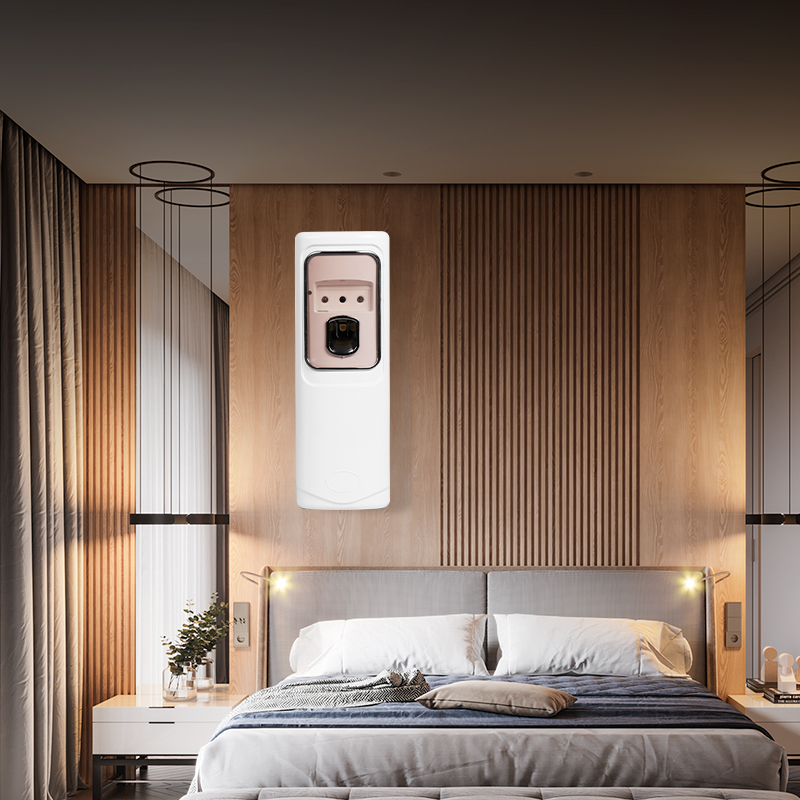
Automation transforms ambient scenting from an active chore into a passive background experience. Programmable units represent the industry standard for serious fragrance strategies.
Programmable models utilize digital interfaces. They feature onboard LED screens, Bluetooth connectivity, or full Wi-Fi integration via smartphone apps. More advanced units integrate directly with your HVAC system. You define operational hours, specific work/pause intervals, and varying intensity grades for different times of the day.
Flawless consistency: The machine maintains a steady background fragrance perfectly scaled to the room size.
Prevents olfactory fatigue: Running on customized intervals (e.g., two minutes on, one minute off) gives your nose time to recover.
Maximizes oil lifespan: Strict schedules ensure you never diffuse oil into an empty room at night.
We must acknowledge the initial learning curve. Programming a commercial-grade aroma diffuser machine initially feels like programming a smart thermostat. It requires patience and testing.
Common setup steps include:
Downloading and registering the companion application.
Pairing the device via a local network or Bluetooth connection.
Establishing daily operational windows (e.g., 9:00 AM to 5:00 PM).
Tuning the micro-intervals (diffusion seconds versus pause seconds).
Automated units dominate spaces where continuous perfection matters. They belong in whole-home scenting setups, retail stores, hotel lobbies, and corporate offices. They serve users who demand an "invisible" luxury experience without daily physical management.
To determine which system aligns with your lifestyle, we must evaluate them across three critical operational dimensions.
Timers optimize your consumption rate with mathematical precision. Manual models inevitably lead to "nose blindness" (olfactory fatigue). When a manual device diffuses continuously, your scent receptors become saturated. You stop smelling the fragrance within thirty minutes, even though the oil continues to burn. Timer models solve this by pausing diffusion automatically. This gives your olfactory system time to reset. As a result, you perceive the scent constantly while using significantly less oil.
Pushing a physical button demands zero technical skill. Navigating a companion app requires basic smartphone literacy. However, the industry has evolved. Modern smart interfaces have drastically reduced the friction associated with older LCD-screen models. Ten years ago, programming a schedule required pressing tiny rubber buttons repeatedly to cycle through a 24-hour clock. Today, you simply drag sliders on a touchscreen. The upfront friction lasts only a few minutes.
Scalability heavily favors automation. An aroma fragrance machine designed for large square footage almost mandates a timer. Manual operation proves entirely unscalable for multi-zone setups or HVAC-connected units. You cannot manually climb into your utility closet to toggle an HVAC unit on and off multiple times a day. Large spaces require calculated diffusion intervals to push scent through complex airflow systems evenly.
Feature Dimension | Manual Models | Timer / Programmable Models |
|---|---|---|
Initial Setup Time | Under 1 minute | 10 to 20 minutes |
Daily Time Required | Moderate (requires turning on/off) | Zero (runs on schedule) |
Oil Efficiency | Poor (often left running) | Excellent (micro-intervals save oil) |
Risk of Nose Blindness | High | Low |
Ideal Environment Size | Under 500 sq. ft. | 500 to 5,000+ sq. ft. |
Device Type | Operational Behavior | Estimated Oil Used |
|---|---|---|
Manual Unit | Runs continuously for 8 hours | Maximum depletion |
Timer Unit (Moderate setting) | Runs 60s on, 60s off for 8 hours | 50% depletion compared to manual |
Timer Unit (Light setting) | Runs 30s on, 90s off for 8 hours | 25% depletion compared to manual |
When buyers upgrade to a programmable aroma diffuser scent air machine, they often stumble during the initial setup phase. Demonstrating a little expertise upfront prevents major headaches down the line. Avoid these common adoption risks.
New users frequently set their intervals too high. They configure the machine to run for 60 seconds and pause for only 10 seconds. This aggressively over-saturates the air, leading to headaches and wasted oil. Best practice dictates starting extremely low. Set the machine for 20 seconds of work and 60 seconds of pause. Live with this setting for two days. Only scale up the work time if you cannot detect the fragrance.
Failing to sync the aroma device's active hours with the building's air circulation system causes poor performance. If you program an HVAC-connected unit to diffuse scent at 3:00 AM, but your building's thermostat turns the main fan off at night, the scent will pool in the ductwork. Always align your diffusion schedules with active airflow periods.
Because timer models run flawlessly in the background, they create a false sense of invincibility. Users completely forget they exist. This leads to missed routine cleaning cycles. More commonly, users forget to check the oil levels until the machine runs completely dry for several days, which strains the internal pump. Set a recurring monthly calendar alert on your phone to inspect the bottle and run rubbing alcohol through the system.
Making your final decision requires honest reflection on your habits, your space, and your tolerance for technology. Use this shortlisting logic to finalize your choice.
You are scenting a micro-space. Single rooms under 500 sq. ft., like powder rooms or entryways, do not require complex automation.
You want sporadic fragrance. If you only desire scent for specific, short durations (1-2 hours) during activities like meditating, reading, or hosting a dinner party.
You prefer physical interfaces. If you or your staff actively dislike companion apps, Wi-Fi pairing, or digital screens, a tactile appliance provides peace of mind.
You want a signature background scent. If your goal is a consistent ambiance that guests notice the moment they walk in, automation handles this flawlessly.
You manage a large environment. Scenting a large home, a multi-room office, a retail space, or integrating directly into an HVAC system strictly demands precise interval control.
You prioritize budget efficiency. If you want strict control over your monthly fragrance oil budget, timers prevent accidental continuous running and eliminate waste entirely.
The debate over ease of use ultimately comes down to your personal timeline. Manual models are undisputedly easier on day one. You plug them in, press a button, and immediately enjoy the fragrance. However, timer models are vastly easier on day one hundred. They remove the mental friction of daily operation and protect your oil supply from accidental waste.
For any serious, long-term ambient scenting strategy, the upfront friction of learning to program a timer remains negligible. That brief initial setup is heavily outweighed by daily convenience and superior scent consistency. If you want a luxury experience, you must let the machine do the heavy lifting.
Evaluate your daily routine and spatial requirements honestly. Review your desired oil budget. Take the next step by comparing specific manual and programmable models in our catalog to find your perfect match, or book a consultation with our team for professional HVAC scenting setup guidance.
A: Yes. By utilizing precise work and pause intervals, along with automatic daily shut-offs, timer models prevent unnecessary continuous diffusion. This dramatically reduces wasted fragrance and significantly extends the lifespan of your oil bottle compared to manual units.
A: Generally, no. While you can plug a basic manual unit into a smart outlet, this only controls the main power supply. A smart plug will not allow you to control the micro-intervals (e.g., 30 seconds on, 60 seconds off), which is vital for proper cold-air diffusion.
A: Modern app-controlled machines have made this highly intuitive. Navigating the app feels remarkably similar to setting a smartphone alarm clock. For standalone units with physical LCD screens, you may need a quick five-minute review of the user manual to master the 24-hour clock format.


