
Views: 0 Author: Site Editor Publish Time: 2026-06-18 Origin: Site


Walking into a luxury hotel lobby often reveals a signature, captivating aroma. This experience rarely happens by accident or through basic consumer-grade ultrasonic diffusers. Commercial spaces demand heavy-duty solutions built for durability, massive coverage, and output consistency. Facility managers constantly face a unique challenge. They need to achieve consistent, residue-free ambient scenting across thousands of square feet. Doing this without constant manual intervention or risking inventory damage requires specialized equipment. Water-based misters simply cannot scale to meet these operational demands.
This article deconstructs the underlying technology powering modern ambient scenting. We will explore various integration methods and the key criteria for evaluating a commercial scenting deployment. You will learn exactly how to match the right equipment to your facility's unique airflow. By understanding the core mechanics, you can select a system optimized for large-scale environments.
To understand modern commercial scenting, you must look at the mechanics of cold-air diffusion. This process, known as nebulization, represents a massive leap over traditional consumer diffusers. High-velocity pressurized air forces liquid fragrance oil through a highly engineered, customized atomizer. The sheer force breaks the heavy liquid down into sub-micron particles. These particles typically measure under 10 microns in diameter. For context, a human hair is roughly 70 microns thick. Creating such tiny droplets allows the fragrance to behave more like a gas than a liquid.
Commercial spaces cannot afford the risks associated with water-based ultrasonic technology. Ultrasonic diffusers create a heavy, wet mist. Introducing extra humidity into commercial environments invites serious mold risks, especially around air conditioning vents. Furthermore, water-heavy droplets fall quickly. They leave a noticeable, slippery residue on hard floors, retail inventory, and delicate electronics. Nebulizers solve this by producing a completely dry mist. It contains zero water, ensuring your floors stay safe and your merchandise remains spotless.
Particle size directly determines how long a scent lingers in the air. Because nebulized nano-particles are incredibly light, they remain suspended in ambient air for hours. Gravity barely affects them. Natural air currents easily carry these sub-micron particles across vast spaces. This ultra-light weight guarantees sustained scent density over long periods. You use significantly less fragrance oil because the mist does not immediately fall to the ground.
Heating essential oils alters their fundamental chemical structure. Traditional warmers burn off the delicate top notes of a fragrance, leaving behind a dull, sometimes acrid base scent. Cold-air diffusion eliminates heat entirely. The atomizer preserves the exact complex notes formulated by the perfumer. You get an authentic, unadulterated aroma profile from the first drop of oil to the very last.
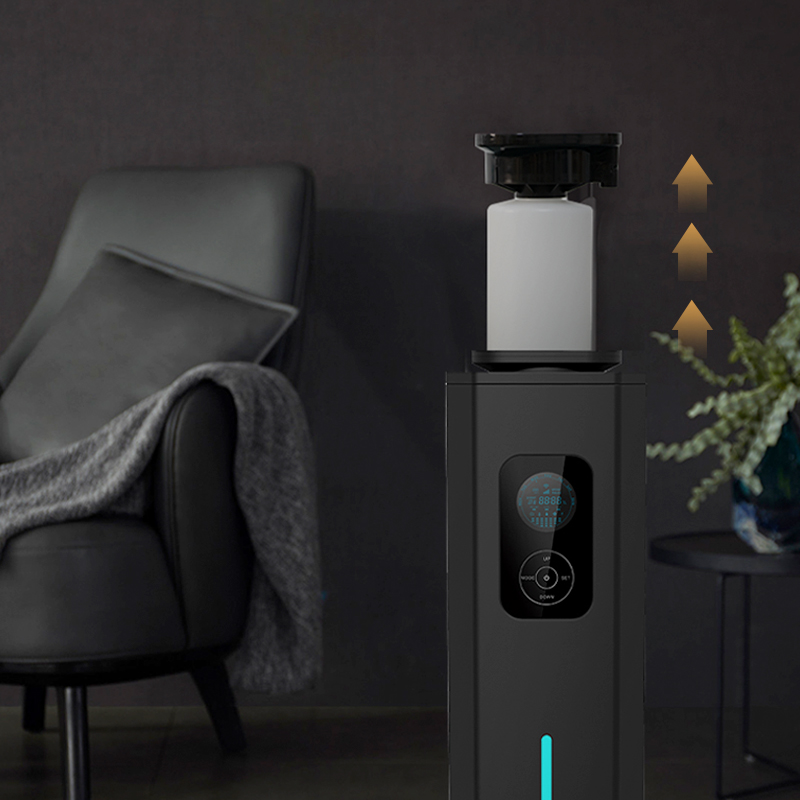
Choosing the right delivery architecture dictates the success of your ambient scenting strategy. Facilities generally deploy either centralized HVAC integration or localized standalone units. Many large properties use a hybrid approach.
Centralized scenting offers the most discreet and uniform coverage available. The machine connects directly to the supply duct of the central air system. The existing HVAC fan acts as the delivery vehicle, pushing the dry nano-mist seamlessly throughout the entire facility.
Not every building supports HVAC integration. Older buildings or leased spaces often lack accessible ductwork. In these scenarios, facility managers deploy independent units placed strategically across specific zones.
To help visualize the operational differences, consider this quick comparison chart:
| Feature | HVAC Integrated System | Localized Standalone Unit |
|---|---|---|
| Coverage Area | Massive (up to 10,000+ sq. ft.) | Targeted (500 to 3,000 sq. ft.) |
| Installation Complexity | High (Requires HVAC access & drilling) | Low (Plug and play or simple wall mount) |
| Visual Profile | Invisible (Hidden in mechanical rooms) | Visible (Requires matching interior decor) |
| Airflow Reliance | Depends on AHU fan schedule | Leverages natural ambient room drafts |
When selecting a comprehensive air scent system, operators must align their building's mechanical realities with their spatial goals.
Evaluating the hardware goes beyond just checking square footage claims. Enterprise-grade equipment must offer features designed to reduce manual labor and optimize resource consumption.
Modern scenting platforms rely heavily on digital controls. The best units feature built-in Wi-Fi or Bluetooth connectivity. Facility managers use mobile apps or web dashboards to program exact operating hours. You can set the machine to run from 8:00 AM to 10:00 PM and shut off completely overnight. This prevents expensive fragrance oil waste during non-business hours. Furthermore, you can program different intensity levels for different times of the day to combat olfactory fatigue.
Frequent manual refilling destroys operational efficiency. You must assess the ratio of the oil reservoir size to the machine's consumption rate. Many entry-level units feature small 100ml bottles. A high-efficiency commercial air scent machine generally houses 500ml to 1000ml reservoirs. Proper programming ensures these large canisters only require refilling every 30 to 60 days. This significantly lowers maintenance overhead.
Multi-location businesses need centralized control. Advanced software dashboards allow a single administrator to manage multiple machines across different branches or internal building zones. You can adjust the lobby scent intensity in New York while simultaneously checking the oil levels of a unit in Chicago.
Placing equipment in public spaces introduces risk. Curious guests or unauthorized staff members might try to alter the settings. Enterprise units feature lockable oil canisters and hidden control panels. Physical keys or digital passwords prevent anyone from tampering with the intensity levels or stealing the fragrance oil.
Theoretical coverage claims rarely match real-world building dynamics. Physical implementation introduces several distinct spatial challenges. Understanding these variables ensures your scenting strategy actually works.
Building ventilation dramatically impacts scent retention. Engineers measure this via Air Changes per Hour (ACH). A high ACH means the HVAC system pulls fresh outside air in and exhausts indoor air quickly. High-draft areas, like entrances with continuously opening doors, suffer from rapid scent dilution. You must program higher intensity settings in these zones to maintain a consistent aroma profile.
Manufacturers typically advertise coverage in square footage. This metric assumes standard eight-foot or ten-foot ceilings. However, scenting is a volumetric challenge. You are filling cubic space, not flat floor space. A 2,000-square-foot lobby boasting 30-foot vaulted ceilings contains three times the air volume of a standard room. You must calculate total cubic volume (Length × Width × Height) and adjust manufacturer claims downward for exceptionally high ceilings.
Integrating a unit into ductwork requires overcoming static pressure. Commercial HVAC ducts operate under significant air pressure. If the scent machine’s internal air pump lacks sufficient power, the duct pressure will push the nano-mist back into the machine. This phenomenon, known as "blowback," causes internal oil leaks and ruins the equipment. Installers must use proper rigid installation tubes and verify the pump rating against the duct's static pressure.
No machine runs forever without basic care. Facility managers must acknowledge the reality of atomizer maintenance. The sub-micron nozzles handle thick, viscous oils daily. Over time, microscopic blockages occur. Technicians must perform periodic cleaning routines. Flushing the tubes and nozzles with high-grade rubbing alcohol every few months prevents clogs and extends the lifespan of the internal pump.
Introducing any substance into a commercial breathing environment requires strict adherence to safety standards. Facility managers must protect indoor air quality while delivering a premium guest experience.
Volatile Organic Compounds (VOCs) trigger air quality monitors and cause health concerns. Traditional aerosol sprays use chemical propellants heavily laden with harmful VOCs. Dry-mist nebulization operates entirely differently. Because the process relies purely on pressurized ambient air, true cold-air diffusion produces minimal VOCs. This keeps commercial indoor air quality monitors in the safe zone.
Scent safety is highly regulated globally. You must shortlist vendors whose fragrance oils meet the strict standards set by the International Fragrance Association (IFRA). IFRA guidelines dictate acceptable concentration levels for various aromatic compounds. Using non-compliant, cheap oils exposes your business to liability and risks causing adverse reactions among guests.
Complete allergy elimination is impossible, but risk mitigation is straightforward. High-quality commercial oils undergo rigorous testing. Proper diffusion dilutes the oil into millions of sub-micron particles per cubic meter. This extreme dilution, combined with ambient delivery, drastically reduces the risk of allergic reactions compared to direct skin contact or heavy aerosol sprays.
Property managers spend thousands maintaining pristine environments. A primary concern is verifying the mist will not damage assets. Because cold nebulization strips moisture out of the equation, the nano-particles evaporate directly into the air. They do not leave a sticky or slippery film on expensive marble floors, wood furniture, or sensitive computer electronics.
Selecting the optimal equipment requires a methodical approach. Follow these logical steps to ensure successful deployment and avoid mismatched hardware.
A commercial air scent machine is an engineered spatial appliance, not a decorative tabletop accessory. Successfully elevating a commercial environment requires a deep understanding of fluid dynamics, building ventilation, and precise cold-air diffusion technology. By selecting equipment featuring IoT controls, proper reservoir capacities, and tamper-resistant designs, you streamline operations and protect interior assets from moisture damage.
The success of your deployment relies entirely on matching nebulization technology with your facility's specific airflow dynamics. Rushing this process leads to uneven coverage and wasted fragrance oil. We strongly encourage operators to request a comprehensive airflow assessment or a customized HVAC compatibility audit from a qualified scenting provider before finalizing any equipment decisions.
A: No. Cold-air nebulization breaks oils down into dry nano-particles that evaporate into the air rather than settling on surfaces. It uses zero water or heavy propellants, ensuring your marble floors, retail inventory, and delicate electronics remain completely safe and residue-free.
A: Properly installed systems inject the dry mist downstream from the air filters. This means the nano-particles travel freely through the ductwork without ever touching or clogging the filtration system. The dry nature of the mist also prevents moisture buildup and metal corrosion inside the ducts.
A: Depending on the machine's programming, intensity settings, and operating hours, a standard 500ml commercial bottle typically lasts between 30 and 60 days. Utilizing IoT scheduling to turn the machine off during non-business hours drastically extends the lifespan of the oil.
A: Most commercial machines require specifically formulated aroma oils. High-viscosity essential oils often prove too thick for the delicate internal components. Pouring heavy, unapproved oils into the reservoir can easily clog the sub-micron atomizers, potentially ruining the pump and voiding the hardware warranty.


