
Views: 0 Author: Site Editor Publish Time: 2026-06-27 Origin: Site


Transitioning from localized, standalone air fresheners to whole-building scenting represents a massive shift in facility management. It moves your property from temporary odor masking to a highly engineered brand experience. You no longer just cover up smells; you actively design atmospheric spaces.
For facility managers, hotel operators, and retail directors, understanding how a commercial hvac scent diffuser works is absolutely critical. You must grasp the underlying mechanics before authorizing any permanent ductwork integration. Lacking this knowledge often leads to compromised indoor air quality or damaged equipment.
This guide breaks down the core technology and the realities of physical ductwork integration. We explore rigorous evaluation criteria required to select the right equipment for large-scale commercial environments. You will learn exactly how to deploy ambient scenting safely, efficiently, and effectively across thousands of square feet.
Traditional aerosols and basic water-based diffusers consistently fail in large commercial spaces. They scale poorly across massive square footage. They demand excessively high labor costs because maintenance staff must constantly refill them. Worse, introducing moisture into complex ventilation systems creates severe risks for mold generation.
Modern commercial scenting relies on a highly precise mechanical process. An internal air pump generates pressurized air. The system forces this pressurized air over a liquid fragrance oil reservoir and through a customized micron-nozzle. This intense pressure physically breaks the liquid apart.
The oil atomizes into an ultra-fine, dry mist composed of nanoparticles. These particles typically measure strictly under one micron in diameter. This specific size is crucial for commercial applications.
Maintaining strict "waterless" standards is a non-negotiable requirement for commercial ductwork integration. Adding any water into an HVAC system severely degrades indoor air quality (IAQ). Cold-air nebulization remains entirely water-free. It prevents microbial growth and protects the building's respiratory health.
Because these sub-micron particles are incredibly small, they behave much like a natural gas. They do not fall to the ground quickly. Instead, they remain perfectly suspended in the ambient air for hours. This long hang-time ensures consistent, uninterrupted ambient scenting.
Furthermore, this dry mist guarantees safety for your physical assets. The particles leave absolutely no oily residue behind. They will not coat expensive hotel furniture, delicate retail inventory, or vital HVAC fiberglass filters. Your space smells pristine while remaining physically clean.
Connecting a machine to your building's respiratory system requires precision. Installers do not simply place a unit inside a vent. They follow strict mechanical protocols to ensure optimal airflow and safety.
Technicians usually install the system using a specialized, flexible polymer tube. They route this tube directly into the supply air plenum. The supply plenum is the section of ductwork carrying treated air into the building.
Placement matters immensely. Installers must tap into the duct strictly post-blower and post-filter. This specific location ensures the fragrance travels outward into the occupied space. It prevents the costly scent mist from looping backward and ruining the expensive HEPA filtration system.
For mounting, you generally have two primary options:
An HVAC diffuser contains no primary fan of its own to push air through a building. It relies entirely on your building's existing air handler unit (AHU). You leverage the massive fans already operating inside your ductwork.
Therefore, you must synchronize the diffuser's operation times directly with the HVAC fan schedule. If your HVAC fan stops running, the scent stops moving. Programming the diffuser to spray while the AHU fan is off wastes expensive oil. It also risks oil pooling inside the stagnant duct.
A single high-capacity machine can scent vast areas efficiently. Depending on the equipment, one unit can easily cover 2,000 to over 10,000 square feet. This impressive scalability depends heavily on the HVAC system's CFM (Cubic Feet per Minute) rating. Higher CFM means faster, wider fragrance distribution across multiple zones simultaneously.
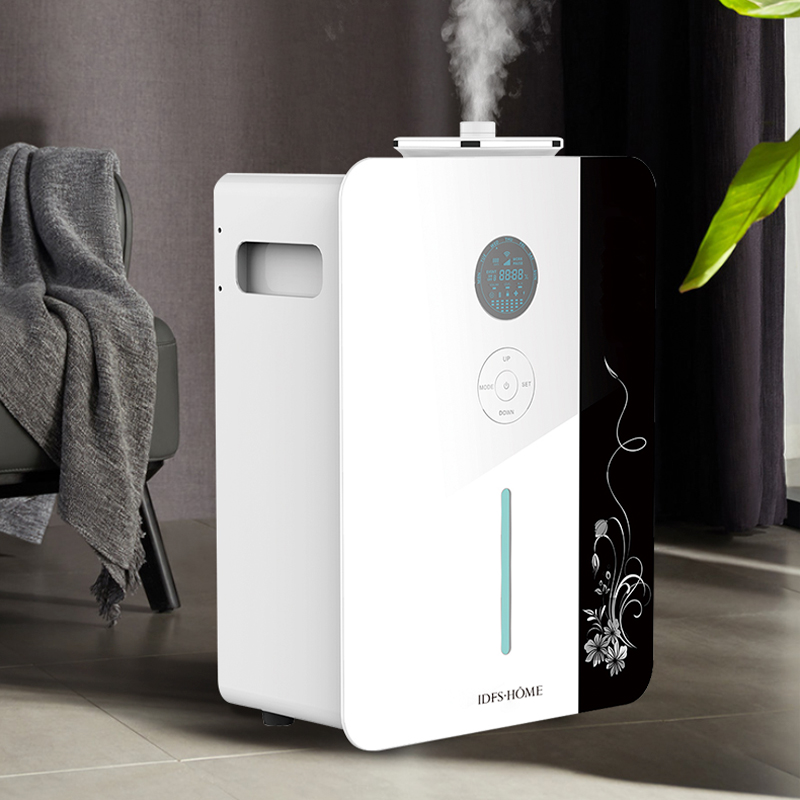
Not all scenting machines perform equally under commercial strain. Facility leaders must evaluate potential equipment using strict, outcome-based criteria. You must balance coverage, intelligent controls, and rigid safety compliance.
Always match the oil reservoir size to your facility's desired service intervals. Choosing a 1000ml reservoir over a standard 500ml one reduces labor dramatically. Your maintenance staff will spend half as much time checking and refilling bottles.
When reviewing manufacturer square footage claims, approach them critically. Evaluate these claims against your actual ceiling height. A space with 20-foot ceilings requires twice the output of a space with standard 10-foot ceilings. Always account for your specific HVAC layout and zoning boundaries.
Manual machines have no place in a modern commercial facility. Digital timers and precise intensity adjustments are mandatory features. You need the ability to fine-tune the ambient experience daily.
Bluetooth or Wi-Fi control offers tremendous operational convenience. Facility managers can adjust settings from a smartphone without entering dirty mechanical rooms. Multi-event scheduling provides massive value for retail and hospitality. You can program higher scent intensities during peak foot traffic hours. You can instruct the machine to power down entirely during closed hours, saving substantial resources.
Commercial environments face strict health regulations. You must prioritize occupant safety above all else.
| Feature Category | Standard Requirement | Premium Capability | Business Impact |
|---|---|---|---|
| Reservoir Capacity | 500ml bottle | 1000ml+ or multi-bottle system | Determines staff labor hours for refilling. |
| Scheduling | Basic 24-hour daily timer | Wi-Fi enabled multi-event dayparting | Optimizes oil consumption based on foot traffic. |
| HVAC Syncing | Manual timing alignment | Automated airflow sensor integration | Prevents oil pooling when AHU fans shut off. |
Integrating third-party equipment into expensive mechanical systems naturally invites scrutiny. Facility managers rightly worry about potential damage. Understanding the true risks versus the perceived myths ensures a smooth deployment.
The most common objection from facility engineers is simple: Will this spray oil everywhere and damage my HVAC system? The answer is no, provided you use the correct technology.
Properly calibrated cold-air nanoparticles pass cleanly through ducts. Because they are ultra-fine and dry, they do not adhere to galvanized metal. They do not soak into acoustic fiberglass lining. The mist acts like air, traveling seamlessly until it exits the supply registers into the room.
Professional installation is highly recommended because amateur mistakes cause severe issues.
Wrong Placement: Installing the nozzle before the main air filter represents a catastrophic error. The system will spray expensive oil directly into the filter media. This wastes your fragrance completely. It also rapidly clogs the filters, restricting building airflow and straining the blower motor.
Static Pressure Issues: HVAC supply plenums operate under high positive static pressure. If you use cheap, unrated tubing, this pressure will push back into the diffuser. It can force liquid oil backward into the machine's internal motor, destroying it instantly. Installers must use high-quality, pressure-resistant tubing and one-way check valves to prevent this backdraft.
Commercial scenting is not a "set it and forget it" utility. It requires predictable, scheduled maintenance.
Before purchasing equipment, you must evaluate your building's fundamental architecture. Not every commercial space can support ducted scent integration.
Determine exactly how your building handles climate control. Does your facility utilize a large, centralized ducted system? If yes, you are an ideal candidate for duct integration.
However, many hotels and older offices rely on localized split systems, window units, or PTACs (Packaged Terminal Air Conditioners). If your building uses PTACs, centralized integration is physically impossible. You do not have the shared ductwork required to move the air. In these scenarios, you must pivot to deploying multiple standalone commercial towers throughout the space.
Consider the fragmented costs of traditional methods. Purchasing hundreds of wall-mounted aerosol cans every month drains facility budgets. Staff waste countless hours wandering the building to replace tiny batteries and empty cans.
Transitioning to a centralized system requires an initial equipment purchase and professional installation. You also subscribe to a recurring bulk oil delivery. However, this centralization drastically reduces labor hours. It eliminates battery waste entirely. It guarantees a perfectly uniform scent experience that fragmented aerosols can never achieve.
| HVAC System Type | Compatibility Status | Required Solution |
|---|---|---|
| Centralized Ducted (VAV/CAV) | Highly Compatible | Direct Supply Plenum Integration |
| Rooftop Packaged Units (RTU) | Highly Compatible | Direct Supply Plenum Integration |
| Ductless Mini-Splits | Incompatible | Standalone Floor/Wall Diffusers |
| PTAC Units (Hotel Style) | Incompatible | Standalone Floor/Wall Diffusers |
If you believe your facility is ready, avoid buying equipment blindly. First, conduct a thorough HVAC audit alongside your maintenance team. Locate the primary air handler units servicing your target zones.
Next, request a consultation with a commercial scenting provider. Ask them to determine the exact CFM of your system. Have them map out your zoning requirements to ensure the fragrance reaches the intended areas without bleeding into restricted zones like cafeterias.
A properly specified scenting system operates as a highly engineered facility solution. It smartly leverages your building's existing airflow to deploy waterless, dry-mist fragrance evenly. This approach abandons the messy, localized methods of the past in favor of centralized efficiency.
When evaluated against strict indoor air quality standards and installed correctly, it proves exceptional. It remains the most discreet, labor-efficient method for building-wide atmospheric branding available today.
Take action by reviewing your building's mechanical blueprints. Consult directly with your internal HVAC technician or a dedicated commercial scenting specialist. They will help you spec the exact machine capacity required to transform your ductwork into a brand asset.
A: No, provided it uses waterless cold-air nebulization. This specific technology produces ultra-fine, dry nanoparticles. These particles act like a gas and do not settle, pool, or leave any oily residue on metal ductwork or fiberglass insulation.
A: A standard bottle typically lasts between 30 to 90 days. The exact duration depends heavily on your programmed operating hours, the specific intensity settings chosen, and the total square footage the unit must cover.
A: The scent will reach any specific area serviced by the ductwork zone the diffuser is tapped into. Large, multi-zone buildings usually require installing multiple diffusers across different air handlers to achieve full-building coverage.
A: Yes. For constant, uninterrupted ambient scenting, your HVAC fan must be set to the "ON" position rather than "AUTO". Otherwise, the scent mist will only disperse through the building during active heating or cooling cycles.


