
Views: 0 Author: Site Editor Publish Time: 2026-06-06 Origin: Site


Selecting the perfect ambient scent system presents unexpected challenges. You cannot simply buy a unit based on a generic coverage label. Purchasing the wrong size leads to significant real-world issues. Oversizing a unit causes rapid olfactory fatigue. Undersizing it delivers a negligible atmospheric impact. At the critical decision stage, buyers must move past flashy marketing claims. You need to evaluate your actual spatial realities instead.
This article provides a concrete, evidence-based framework for making that choice. We help you match spatial volume, airflow dynamics, and installation types to the correct hardware. We approach flat square-footage claims with healthy skepticism. Instead, we focus heavily on implementation realities and physical environment limits. By the end of this guide, you will understand exactly how to analyze your space. You will learn to size your scenting system effectively and avoid common purchasing mistakes.
Square footage is a flawed metric: True coverage requires calculating cubic volume and factoring in HVAC zoning and natural airflow.
Technology matters at scale: Waterless cold-air diffusion is mandatory for spaces over 1,000 sq. ft. to prevent residue and ensure consistent distribution.
The 1,500 sq. ft. threshold: This is the standard tipping point where buyers should transition from standalone units to HVAC-integrated systems.
Total Cost of Ownership (TCO): Larger coverage areas exponentially increase fragrance oil consumption; evaluate refill capacities and proprietary oil lock-ins before hardware costs.
Many manufacturers plaster a simple square-footage rating on their boxes. You should view this number with extreme caution. True scent dispersion relies on physical variables that a flat two-dimensional metric cannot capture.
Air occupies three dimensions. Your scent system must fill that entire volume. Ceiling height drastically alters the capacity requirements of any aroma scent machine. Imagine a 1,000 square foot retail space. If it has standard 8-foot ceilings, you need to scent 8,000 cubic feet of air. Now, imagine the same floor plan with 20-foot vaulted ceilings. You suddenly have 20,000 cubic feet of space. You need a device with more than double the output capacity. Always calculate your room length multiplied by width multiplied by height. This gives you the genuine target volume.
Walls and doors actively block fragrance mist. An open-concept showroom allows scent to travel freely on natural air currents. A similarly sized office with closed partition doors traps the scent. Natural ventilation also plays a massive role. Open windows or drafty corridors pull fragrance outside. This leaves your intended target zones completely un-scented. You must map out your physical barriers. Place machines upstream of high-traffic airflow paths for the best results.
Technology type dictates safety in large rooms. Ultrasonic diffusers use water to carry fragrance. They work fine for tiny bedrooms. However, they fail miserably in large spaces. They push heavy water molecules into the air. These droplets fall quickly to the ground. This creates localized heavy scent zones. Worse, it creates severe mold risks. The falling water ruins hardwood floors and damages expensive furniture.
Cold-air nebulization solves this entirely. It uses pressurized air to atomize pure oil into a dry nano-mist. These microscopic particles stay suspended in the air for hours. They travel further without leaving any sticky residue behind. If your space exceeds a few hundred square feet, cold-air technology is non-negotiable.
Common Mistake: Buying a high-capacity ultrasonic unit for a large living room. The mist will pool on the floor, making it slippery while leaving the opposite side of the room completely scentless.
As spaces grow larger, you face a critical hardware decision. Do you use multiple local units or one central system? The industry standard tipping point sits around 1,500 square feet.
These units operate independently within the room. You plug them into a standard wall outlet.
Best for: Apartments, single retail rooms, hotel lobbies, and waiting areas.
Pros: They offer plug-and-play simplicity. You pay zero installation costs. You can easily move them if you rearrange your furniture.
Cons: They create localized scent pooling. The fragrance remains noticeably stronger right next to the unit. They also occupy physical floor or desk space, leaving a visible footprint.
These systems attach directly to your building's central heating and cooling ductwork. They inject nano-mist into the airflow right after the air handler.
Best for: Large multi-story homes, expansive open-concept offices, and sizable commercial spaces.
Pros: They remain entirely invisible. They utilize existing ductwork to deliver perfectly even distribution throughout the entire building. No localized strong spots exist.
Cons: They require professional installation or advanced DIY skills. You must perform regular duct maintenance. The scent only circulates effectively when your HVAC fan actively runs.
Feature | Standalone Systems | HVAC Integrated Systems |
|---|---|---|
Ideal Coverage | Under 1,500 sq. ft. | 1,500 to 5,000+ sq. ft. |
Installation | Plug and play (Instant) | Professional or advanced DIY |
Scent Distribution | Strong near unit, fades far away | Uniform across all connected rooms |
Visual Footprint | Visible device on floor/table | Hidden in utility closet |
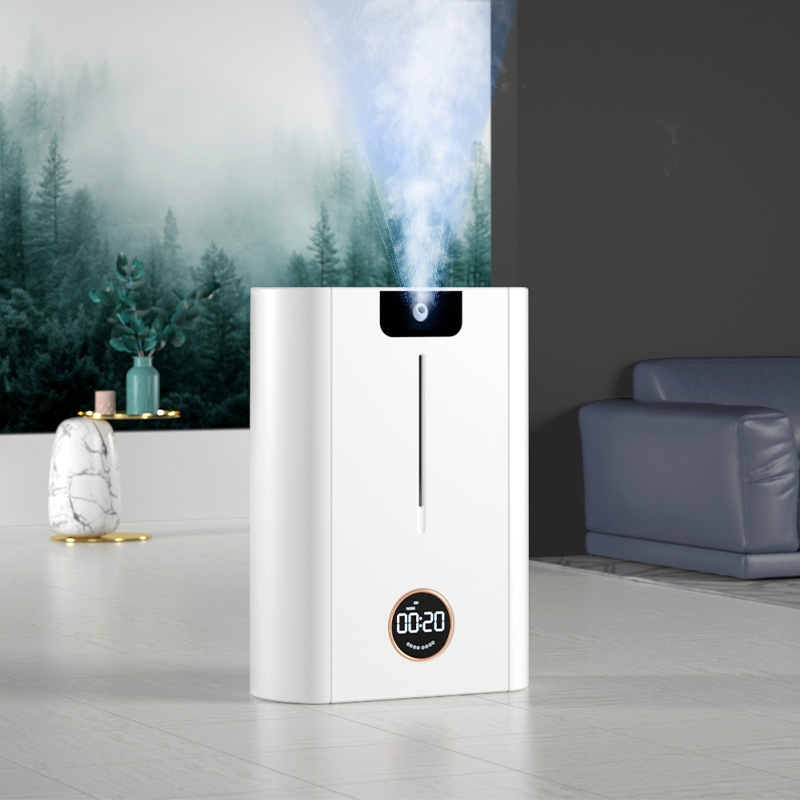
Hardware design changes drastically based on coverage goals. You cannot force a small machine to do a big job. Here is how to evaluate units across three distinct size tiers.
For intimate rooms, you typically rely on a desktop or wall-mounted aroma diffuser machine. These spaces include bathrooms, small bedrooms, or individual office cubicles.
Key Evaluation Metric: Whisper-quiet operation. Decibel levels matter immensely in small, enclosed spaces. A machine might diffuse beautifully. However, if it hums or hisses loudly, it ruins the ambiance. Look for units rated under 30 decibels. You want the atmospheric benefit without acoustic distraction.
As you expand into larger living rooms or retail boutiques, output needs increase. You generally transition to a tower or robust standalone aroma fragrance machine. These sit on the floor and project mist upward.
Key Evaluation Metric: Programmable intensity controls. A medium space experiences fluctuating foot traffic and changing airflow. You need the ability to manage scent throw across different times of day. High-end units let you program heavy diffusion during busy afternoons and light diffusion during quiet mornings.
You have surpassed the capability of localized units. Here, you need a specialized, heavy-duty aroma diffuser scent air machine connected to the ductwork.
Key Evaluation Metric: Cold-air atomization efficiency, internal pump durability, and multi-event scheduling software. These machines run constantly. The internal air pump must handle high friction and heat. Check the pump warranty specifically. Also, ensure the scheduling software can integrate multiple daily events to match building occupancy precisely.
Scaling your coverage area dramatically alters your resource requirements. Hardware represents just the initial step. Buyers frequently underestimate the ongoing material demands of large-scale scenting. You must evaluate consumption rates carefully.
When you scent 3,000 square feet, you burn through liquid quickly. You need to calculate the milliliter per hour (ML/hour) usage at maximum intensity. A standard 100ml oil bottle lasts months in a tiny bedroom. In a massive lobby, that same bottle vanishes in days. High-capacity machines require a 500ml or 1000ml reservoir. If you buy a large machine with a small tank, you will find yourself refilling it constantly.
Estimated Monthly Fragrance Consumption Chart (At Moderate Settings) | ||
Coverage Area | Estimated Monthly Oil Usage | Recommended Tank Size |
|---|---|---|
500 sq. ft. | 30ml - 50ml | 100ml |
1,500 sq. ft. | 100ml - 150ml | 250ml - 300ml |
3,000 sq. ft. | 250ml - 350ml | 500ml |
5,000+ sq. ft. | 500ml - 800ml+ | 1000ml |
Beware the classic razor and blades business model. Some manufacturers sell high-capacity machines cheaply. However, they lock the machine to proprietary oil cartridges. You cannot pour your own liquid into them. Over time, buying restricted brand-name oils drains your budget. Always verify if the hardware accepts third-party fragrance oils. A truly versatile unit features a refillable bottle system, giving you total freedom of choice.
High-output systems push immense volumes of dense oil through tiny nebulizer nozzles. Naturally, these nozzles clog over time. You must factor in cleaning frequencies. A massive commercial unit requires monthly nozzle purges using rubbing alcohol. If you ignore this maintenance, the atomization efficiency plummets. The machine will consume oil without actually scenting the room. Look for machines featuring easily removable nozzle heads.
Even the best hardware fails if it disrupts the daily lives of the occupants. You must anticipate user experience complaints before you finalize a purchase. A well-scented room loses its charm if the machine annoys everyone nearby.
Physics dictates that high-coverage standalone machines require powerful internal air pumps. These pumps must generate substantial pressure. This process naturally causes vibration and hissing noises. We frequently see user complaints about acoustic disruption in quiet environments like spas or executive offices. If you place a powerful unit on a hard wooden floor, the vibration amplifies.
Best Practice: Always place high-output standalone machines on a shock-absorbing silicone mat. This simple trick eliminates up to 50% of the perceived operational noise.
Wi-Fi and Bluetooth app connectivity might seem like unnecessary gimmicks for small diffusers. However, for large coverage areas, smart controls remain essential. Human noses adapt quickly to constant smells. This adaptation is called olfactory fatigue. If an aroma scent machines runs continuously, occupants will stop smelling it after an hour.
Smart apps allow you to schedule dynamic resting periods. You can program the machine to run for ten minutes, then pause for five minutes. This pulsing strategy prevents fatigue. It ensures the scent remains noticeable to occupants all day long. It also dramatically reduces your oil consumption.
You cannot simply tape a machine to a duct. Not all central air systems accept scent units easily. You must perform brief compatibility checks before committing to an HVAC system.
Duct Access: You need physical access to the supply ductwork immediately after the fan unit. Flexible fabric ducts often prove difficult to tap into compared to rigid metal ducts.
Fan Cycling Settings: Scent mist only travels when air moves. If your thermostat only runs the fan during active heating or cooling, your scent will stop during mild weather. You must have a thermostat capable of running the fan independently on a continuous or circulated schedule.
Filtration Bypass: Never install the injection nozzle before the main air filter. The filter will instantly trap the nano-mist, ruining the filter and blocking the fragrance.
Sizing your scenting system correctly guarantees a pleasant, consistent atmospheric experience without wasting resources. You must look far beyond generic square footage labels. Evaluating your environment objectively ensures you invest in the right technology the first time.
Decision Shortlisting Logic:
Calculate your total cubic volume first, factoring in your specific ceiling heights.
Determine if your space requires a localized standalone unit or a whole-building HVAC system based on the 1,500 square foot threshold.
Audit the noise tolerance of your target space to ensure the pump decibel level matches the environment.
Calculate your estimated monthly oil consumption to prepare for ongoing operational demands.
Next-Step Action: Before you purchase any high-capacity unit, we strongly encourage you to request a professional spatial consultation. Alternatively, thoroughly inspect your HVAC utility closet to confirm you have adequate duct access and power outlets available. Taking these physical measurements today prevents costly return shipping tomorrow.
A: Yes, you can deploy several small units. However, this approach requires significantly more daily maintenance. You must clean and refill multiple water tanks or oil bottles individually. Furthermore, it often creates uneven "scent zones." You will experience strong fragrance pockets near the devices and dead zones in between them. A single correctly sized unit provides a much more uniform ambient experience.
A: Absolutely. Scent machines fill three-dimensional volume, not just flat floor space. A 1,000 square foot room with standard ceilings needs a standard machine. That exact same 1,000 square foot room with 20-foot vaulted ceilings requires a machine rated for at least 2,000 square feet. Always calculate your cubic volume.
A: No, it will not cause damage provided it utilizes waterless cold-air atomization technology. This process turns the pure essential oil into a completely dry nano-mist. This dry mist travels smoothly through metal and flex ducts without leaving any sticky residue. Conversely, you should never connect water-based ultrasonic systems to your HVAC, as they will cause severe condensation and mold issues.


