
Views: 0 Author: Site Editor Publish Time: 2026-08-02 Origin: Site


The home fragrance and wellness hardware market is expanding rapidly, driven by consumers seeking sophisticated aromatherapy solutions for their living spaces. This growth brings a significant challenge: high saturation of generic, unbranded devices. Brands face a severe dilemma when attempting to scale their hardware offerings. Selling third-party brands dilutes your equity and sends customers to competitors. White-labeling generic models triggers a relentless race-to-the-bottom pricing war. Conversely, full-scale bespoke manufacturing requires prohibitive upfront capital for research, development, and steel tooling.
Private label manufacturing provides a strategic middle ground. You control aesthetics, functionality, and margins without shouldering the operational drag of ground-up hardware engineering. This approach empowers you to build a cohesive brand identity, pairing custom hardware with your signature scents. A private label essential oil diffuser bridges the gap between rapid deployment and premium brand positioning.
Understanding the nuances of hardware sourcing prevents costly supply chain mistakes. You must choose a production model that aligns with your capital reserves, timeline, and technical capabilities. The spectrum ranges from buying off-the-shelf stock to complete engineering overhauls on the factory floor.
White labeling involves purchasing existing, unbranded stock directly from a factory's current inventory. You apply minimal customization. Usually, this means the factory pad-prints your logo on the device exterior and ships it in a standard box. Minimum Order Quantities (MOQs) remain extremely low, allowing for immediate market entry. However, the risk of direct competitor overlap is exceptionally high. Multiple competing brands often sell the exact same physical unit under different names. This commoditizes your offering and destroys perceived value in the eyes of the consumer.
The private label diffuser model takes a proven, factory-tested base architecture and applies exclusive brand specifications. You utilize the factory's existing Printed Circuit Board Assembly (PCBA) and internal chassis. You then modify custom colors, swap housing finishes, design bespoke packaging, and request minor feature tweaks like specific LED light temperatures. This transforms a standard unit into a product that reflects a unique brand identity. You leverage the factory's existing internal components while controlling the external consumer experience. This model balances speed, cost, and brand differentiation.
Original Equipment Manufacturer (OEM) sourcing requires ground-up engineering based entirely on your proprietary CAD designs. An OEM diffuser involves creating new steel injection molds, designing custom PCB layouts, and undergoing rigorous prototype testing. Tooling costs are massive. Cutting a multi-cavity steel mold for a new plastic housing requires significant upfront cash. Development timelines easily extend past a year as you iterate through multiple mechanical samples. While OEM provides absolute exclusivity, it lacks the agility of private labeling. You should reserve OEM for highly specialized, patented technologies.
| Sourcing Model | Customization Level | Typical Lead Time | Upfront Capital Risk | Competitor Overlap Risk |
|---|---|---|---|---|
| White Label | Low (Logo only) | 15 - 30 Days | Low | Very High |
| Private Label | Medium (Colors, Finishes, Packaging) | 60 - 90 Days | Moderate | Low |
| OEM | High (Ground-up Engineering) | 12 - 18 Months | Very High | None |
Transitioning to a private label strategy transforms your hardware from a low-margin accessory into a core revenue driver. The benefits extend far beyond simple branding, impacting your entire operational structure and cash flow management.
Hardware development burns cash rapidly. Private labeling eliminates the need for expensive prototyping cycles. You skip PCB engineering entirely. You avoid the massive initial capital required for steel injection molds. By utilizing a factory's existing internal architecture, you bypass the most expensive phases of product development. You can then reallocate these R&D budgets directly to marketing, inventory acquisition, and customer retention campaigns. This capital efficiency accelerates overall brand growth and keeps your balance sheet healthy.
Market trends shift quickly in the wellness sector. A standard private label launch moves swiftly through the supply chain. Sample approval takes roughly two weeks. The bulk production run requires 30 to 45 days on the assembly line. Ocean freight and customs clearance add another month. You can launch a fully branded, customized device in 60 to 90 days. Custom OEM builds drag on for 12 to 18 months. Speed allows you to capitalize on emerging wellness trends like waterless diffusion or smart home integration before market windows close.
Successful fragrance brands operate on the razor and blades business model. The hardware is the razor; the essential oils are the blades. A proprietary-looking device increases the lifetime value of your customers. They buy your signature essential oil blends repeatedly to use in your specific machine. Controlling the hardware experience enhances the delivery of tailored wellness solutions. Customers return to your brand for consumable oils targeted specifically at sleep, anxiety relief, or deep focus.
Demand fluctuates based on seasonality and marketing virality. Established private label manufacturers scale production volumes up or down based on your purchase orders. You can increase order volumes rapidly to meet Q4 holiday spikes. You scale back during slower summer months. This elasticity means you avoid carrying excessive raw material inventory or paying for idle factory time. You lean on the manufacturer's established supply chain to absorb volume shocks and manage component sourcing.
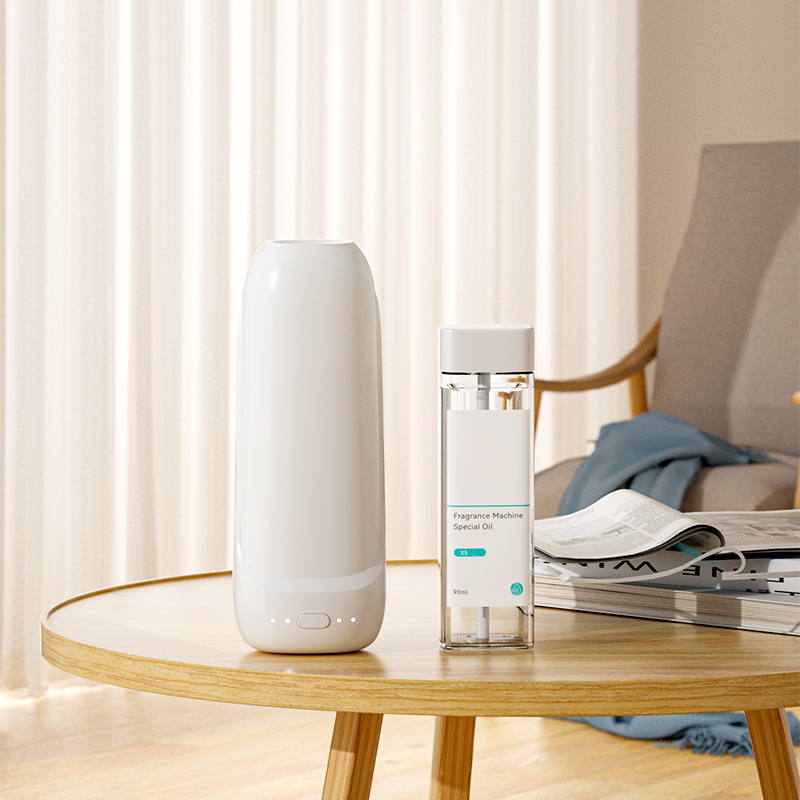
Creating a custom aroma machine requires careful selection of materials and technology. Every physical attribute must reinforce your brand's core message and aesthetic. You must understand the technical limitations and advantages of different manufacturing materials.
The external housing dictates the perceived value of your device. You have multiple material options to consider, each with specific manufacturing requirements.
You must balance premium materials against standard polymers. Premium materials increase perceived value but raise your unit cost. The physical design and material choice must visually complement your signature scent experience. Align the hardware's tactile feel with your overarching wellness aesthetic.
Atomization technology defines how the device disperses scent. Ultrasonic mechanisms use a ceramic piezo plate vibrating at high frequencies (typically 1.7MHz or 2.4MHz) to agitate water and oil into a fine mist. They operate whisper-quiet, making them ideal for sleep-focused signature blends. Nebulizing mechanisms use pressurized air pumps to atomize pure essential oils without water. This delivers a potent, undiluted aroma perfect for clinical aromatherapy or large open spaces. Match the internal technology directly to the specific wellness goals of your target audience.
Smart features elevate standard hardware into premium lifestyle devices. You can request the factory to integrate Tuya IoT modules or ESP32 chips for seamless Wi-Fi and app controls. Ensure compatibility with smart home ecosystems like Alexa or Google Home. Evaluate sensory additions carefully. Ambient LED lighting with customizable color palettes enhances the therapeutic environment. Built-in timer settings and variable mist output controls give users precise command over their fragrance experience.
Profitable hardware scaling requires strict oversight of unit economics. You must understand every variable that impacts your final landed cost before issuing a purchase order.
Minimum Order Quantities (MOQs) directly impact your unit pricing. Factories do not set MOQs arbitrarily. They base them on the minimum requirements of their raw material suppliers. A basic private label run with custom colors requires the factory to purchase a minimum batch of custom-dyed plastic resin. Custom printed packaging requires a minimum run on an offset printing press. This typically sets the MOQ at 500 to 1,000 units. If you demand custom tooling for minor housing modifications, expect MOQs to jump to 3,000 units or more. Higher volumes dilute the factory's setup costs, resulting in a lower per-unit price.
You must calculate the total landed cost per unit accurately. Do not base your financial models solely on the factory's Ex Works (EXW) or Free on Board (FOB) quote. Landed cost includes the raw manufacturing price, custom packaging upgrades, and comprehensive freight forwarding fees. You must also factor in import tariffs, customs duties, and domestic warehousing costs. Failing to account for ocean freight and import tariffs will destroy your profit margins.
Develop a strict pricing strategy. Calculate your retail pricing based on the fully landed cost. Hardware generally demands a healthy gross margin to remain viable. Target a 60% to 80% gross margin on the device itself. This margin absorbs marketing acquisition costs and provides a buffer for potential warranty replacements. The hardware margin secures your upfront cash flow, while the consumable oils drive long-term profitability.
Importing electronics carries inherent liabilities. Strict quality control and compliance protocols protect your brand reputation and ensure consumer safety. You cannot cut corners on factory floor inspections.
Electrical and safety certifications are mandatory. You cannot legally or safely sell electronics in major markets without them. Ensure the factory provides valid UL or ETL certifications for the power adapters used in the North American market. European markets require CE marking. Verify RoHS compliance to guarantee the device materials are free from hazardous substances like lead or cadmium. If your device includes Bluetooth or Wi-Fi, it must pass FCC testing for wireless features. Never bypass these certifications.
Conduct rigorous factory audits before transferring deposits. Verify the manufacturer holds an active ISO 9001 certification for Quality Management Systems. This ensures they follow standardized assembly and testing procedures. Request BSCI (Business Social Compliance Initiative) audit reports to confirm ethical sourcing and fair labor practices. Ethical manufacturing aligns with the core values of modern wellness consumers.
Establish clear defect rates and warranty liabilities upfront. Negotiate strict Acceptable Quality Limit (AQL) standards. A standard Level II inspection using AQL 1.5 for major defects and 4.0 for minor defects is typical. A major defect means the unit fails to power on or leaks water. A minor defect might be a slight scratch on the bottom plate. Demand that the factory performs a 24-hour aging test on all units before packaging to catch early PCB failures. Define the warranty replacement terms clearly in your manufacturing contract.
Your manufacturing partner dictates the success or failure of your hardware line. Vetting suppliers requires diligence and technical scrutiny. You must look past polished Alibaba profiles and evaluate their actual production capabilities.
Distinguish engineering competence from trading companies. Many profiles on sourcing platforms belong to middlemen, not actual factories. Middlemen inflate prices and lack direct control over the assembly line. Look for a true factory with an in-house engineering team. Request photos of their injection molding machines and PCB assembly lines. Verify their registered business scope explicitly states manufacturing, not just trading.
Master the prototyping and sampling process. Never commit to a bulk order based on digital renders. Request a Golden Sample. This is the finalized, physical unit that represents the exact quality of the mass production run. Test the atomization efficiency rigorously using your specific signature blends. Different oil viscosities react differently to ultrasonic plates and nebulizing nozzles. Verify material quality, button tactility, and packaging durability.
Prioritize communication and intellectual property protection. Sign Non-Disclosure Agreements (NDAs) before sharing your brand assets. For overseas manufacturing, utilize NNN (Non-Disclosure, Non-Use, Non-Circumvention) agreements drafted by local legal counsel. Demand clear, responsive, English-speaking account management. Miscommunications regarding Pantone colors or voltage requirements lead to disastrous production errors.
Private label manufacturing offers a highly effective route to market for growing wellness brands. It allows you to deploy premium hardware without the crushing financial burden of ground-up engineering. The best path forward depends entirely on your capital availability, desired retail price point, required feature set, and how the hardware integrates with your consumable product lines.
A: Minimum Order Quantities depend on customization depth. Basic private labeling, which includes custom colors and branded packaging on an existing mold, typically requires 500 to 1,000 units. If you require minor structural modifications or custom tooling, expect MOQs to start at 3,000 units due to raw material minimums.
A: The entire process generally takes 60 to 90 days. Sampling and approval take about 14 days. Mass production requires 30 to 45 days on the assembly line. Ocean freight and customs clearance add an additional 30 days before the inventory arrives at your warehouse.
A: An OEM diffuser involves ground-up custom engineering, requiring new CAD designs and expensive steel injection molds. A private label diffuser uses an existing, factory-tested physical mold but customizes the external colors, finishes, and packaging to match your brand.
A: You must test a physical sample with your specific oils. Oil viscosity impacts atomization. Thick oils like vetiver may clog certain nebulizers, while citrus oils can degrade cheap plastics. Match the hardware's output capabilities to your desired therapeutic goals.
A: If you use the factory's existing internal components without modification, their current CE, FCC, or UL certifications usually transfer to your branded unit. You only pay for new testing if you alter the electrical components or require certifications under your specific brand name.
A: Yes. Factories provide a die-cut template of the box. Your design team applies your custom branding, typography, and imagery to this template. The factory then prints and cuts the custom packaging during the mass production phase.
A: Premium models utilize ceramic, frosted glass, or natural wood exteriors. These materials offer a heavy, luxurious feel and resist essential oil corrosion better than standard plastics. However, high-grade polypropylene remains essential for the internal water reservoir due to its chemical resistance.


