
Tracy Phone:+86-18015583589 Tracy Email:tracy@ramon-aroma.com Grace Phone:+86-15152466145 Grace Email:grace@ramon-aroma.com


Views: 0 Author: Site Editor Publish Time: 2026-06-23 Origin: Site


Commercial scenting carries exceptionally high stakes for modern businesses. Scent marketing reliably drives dwell time and boosts brand recall across various industries. However, deploying the wrong hardware in a massive space quickly leads to wasted consumables, uneven coverage, and severely compromised brand perception.
You must clearly differentiate commercial deployment from standard residential use. Large architectural spaces require perfect hardware alignment and strict fluid dynamics considerations. Managing scent across expansive lobbies or open-plan offices demands robust, high-capacity equipment and precise operational control mechanisms.
We designed this guide as an objective framework for B2B buyers, facility managers, and procurement teams. You will learn how to evaluate professional aroma machine technologies based on physics, fluid dynamics, and actual implementation realities. We outline the crucial metrics required to properly match spatial volume with correct diffusion hardware.
Volume Over Area: Commercial sizing must be calculated by cubic meters (L × W × H), not just square footage.
Technology Standard: Cold-air diffusion (nebulizing) is the commercial baseline; water-based or heat-based systems are inadequate for large scales.
HVAC vs. Standalone: The choice dictates whether your scent is invisible and centralized (HVAC) or zonal and flexible (Standalone/Floor units).
Hidden Costs: Total Cost of Ownership (TCO) is driven more by essential oil consumption and maintenance efficiency than the initial hardware price.
Large commercial venues present a unique spatial gap. Grand hotel lobbies, open-plan corporate offices, and expansive retail showrooms feature very high ceilings. They also battle competing HVAC airflow and experience continuous, high foot traffic. These structural and environmental factors disperse scents unpredictably. A standard device simply cannot overcome these chaotic air currents.
Buyers frequently fall into the sizing trap. They evaluate equipment based strictly on square footage. You must shift your metric from area to volume. We use a critical, non-negotiable formula for commercial scenting:
Length × Width × Ceiling Height = Cubic Volume
Relying solely on square footage causes facility managers to severely under-spec or over-spec their equipment. Ignoring high ceilings means a machine designed for a flat apartment will fail in a vaulted lobby. Under-speccing creates invisible ROI where visitors smell absolutely nothing. Over-speccing produces overpowering localized zones that alienate guests.
Standard residential technologies completely mismatch commercial demands. Let us examine why consumer-grade ultrasonic and heat-based units fail:
Chemical Alteration: Heat-based diffusers alter the delicate chemical profile of fragrance oils, often ruining the intended scent profile.
Moisture Damage: Ultrasonic diffusers use water. Pumping continuous water vapor into a commercial space risks serious moisture damage to fixtures and inventory.
Poor Projection: Residential units lack the powerful micro-particle projection necessary to travel through aggressive commercial airflow. They produce heavy droplets that fall instantly to the floor.
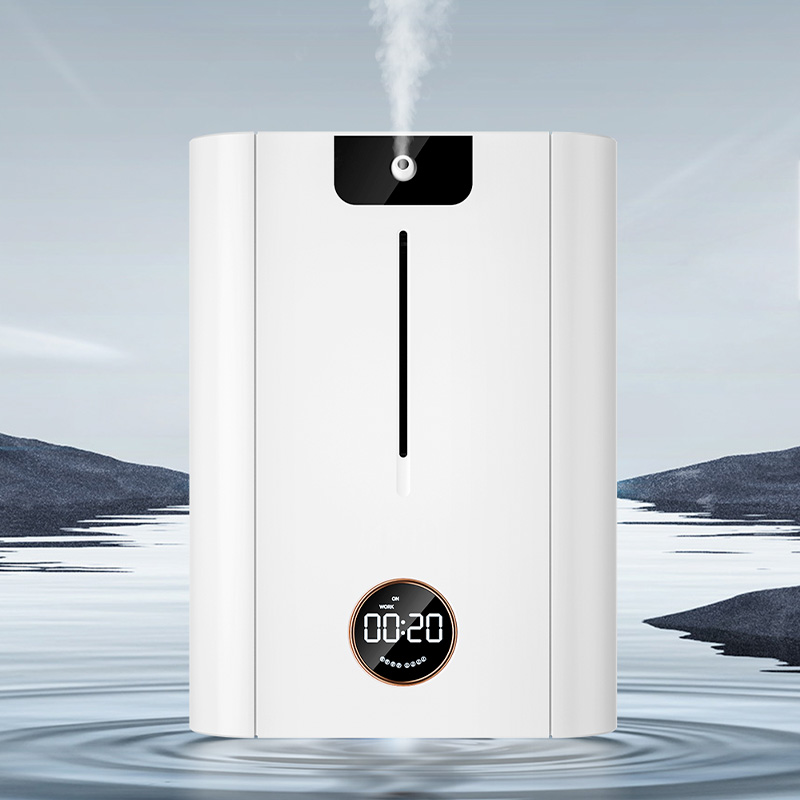
Cold-air diffusion stands as the absolute baseline for commercial scent marketing. This technology uses highly pressurized air to break pure essential oils into ultra-fine micro-particles. These particles measure around 1μm in diameter. The process occurs entirely without heat or water. It relies strictly on high-velocity air pressure.
This mechanism perfectly fits commercial applications. It retains the complete chemical integrity of the essential oil. The ultra-fine mist provides the longest possible hang-time in the air. Therefore, nebulizing machines deliver the most consistent and luxurious scenting experience across massive, high-traffic spaces.
HVAC-integrated systems represent the pinnacle of centralized commercial scenting. A technician plumbs the device directly into the building's central ductwork. The machine utilizes your existing forced air to distribute the fragrance evenly throughout the entire building. It leverages the building's own mechanical lungs.
They offer the best fit for seamless, invisible scenting across massive footprints. We regularly see them deployed in casinos, premium hotels, and corporate headquarters. They remain completely discrete. However, they strictly require professional installation and easy access to HVAC ductwork.
You will often encounter massive open spaces lacking accessible central air. High-capacity standalone units solve this specific problem. These floor-standing or large wall-mounted units house internal high-powered fans. The fans forcefully project the cold-air mist across vast distances.
They serve as the primary fallback strategy for large venues without centralized AC. They also shine when HVAC control rooms remain inaccessible to daily operational staff. Managers can place them strategically in corners or alongside pillars.
Technology Type | Primary Mechanism | Best Commercial Application | Installation Requirement |
|---|---|---|---|
Cold-Air Nebulizing | Pressurized air breaks oil into 1μm particles | Consistent, high-traffic retail and lobbies | Plug-and-play or wall-mounted |
HVAC-Integrated | Plumbs directly into central ductwork | Massive footprints like casinos and hotels | Professional HVAC contractor |
Standalone / Fan-Assisted | Internal fans disperse mist across open spaces | Large venues lacking central AC access | Flexible floor placement |
Selecting the right Aroma Machine requires more than evaluating square footage. You must match the hardware to your building's distinct architectural realities. Different spaces present unique operational hurdles. We categorize the solutions based on three common commercial constraints.
For Restricted HVAC Control Rooms: Building codes or security protocols often restrict access to main mechanical rooms. If your operational staff cannot reach the central ducts easily, we highly recommend Split-Type Systems. The primary operational unit remains in an accessible area. Staff can easily refill the oil reservoir and adjust controls. Meanwhile, discrete commercial-grade tubing routes the nebulized mist safely up into the restricted HVAC ducts.
For Minimalist or Design-First Spaces: Luxury boutiques and modern art galleries demand pristine visual environments. Visible floor equipment disrupts the carefully curated aesthetic. You should evaluate Ceiling-Installed Diffusers for these environments. Technicians hide these units entirely within drop ceilings. They keep premium floor space completely clear while functioning just as powerfully as high-capacity standalone units.
For Targeted Zonal Scenting: Massive retail corridors and sprawling department stores rarely require a single uniform scent. We evaluate Wall-Mounted Diffusers for these complex layouts. You use them as a coordinated network of smaller units. You place them strategically to create distinct scent zones. This strategy prevents scent clashes and targets specific customer journeys rather than attempting to flood a massive, multi-department area from a single point.
Commercial hardware must do more than simply smell good. It must operate efficiently. Buyers must evaluate the smart capabilities of any proposed fleet. Modern features drastically reduce operational waste and protect your consumable investments.
You must prioritize IoT and automation capabilities. Wi-Fi and Bluetooth controls represent a critical necessity, not a mere novelty. Modern platforms offer granular intensity adjustments. Facility managers can program operating schedules explicitly tied to business hours. A smart unit automatically powers down when the building closes. Furthermore, low-oil alerts actively prevent the equipment from dry running. Dry running damages internal pumps and wastes electrical energy.
You must also rigorously address the acoustic footprint of your chosen equipment. High-powered compressors generate significant noise. You need specific benchmark data to evaluate noise tolerance thresholds correctly. A sound level of <31dB remains strictly required for whisper-quiet environments. Spas, luxury boutiques, and high-end VIP lounges cannot tolerate mechanical humming. Conversely, a threshold of <50dB serves as the maximum acceptable limit for general commercial spaces carrying normal ambient background noise.
Deploying chemicals into public airspaces carries inherent liability. You must protect your employees and guests from allergic reactions and respiratory distress. Procurement teams hold the responsibility of verifying safety credentials before deploying any scenting fleet.
You must mandate strict regulatory standards. Buyers must verify that both the equipment and the compatible essential oils meet IFRA (International Fragrance Association) standards. Furthermore, vendors must supply clear MSDS (Material Safety Data Sheets) for every fragrance formulation. These documents prove crucial for mitigating liability and ensuring occupational safety compliance.
Connecting third-party equipment to a commercial HVAC system introduces material risks. You risk oil residue buildup inside central air ducts if technicians miscalibrate the equipment. We highlight the critical importance of scheduled periodic maintenance. You must also use the proper oil concentrations. Professional hardware typically requires concentrations ranging between 6% and 60%, depending heavily on the specific nebulizer core.
Finally, you must navigate the psychological risk of scent fatigue. Operational managers frequently start new deployments at excessively high intensities. We strongly warn against this practice. We always propose the "subtle is premium" best practice. You should start at a very low concentration. You then gradually increase the intensity over several days. An overpowering scent heavily cheapens the brand experience and actively drives customers away.
You now understand the physics, architectural constraints, and safety requirements. The procurement phase requires strict discipline. Follow these precise steps to shortlist your ideal commercial diffusion hardware.
First, audit your physical space comprehensively. Do not guess the dimensions. Calculate the precise cubic volume using the formula provided earlier. Map out your existing HVAC accessibility. Note every restricted mechanical room and measure the ceiling height of every unique zone.
Second, define your true operational capacity. Determine exactly who will refill the oil on a routine basis. If your facility staff lacks dedicated maintenance time, you must prioritize autonomy. Prioritize machines featuring high-capacity oil reservoirs exceeding 500ml. Pair these large reservoirs with app-based monitoring systems to eliminate daily physical checks.
Third, demand technical proof before signing contracts. Advise your procurement buyers to request independent coverage testing data directly from the manufacturer. You should run pilot trials in a single isolated space. Verify the actual mist hang-time and acoustic footprint before committing to an expensive, multi-story fleet rollout.
Securing the best commercial diffusion hardware requires precise alignment. You must balance your architectural reality, your desired sensory outcome, and your daily operational bandwidth. A mismatch in any of these three areas results in wasted resources and poor brand perception.
You must remember that cold-air nebulizing technology remains absolutely non-negotiable for large spaces. Heat and water-based systems will fail you. Ultimately, your core deployment decision pivots purely on HVAC integration versus standalone strategic placement.
We strongly encourage buyers to begin immediately with a spatial audit. Calculate your exact cubic volume today. Armed with this accurate data, reach out to professional vendors and request comprehensive projections mapping out both hardware capabilities and long-term consumable efficiencies.
A: You calculate sizing based on cubic volume, not square footage. Multiply the room's length by its width, and then multiply that number by the ceiling height (L × W × H = Cubic Volume). Adjusting for high ceilings ensures the machine possesses enough power to project particles evenly without overworking the compressor.
A: Commercial machines utilize cold-air nebulizing technology. They use pressurized air to break pure oil into 1μm dry particles without heat or water. Regular residential diffusers rely on ultrasonic technology. They mix oil with water, creating a heavy, wet mist suitable only for very small, enclosed rooms.
A: No. You must use oils specifically formulated for cold-air nebulization. The oil requires a precise viscosity to prevent pump clogging. Furthermore, commercial oils must strictly carry IFRA compliance certifications and detailed MSDS documentation to ensure public safety in high-traffic environments.
A: Refill frequency depends heavily on the internal reservoir size, operational schedule, and mist intensity. A 500ml reservoir running at low intensity can last several months. Utilizing smart scheduling features to operate strictly during business hours drastically extends these refill cycles.


