
Views: 0 Author: Site Editor Publish Time: 2026-09-30 Origin: Site


Facility managers and homeowners often struggle with large, open-concept spaces. You invest in multiple standard diffusers hoping for even coverage. Instead, they overwhelm the immediate area while completely failing to reach the corners of the room. This leaves massive dead zones. The 1000 square foot dilemma is a common transitional size. It is too large for standard residential water-based diffusers, which typically max out at 100 to 300 square feet. Yet, the space might feel too small to justify complex, multi-zone industrial HVAC scenting systems.
This guide serves as a technical evaluation. We will explore whether a single machine can handle this specific footprint. A single unit can indeed effectively cover 1000 square feet. However, success depends entirely on diffusion technology, spatial layout, and airflow dynamics. You must understand cubic footage versus square footage and evaluate how walls and HVAC systems impact scent migration.
Technology is the Bottleneck: Standard tabletop ultrasonic diffusers cannot effectively cover 1000 sq ft; cold-air nebulizing technology is a strict requirement for spaces of this size.
Layout Dictates Equipment: A single standalone unit works flawlessly for open-concept 1000 sq ft spaces (like large living rooms or open retail floors), but segmented rooms (e.g., a lobby plus adjacent corridors) require HVAC integration or multiple smaller units.
Capacity Equals Efficiency: A true large capacity diffuser reduces maintenance overhead, requiring oil replenishment monthly rather than daily.
Smart Control is Essential: Modern commercial units utilize Wi-Fi/Bluetooth apps to precisely calculate and manage output for exact square footage, preventing olfactory fatigue.
Placement is Critical: The success of a single-unit deployment relies on leveraging existing HVAC return/supply airflow or strategic placement in high-circulation zones.
Effective coverage means achieving a consistent ambient scent throughout the target area. You want to avoid localized olfactory fatigue. This happens when a scent is so strong in one corner that your nose simply stops registering it. You also want to eliminate overwhelming hot spots. A hot spot occurs when a machine dumps too much fragrance into a stagnant pocket of air. In a 1000 square foot space, successful scenting requires the fragrance particles to remain suspended long enough to travel from one end of the room to the other. The scent should be noticeable but never intrusive. Achieving this balance requires precise control over particle size and output frequency.
Floor space is only half the equation. You must calculate cubic volume to understand true coverage requirements. High ceilings demand significantly more output. The mist must travel further to fill the vertical space before settling. If you only measure floor space, you risk severely under-sizing your equipment. Air changes per hour (ACH) also play a massive role. A room with high ventilation will strip scent from the air faster than a sealed room.
Floor Space (Sq Ft) | Ceiling Height (Ft) | Total Volume (Cubic Ft) | Required Equipment Rating |
|---|---|---|---|
1,000 | 8 (Standard) | 8,000 | 1,000 - 1,500 Sq Ft |
1,000 | 10 (Elevated) | 10,000 | 1,500 - 2,000 Sq Ft |
1,000 | 12 (Commercial) | 12,000 | 2,000 - 2,500 Sq Ft |
1,000 | 15 (Loft) | 15,000 | 2,500 - 3,000 Sq Ft |
1,000 | 20 (Vaulted) | 20,000 | 3,000+ Sq Ft |
Walls, partitions, and doorways drastically impact scent migration. One machine cannot push scent through closed doors. It will also struggle down complex L-shaped hallways without HVAC assistance. In a fully open-concept layout, natural air currents carry the scent freely. Standalone units thrive here. However, if your 1000 square feet includes a main lobby, a side corridor, and two closed offices, a single standalone unit will fail. You must set realistic expectations based on your floor plan. Segmented layouts require strategic HVAC integration to bypass physical barriers and distribute the fragrance evenly through the ductwork.
This specific footprint applies to many common environments. Open-plan residential living areas often hit this mark. Boutique retail stores frequently operate within 800 to 1200 square feet. Medium-sized hotel lobbies and fitness studio reception areas also fit this profile. In each of these cases, the goal is to create a welcoming atmosphere without creating a localized cloud of heavy perfume. The solution must integrate seamlessly into the existing environment, requiring minimal daily intervention from staff or homeowners.
Standard tabletop diffusers rely on ultrasonic technology. They use a vibrating plate to create a mist of water and essential oil. This method involves basic physics. Water-oil molecules are heavy. They measure between 5 and 10 microns in diameter. Because of this weight, they cannot stay airborne for long. They typically fall to the ground within a 100 to 300 square foot radius. Because the particles are heavy and wet, they fail completely when tasked to act as a large area air diffuser. You will notice a strong scent right next to the machine, but nothing ten feet away. This often leads to damp floors and damaged wood furniture near the device.
Ultrasonic units require you to mix a few drops of oil into a tank of water. This creates a severe dilution problem. The resulting scent profile is incredibly weak. A 1000 square foot space has a specific natural air exchange rate. Air constantly moves through vents, doors, and windows. A diluted water-based mist cannot compete with this air turnover. The scent dissipates faster than the machine can produce it. You cannot simply add more oil to the water, as this can clog the ultrasonic plate and permanently damage the device.
Standard diffusers usually feature small water tanks ranging from 100ml to 300ml. In a large room, you would need to run the device constantly on its highest setting. This drains the tank rapidly. You end up performing a tedious maintenance routine every single day. This operational friction is frustrating and unscalable.
Unplug the unit and carry it to a sink.
Dump stagnant water to prevent mold and bacterial growth.
Wipe down the ultrasonic plate with rubbing alcohol to remove oil residue.
Refill the tank with distilled water to prevent hard mineral buildup.
Count out exact drops of essential oil.
Reassemble the unit, carry it back, and plug it in.
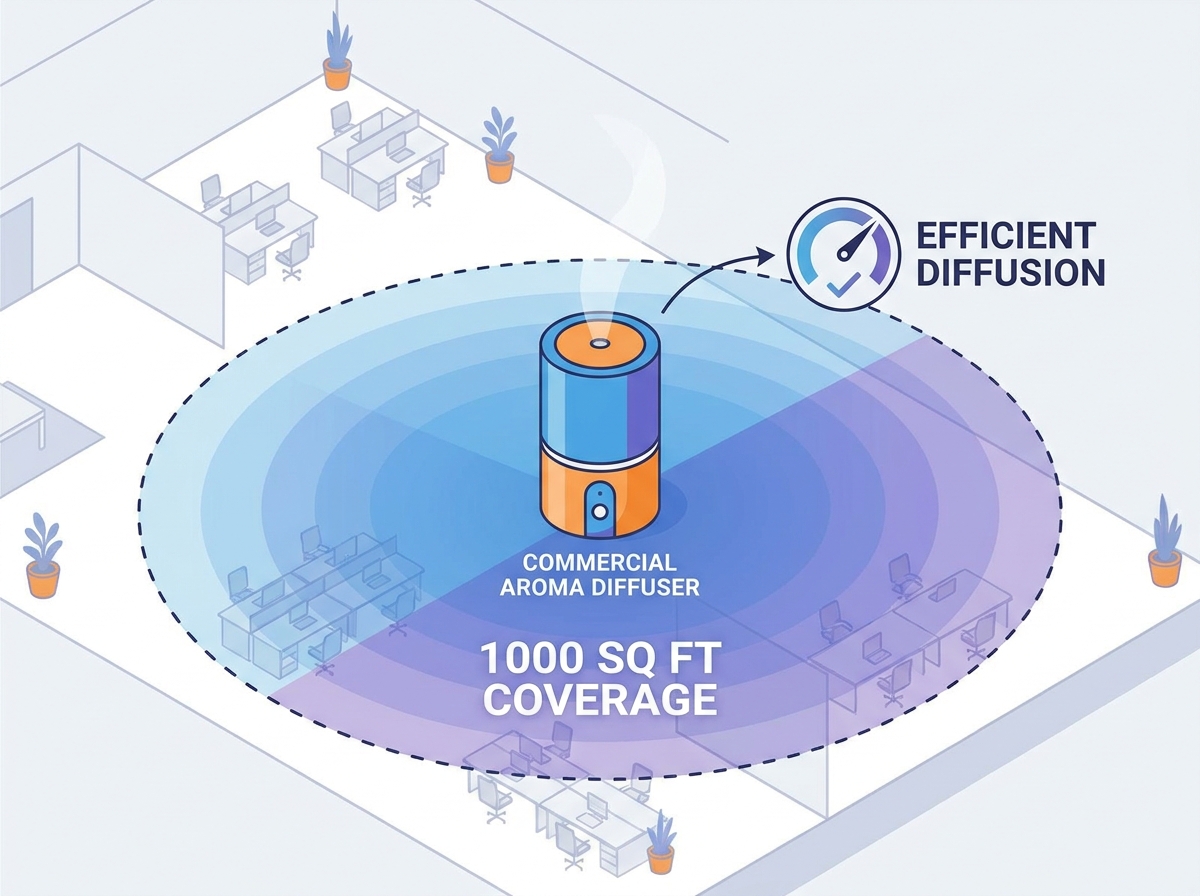
To cover large spaces, you need cold-air nebulization. This technology does not use water or heat. Instead, it uses pressurized air forced through a small tube to create a Venturi effect. This pulls pure fragrance oil up and shatters it against a baffle, breaking it down into a dry mist. This process creates sub-micron particles, typically measuring under 1 micron. Because these particles are incredibly small and dry, they remain suspended in the air for hours. They travel effortlessly on natural air currents. This sub-micron suspension is the exact reason a Commercial Aroma Diffuser succeeds where water-based units fail. It provides true, even coverage across vast square footage without leaving any residue.
You have two primary deployment methods for nebulizing technology. Each has distinct mechanical advantages depending on your building layout.
Standalone Units: These are plug-and-play devices. They require zero installation costs. You simply place them in the room and turn them on. They are ideal for open-concept homes and single-room retail spaces. However, they rely entirely on ambient room airflow to distribute the scent. You must position them carefully to maximize their reach.
HVAC Integration: These units connect directly to your ductwork. They provide perfectly even distribution across segmented rooms. This is ideal for divided office spaces or complex layouts. The downside is the requirement for ductwork access. You must drill a small hole into the supply plenum and insert a PTFE tube to deliver the mist into the airstream.
When targeting a 1000 square foot space, do not buy a machine rated for exactly 1000 square feet. You should look for machines rated for 1,500 to 2,000 square feet. This provides an industry-standard evaluation lens. Running a slightly oversized motor at 50% capacity reduces mechanical wear and tear. It extends the lifespan of the internal air pump. Conversely, running a smaller unit at maximum capacity stresses the motor, generates excess heat, and increases noise levels. Oversizing gives you headroom to adjust for high ceilings, poor airflow, or sudden changes in building ventilation.
App-controlled functionality is a strict necessity for modern scenting. Modern apps allow you to input your exact square footage. The system then auto-calculates the optimal diffusion rates. You can set precise operating hours to match your daily schedule or business hours. You can also monitor oil levels remotely. This level of control ensures you only disperse scent when the room is occupied. It prevents waste and maintains a consistent ambient experience without requiring manual adjustments.
Granular control over the diffusion cycle dictates your success. You need the ability to set specific work and pause intervals. For example, you might program the machine to run for 45 seconds and then pause for 180 seconds. This prevents scent saturation in the room. Continuous output quickly leads to olfactory fatigue. By pulsing the scent, you keep the fragrance noticeable without overwhelming the space. It also strictly manages consumable usage during off-hours, stretching your oil supply further.
Standard tabletop units use tiny 50ml bottles. Commercial units utilize 500ml or 800ml reservoirs. This difference directly impacts your maintenance schedule. A large capacity diffuser drastically reduces the time you spend refilling the machine. A 500ml bottle running at medium intensity in a 1000 square foot space should easily last 30 to 45 days. You transition from daily maintenance to a simple monthly check. This allows facility managers to integrate scenting into their standard monthly preventative maintenance routines.
Many high-quality standalone units feature internal fans. The nebulizer creates the dry mist, and the fan pushes it out of the machine. This internal fan assistance helps project the mist upward into the room's natural air currents. It prevents the mist from settling immediately around the base of the unit. This feature maximizes the effective reach of a large area aroma diffuser, ensuring the scent travels across the entire floor plan even in rooms with stagnant air.
Nebulizing pumps generate a mechanical hum. You must address this noise level before deployment. Look for units that operate under 40 decibels (dB). This is roughly equivalent to a quiet library or a soft whisper. In commercial settings with background music, a 40dB hum is invisible. In a quiet residential living room, you might notice it if the unit is placed right next to a sofa. Proper placement mitigates this minor acoustic footprint. Keep the unit at least six feet away from primary seating areas.
Feature | Ultrasonic Diffuser | Standalone Nebulizer | HVAC Integrated Nebulizer |
|---|---|---|---|
Coverage Area | 100 - 300 sq ft | 500 - 2,000+ sq ft | 1,000 - 5,000+ sq ft |
Technology | Water & Vibration | Cold-Air Pressurization | Cold-Air Pressurization |
Maintenance | Daily Refills | Monthly Refills | Monthly Refills |
Ideal Layout | Small Bedrooms | Open Concept Spaces | Segmented Rooms / Multi-Zone |
Installation | Plug & Play | Plug & Play | Requires Ductwork Access |
Residue Risk | High (Water/Oil Fallout) | Zero (Dry Mist) | Zero (Dry Mist) |
Where you put the standalone machine matters immensely. Placing it near an open window allows the scent to escape immediately. Placing it directly under an exhaust vent pulls the mist out of the room before it circulates. Hiding the unit behind heavy furniture blocks the airflow entirely. Furthermore, placing a smart unit in an area with poor Wi-Fi reception breaks the app functionality. You must place the unit in a high-circulation zone with clear airspace and a strong internet connection. Position it near an HVAC supply register so the incoming air pushes the scent into the center of the room.
If you choose HVAC integration, you face specific mechanical risks. Improper installation ruins efficiency. You must tap into the supply line, not the return line, to push scent into the rooms. Tapping the return line pulls the scent through the air filter, destroying the fragrance particles and clogging your filter. You also have to account for static pressure within the ductwork. If the pressure is too high, it can push the mist back into the machine. We strongly recommend professional consultation if you go this route. A qualified technician ensures the tube is angled correctly and the pressure is balanced.
Pure fragrance oil is an investment. You need a realistic framework for estimating burn rates. A highly efficient nebulizer consumes roughly 1ml to 2ml of oil per hour of active diffusion. You must balance the upfront machine cost against long-term operational expenses. Buying fragrance oil in bulk significantly reduces your monthly spend. Dialing in your app schedule ensures you never waste oil when the space is empty. Track your usage for the first 30 days to establish a baseline burn rate for your specific building.
When dispersing scent across large footprints, safety is paramount. You must use IFRA-compliant fragrance oils. These oils meet strict global safety standards. Ensure the oils are VOC-safe (Volatile Organic Compounds). This is especially critical in environments with pets, children, or sensitive individuals. Cold-air nebulization is inherently safer than heated diffusion, but the quality of the oil you put into the machine dictates the safety of the air you breathe. Never use cheap, synthetic oils diluted with harmful carrier fluids in a commercial nebulizer.
Measure your ceiling heights to calculate the total cubic footage of your space.
Map your existing HVAC supply vent locations to identify high-airflow zones for optimal placement.
Calculate your monthly fragrance budget based on a 500ml reservoir capacity and a 1.5ml per hour burn rate.
Select a unit rated for at least 1500 square feet to ensure optimal motor longevity and quiet operation.
A: Residential tabletop diffusers use ultrasonic plates and water to cover 100 to 300 square feet. They require daily refills. Commercial units use cold-air nebulizing technology to break pure oil into a dry mist. They feature durable motors, smart app controls, and large reservoirs designed to cover 1000+ square feet with only monthly maintenance.
A: It depends on your schedule and intensity. If a machine consumes 1.5ml per hour and runs for 8 hours a day, it uses 12ml daily. A 500ml reservoir would last approximately 41 days before requiring a refill under these specific operating conditions.
A: Yes. Modern commercial machines feature programmable intensity settings and smart app controls. You can easily dial down the output frequency and duration. This allows a powerful machine to scent a smaller space perfectly without causing olfactory fatigue or overwhelming the room.
A: No. True cold-air nebulizers create a dry, sub-micron mist. These microscopic particles remain suspended in the air and dissipate naturally. Unlike water-based ultrasonic diffusers or heated units, nebulizers leave absolutely no wet or oily residue on your floors, artwork, or furniture.
A: One large commercial unit is vastly superior. It offers better cost-efficiency, app-controlled convenience, and consistent scenting. Multiple small units result in uneven coverage, conflicting scent zones, and the frustrating daily maintenance of refilling several tiny water tanks across the room.


