
Views: 0 Author: Site Editor Publish Time: 2026-09-29 Origin: Site


Many buyers see a plume of white mist from a fragrance device and assume it adds meaningful moisture to the room. This is a common misconception. When you struggle with dry indoor air, buying a fragrance-first device leaves core problems completely unresolved. You still experience static shocks, dry skin, and respiratory irritation. You also waste your budget on the wrong hardware. This guide evaluates how different devices process moisture and scent. We separate marketing claims from mechanical realities. You will learn the technical differences between atomization, evaporation, and ultrasonic vibration. We look at output metrics, material degradation, and maintenance protocols. This information helps you choose the correct unit for your specific indoor air quality goals. Stop guessing with your indoor air quality and start measuring actual output.
Output Reality: Standard aroma diffusers output between 15ml to 30ml of water per hour, which is statistically insignificant for altering the relative humidity (RH) of a standard-sized room, though it may offer "light humidity" in a localized micro-climate.
Device Distinction: A cold-air scent diffuser uses zero water and relies on air pressure to create a dry mist, offering no humidification benefits, whereas an ultrasonic diffuser uses water as a carrier for oil but is not a substitute for a humidifier.
The Hybrid Compromise: An "essential oil humidifier" bridges the gap by offering larger water tanks (1L+), but requires strict maintenance protocols to prevent oil-induced plastic degradation and bacterial growth.
Purchasing Logic: Decisions must be based on the primary objective—if the goal is raising room humidity above 40%, a dedicated evaporative or ultrasonic humidifier is mandatory; if the goal is ambient, propellant-free fragrance, a diffuser is the correct choice.
Understanding how these devices operate is the first step in setting realistic expectations. Each technology processes liquids differently. This mechanical operation dictates whether a device can alter your room's humidity or merely scent the air. We evaluate the internal components to show exactly what happens when you press the power button.
An ultrasonic diffuser operates using a small piezoelectric transducer. This is a ceramic disc located at the base of the water tank. When powered, this disc vibrates at high ultrasonic frequencies, typically around 1.7 to 2.4 megahertz. These rapid vibrations create intense agitation in the water. This mechanical action breaks both the water and the added essential oils into microscopic particles. The surface of the water essentially shatters into a fine mist.
The device then uses a small internal fan to blow these micro-particles up and out of the nozzle. You see this as a fine, cool white mist. However, the output limitation is severe. Most of these units feature very small tank sizes, ranging from 100ml to 500ml. They are designed to run for several hours on this tiny amount of water. Because they release moisture so slowly, the resulting mist provides only localized, micro-level moisture. It evaporates almost immediately upon hitting the room's ambient air. It cannot achieve room-scale humidification. The ceramic disc is also prone to mineral scaling if you use hard tap water, which reduces its vibration frequency and lowers the mist output over time.
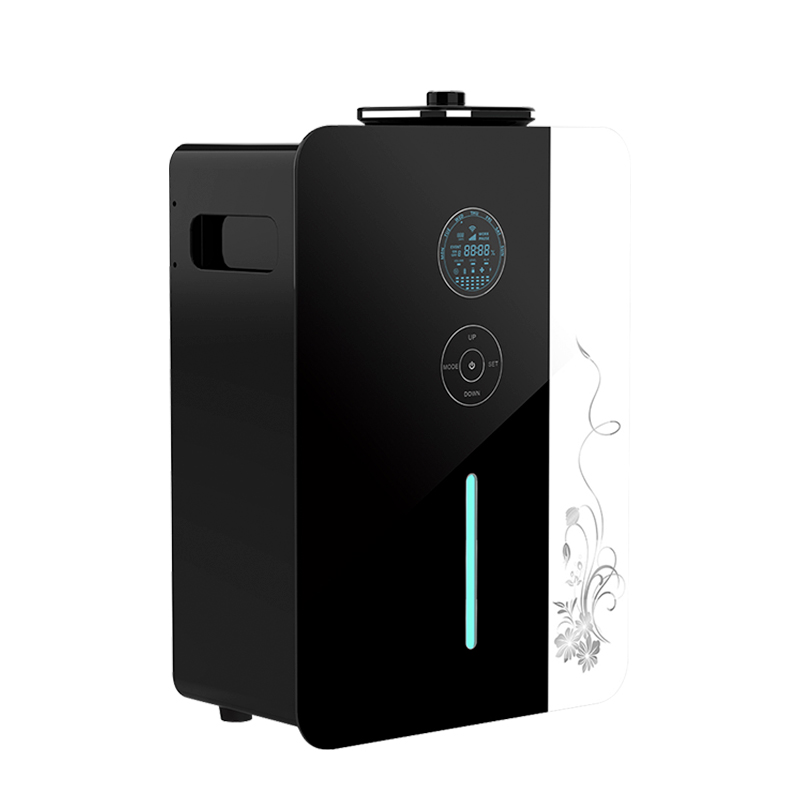
A cold-air scent diffuser completely removes water from the equation. This technology utilizes the Bernoulli principle. An internal pump generates pressurized air. This air forces pure fragrance oil up through a tiny tube into an internal atomizing chamber. The high-velocity air shears the oil into ultra-fine nanoparticles. This process atomizes pure essential oils without using heat or water. There is no ceramic disc and no water reservoir.
This creates a distinct dry mist advantage. Because the particles are incredibly small—often less than one micron in diameter—they remain suspended in the air for hours. They travel on natural air currents. This dry nano-mist leaves no oily residue on your furniture, floors, or electronics. It also avoids the use of synthetic propellants or chemical masking agents found in commercial aerosol sprays. You get pure olfactory output without the heavy fallout associated with water-based sprays.
Regarding moisture impact, we must be explicit. A cold-air nebulizer does not interact with indoor humidity levels at all. It extracts liquid oil and turns it into a dry gas. It offers zero humidification. It is strictly a high-fidelity scenting tool designed for maximum fragrance coverage. If your room is at 25% relative humidity before turning on a nebulizer, it will remain at 25% relative humidity while it runs.
Passive scenting methods include reed diffusers, air-dry clay, and unglazed terracotta stones. These materials absorb essential oils through capillary action. The oil then slowly evaporates from the porous surface into the surrounding air. These passive diffusers rely entirely on existing ambient air circulation. They do not use electricity, fans, or water. Consequently, they offer zero moisture addition to the environment. They are strictly for localized scenting in small areas like bathrooms or entryways.
Mechanical evaporative humidifiers operate on a completely different scale. True evaporative humidifiers suck in dry room air using a powerful fan. They force this air through large, water-saturated wicking filters. As the dry air passes through the wet filter, it absorbs heavy amounts of moisture. The fan then blows this newly humidified air back into the room. This process actually elevates room humidity. It is a high-volume mechanical process, distinguishing it entirely from passive scent devices. An evaporative humidifier can push gallons of water into the air daily, whereas a passive diffuser pushes zero.
To make an informed purchase, you must evaluate feature-to-outcome metrics. Industry-standard measurements include milliliters per hour (ml/hour), total tank capacity, and square footage coverage. Comparing these numbers reveals the stark contrast between scenting devices and moisture-adding devices. You cannot manage what you do not measure.
Let us compare standard output rates. A typical ultrasonic fragrance device emits roughly 15ml to 30ml of water per hour. If you run it for ten hours, it uses about one cup of water. In contrast, a standard bedroom humidifier outputs between 200ml and 400ml per hour. A proper humidifier can push a full gallon (about 3,700ml) of water into the air over a single night. The mathematical difference in output is massive. Expecting a 300ml tank to humidify a master bedroom is mechanically impossible.
There is a micro-climate exception. While an ultrasonic unit cannot humidify an entire room, it provides light humidity directly within a user's personal breathing zone. If you place a unit on your desktop right next to your keyboard, you will feel the moisture. It also works in very small, enclosed spaces like a powder room or a closet. This localized effect is useful for personal comfort but does not change the room's overall environment.
Understanding the physics of relative humidity (RH) explains this limitation. RH measures how much water vapor the air currently holds compared to its maximum capacity at a specific temperature. Warm air holds more moisture than cold air. When a small fragrance device releases 20ml of water into a 200-square-foot room, the dry air absorbs it instantly. The moisture disperses so thinly across the total air volume that it evaporates before registering on a standard room hygrometer. Aroma Diffusers simply lack the volumetric output to move the needle on a digital humidity monitor.
Device Type | Average Tank Size | Output Rate (ml/hr) | Primary Purpose | Impact on Room Humidity |
|---|---|---|---|---|
Ultrasonic Diffuser | 100ml - 500ml | 15 - 30 | Scent & Visual Mist | Negligible (Micro-climate only) |
Cold-Air Nebulizer | 50ml - 500ml (Oil only) | 0 | High-Fidelity Scenting | Zero |
Passive Reed Diffuser | 100ml (Oil only) | 0 | Subtle Localized Scent | Zero |
Evaporative Humidifier | 3,000ml - 6,000ml | 200 - 500 | Adding Moisture | High (Raises room RH) |
Hybrid Oil Humidifier | 1,000ml - 4,000ml | 150 - 300 | Moisture + Scent | Moderate to High |
Manufacturers recognized the consumer desire to combine these functions. This led to the hybrid category: the essential oil humidifier. These devices are built with larger tanks, usually exceeding one liter. They incorporate specialized oil trays or utilize medical-grade plastics designed to withstand corrosive essential oils. They attempt to bridge the gap between high-volume moisture output and ambient scenting.
You must evaluate the trade-offs with hybrid units. There is a constant compromise between optimal scent throw and optimal humidification. Optimal scent requires a higher concentration of oil to water. Optimal humidification requires a high volume of water output. When you push three liters of water into the air, the few drops of oil you added become heavily diluted. The scent throw is often very weak compared to a dedicated nebulizer. Conversely, if you add too much oil to a large water tank, you risk clogging the ultrasonic transducer or degrading the internal components. You rarely get the best of both worlds with a hybrid unit.
You may encounter user reports or search results claiming that humidity actually drops when using a fragrance device. This is an environmental anomaly. These devices do not extract moisture from the air. They lack the mechanical components, like a compressor or desiccant wheel, required for dehumidification. It is physically impossible for a water-emitting device to lower room humidity.
Apparent drops in humidity are typically caused by environmental variables. Concurrent HVAC usage is the most common culprit. When winter heating cycles kick on, the furnace blasts hot, dry air into the room. This rapidly lowers the relative humidity. If you turn on your fragrance unit at the same time the heat turns on, the hygrometer will show a drop in humidity. This drop is caused by the furnace, not the fragrance unit. Poor hygrometer placement, such as placing the sensor near a drafty window or an air return vent, also causes false readings. Always place your hygrometer on an interior wall away from direct airflow to get an accurate reading.
Selecting the correct hardware requires a clear decision framework. You must evaluate your room size, your primary environmental goals, and your need for scalability. Buying the wrong device leads to frustration and wasted money. We outline the exact criteria you need to match the hardware to your physical space.
Establish the baseline rule for your purchase: rank your needs. You cannot have best-in-class humidification and best-in-class scenting in a single cheap device. If dry air mitigation is your absolute priority, your budget must go toward a dedicated humidifier. You need a machine that holds gallons of water. If your primary goal is an olfactory experience, focus entirely on fragrance devices. Do not expect a fragrance unit to cure your dry skin or stop static electricity. Define the problem you are trying to solve before looking at product specifications.
Matching the device to the square footage of your room is critical. Overworking a small unit leads to early motor failure. Under-sizing a unit results in zero noticeable impact. Use this sizing matrix to guide your selection.
Desktop and Personal Space (Under 100 sq ft): An ultrasonic unit is perfectly sufficient here. It provides localized scent and light personal moisture for your immediate breathing zone.
Standard Bedroom (150-300 sq ft): A hybrid essential oil humidifier is required for dual-purpose functionality. You need at least a two-liter tank to maintain humidity through the night while providing a subtle scent.
Open Concept and Large Living Spaces (500+ sq ft): You must separate the functions. Use a cold-air scent nebulizer for widespread fragrance. Pair it with a separate, large-capacity console humidifier to manage the moisture levels across the large footprint.
For enterprise-level or whole-home scalability, standalone units often fall short. You spend too much time refilling tanks and cleaning nozzles. The solution is HVAC integration. You can connect commercial-grade cold-air nebulizers directly to your home's HVAC ductwork. The installation involves drilling a small hole into the supply plenum above the furnace. You insert the atomizing tube into the airstream. The internal fan of your furnace pushes the dry nano-mist through the vents, scenting the entire house evenly. This requires monitoring the static pressure of your ductwork to ensure the mist travels efficiently.
To handle the dry air simultaneously, you pair this with a whole-home bypass humidifier. The bypass humidifier attaches directly to the furnace return air drop. It plumbs directly into your home's water line, eliminating the need for manual refills. A bypass duct routes warm air from the supply plenum through a water-soaked evaporator pad and back into the return. This dual-system approach provides ultimate control over both scent and moisture without the daily maintenance hassle. It requires professional installation but solves the problem permanently.
Owning any device that processes water or atomizes oils comes with adoption risks. You must understand the maintenance realities and safety compliance factors before bringing these units into your home. Neglecting maintenance leads to hardware failure and poor indoor air quality.
Essential oils are highly concentrated, volatile organic compounds. They possess a strong chemical nature. Citrus oils, like lemon and sweet orange, contain high levels of limonene. Heavy resins, like frankincense and myrrh, are thick and sticky. These compounds rapidly degrade standard ABS (Acrylonitrile Butadiene Styrene) plastics found in cheap humidifiers. The limonene breaks down the polymer chains in the plastic.
If you put pure citrus oil into a standard ABS water tank, the plastic will begin to cloud, soften, and eventually crack. This leads to massive water leaks on your furniture or flooring. It is an absolute necessity to purchase devices made with high-density polypropylene (PP) plastic if you intend to mix oil and water. Polypropylene is highly resistant to chemical solvents and will not melt when exposed to concentrated oils. Always check the recycling triangle on the bottom of the water tank; it should have a number 5 inside it, indicating PP plastic.
Water-bearing devices carry a significant maintenance burden. Stagnant water is a breeding ground for pathogens. If you leave water sitting in a tank for days, pink mold (Serratia marcescens) and various bacteria will colonize the dark, damp environment. When you turn the machine back on, the ultrasonic disc will aerosolize those mold spores directly into your breathing air. This causes respiratory distress and foul odors.
You must follow strict maintenance protocols. Empty the water tank daily. Leave the cap off to let the interior air dry. Perform a weekly deep cleaning. Use a solution of white vinegar and water, or a tablespoon of citric acid powder dissolved in warm water. Let the acidic solution sit in the tank for twenty minutes to dissolve mineral scale and kill bacterial growth. Use a small brush to scrub the ceramic transducer gently. Rinse thoroughly before use. If you cannot commit to this cleaning schedule, do not buy a water-based unit.
You must consider the impact of aerosolized tap water. Tap water contains dissolved minerals like calcium and magnesium. When an ultrasonic unit atomizes tap water, it also atomizes those minerals. The water evaporates in the air, leaving the heavy mineral particles to fall onto your furniture as a fine white dust. Breathing in this white dust can irritate the lungs over time. It also triggers false alarms on PM2.5 indoor air quality monitors. Always use distilled or reverse-osmosis water in ultrasonic models to prevent mineral dispersion.
Address respiratory sensitivities carefully. Avoiding commercial air freshener propellants is a major benefit of natural oils. However, adding any volatile organic compounds (VOCs)—even natural ones from essential oils—to dry, irritated airways can sometimes exacerbate issues rather than soothe them. If you suffer from asthma or severe allergies, consult an allergist before introducing concentrated airborne oils into your home environment. Monitor your symptoms closely during the first week of use.
Purchase a digital hygrometer to measure your room's current baseline relative humidity before buying any equipment.
Measure the exact square footage of the room where you intend to place the device to ensure proper sizing.
Inspect the plastic grading on the bottom of the water tank and verify it is made of PP plastic before adding any oils.
Commit to a weekly cleaning schedule using white vinegar or citric acid if you select a water-bearing unit.
Install a dedicated evaporative humidifier if your hygrometer consistently reads below 35% relative humidity.
A: No, standard ultrasonic models release too little water—usually under 30ml per hour—to impact the overall relative humidity of a room, though they may add light moisture to a personal breathing zone.
A: Ultrasonic models use water and vibration to create a wet mist, while cold-air scent diffusers use pressurized air to atomize pure oil into a dry mist without any water.
A: Generally no, unless the humidifier explicitly features an essential oil tray. Pure oils can melt standard plastics and void device warranties.
A: Diffusers do not extract moisture. Perceived drops in humidity are usually due to home heating systems running simultaneously or inaccurate hygrometer readings.
A: They are neutral. They provide high-quality scent without adding moisture, meaning you will still need a separate, dedicated humidifier to combat the dry climate.
A: Yes, provided you use distilled water, clean the tank weekly to prevent bacterial growth, and monitor the room's humidity to ensure it stays between 40-60%.


