
Views: 0 Author: Site Editor Publish Time: 2026-06-23 Origin: Site


Creating a memorable olfactory experience in a massive corporate lobby or a sprawling retail floor is notoriously difficult. Relying on basic residential scenting methods for these sprawling environments often leads to uneven fragrance distribution and rapid hardware failure. Conventional tactics like aerosols, heat elements, or water-based humidifiers simply cannot handle commercial square footage. Enterprise environments demand consistent, residue-free fragrance. You need a system capable of withstanding heavy foot traffic and aggressive HVAC dilution.
We will demystify the mechanical and physical principles behind commercial scenting technologies in this guide. You will discover a clear, objective framework to evaluate equipment types. Facility managers and procurement teams can use these insights to streamline deployment strategies. Understanding how these complex systems function ensures you make informed decisions for your specific architectural layouts. Let us explore the physics of industrial scenting and exactly what makes these devices so effective.
Understanding industrial scenting begins with the physics of fluid dynamics. A high-quality commercial diffuser machine uses pressurized air to manipulate essential oils. This process relies heavily on Bernoulli’s principle. An internal air compressor generates a high-velocity stream of air. This air moves rapidly across the top of a small capillary tube submerged in fragrance oil. The rapid movement creates a pressure drop, pulling the oil upward. Once the oil hits the fast-moving air stream, it shatters into microscopic droplets.
Internal baffles inside the atomizing head catch any larger, heavier droplets and return them to the reservoir. Only the smallest particles escape into the environment. These nanoparticles typically measure under one micron in diameter. To provide context, a human hair is about seventy microns thick. Breaking pure essential or fragrance oils into these ultra-fine dimensions ensures they behave more like a gas than a liquid.
Many facility managers initially attempt to scale up consumer-grade methods. They quickly encounter severe operational liabilities. Heat-based systems alter the chemical composition of fragrance oils. High temperatures burn off delicate top notes, leaving behind a distorted, often unpleasant base scent. Furthermore, heating essential oils constantly poses a subtle fire hazard in unattended commercial zones.
Water-based ultrasonic methods present an even greater risk to enterprise environments. Ultrasonic devices rely on a vibrating disc to agitate water and oil together. This method introduces unwanted humidity into the space. Injecting constant moisture into an HVAC system or a closed retail environment risks mold growth and mildew accumulation. Additionally, the droplets produced by water-based systems are heavy. They fall rapidly to the floor. Over time, this constant fallout leaves a slippery, damaging residue on expensive commercial flooring like polished marble or hardwood.
Nebulized nanoparticles solve the weight problem inherently. They are light enough to move dynamically throughout a room. Natural convection currents easily carry them. Mechanical airflow from vents pushes them across vast spaces effortlessly. They do not drop and pool in one specific area.
This prolonged suspension means the fragrance remains active in the air longer. You use less oil while achieving a much more consistent scent profile. By eliminating water and heat, the fragrance maintains its original chemical integrity from the bottle to the customer's nose.
| Technology Type | Mechanism | Particle Size | Commercial Viability |
|---|---|---|---|
| Cold-Air Nebulization | Pressurized air shatters pure oil | < 1 micron | Excellent (No residue, pure scent) |
| Ultrasonic | Vibrating water and oil mixture | 5 - 15 microns | Poor (Leaves wet residue, dilutes oil) |
| Heat Evaporation | Warming element vaporizes oil | Variable | Poor (Alters fragrance chemistry) |
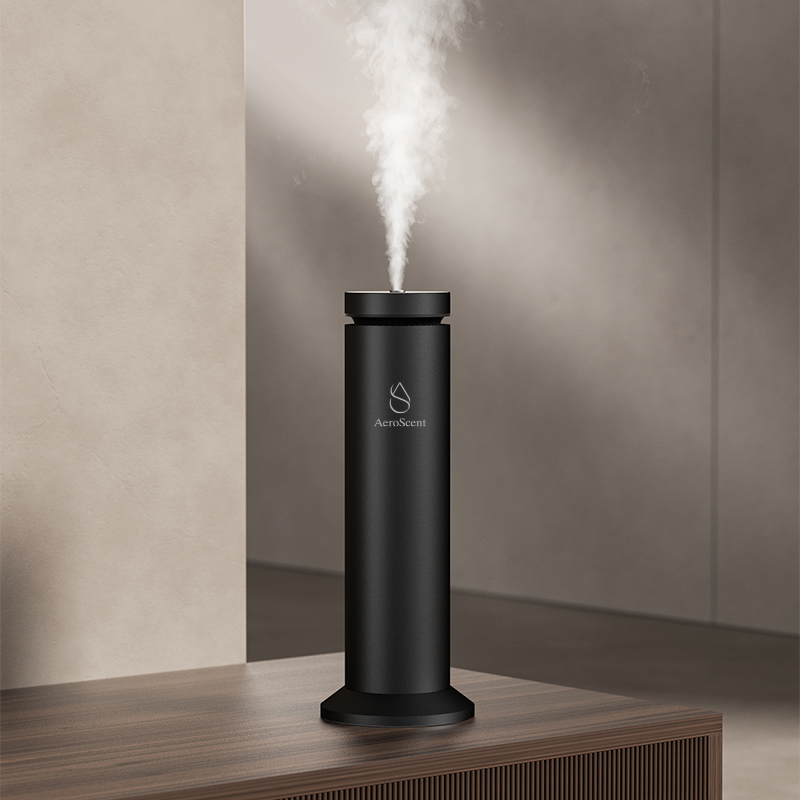
When you map out a fragrance strategy, deployment architecture becomes your primary focus. Targeted zoning utilizes standalone machines to push scent into immediate, high-traffic zones. You will typically place a diffuser unit directly within the space it serves.
A common mistake involves placing standalone systems too close to the floor. For optimal dispersion, always position the nozzle at least six feet high. This allows the sub-micron particles to catch natural cross-breezes before interacting with foot traffic.
For massive facilities, relying on multiple localized devices becomes inefficient. HVAC integration solves this by using the building's own lungs to distribute fragrance.
This method comes with a strict mechanical requirement. Installers must understand static pressure. The supply duct operates under positive pressure. The scent machine's internal output pump must generate enough force to overcome this duct pressure. If it cannot, the building's airflow will force the fragrance backward into the machine's internal housing, flooding the electronics and destroying the compressor.
Modern commercial design favors expansive, open environments. You often encounter constantly opening automatic doors, massive glass facades, and high ceilings. Specialized environments like restaurants, fitness centers, or laboratories feature strong exhaust systems that constantly pull indoor air outside. These spatial dynamics severely disrupt scent concentration.
In a residential room, scent accumulates quickly. In an open-concept commercial lobby, the air volume changes multiple times per hour. You must approach these spaces differently. Relying on simple square footage measurements will lead to underperforming systems. You are scenting a three-dimensional volume of air, not a flat floor plan.
Physics dictates where you should place your equipment. A poorly placed machine wastes expensive consumables. Keep all output nozzles far away from return air vents, exhaust fans, and open windows. If you place a machine near a strong exhaust vent, the building will suck the fragrance outdoors before anyone smells it.
Instead, utilize natural convection currents. Warm air rises and cool air sinks. Place devices where they can leverage the throw of your air conditioning vents. In vestibules with double automatic doors, position the system on the inner wall pointing inward. This traps the scent inside the main lobby rather than blowing it out to the street every time a guest enters.
Human noses adapt quickly to environmental smells. We call this olfactory fatigue or "nose blindness." If a machine sprays continuously, employees and guests will stop noticing the fragrance within fifteen minutes.
Advanced systems use precise interval timing. They never run constantly. A standard calibration might run the pump for thirty seconds, followed by a sixty-second pause. This pulsing action allows the scent to layer naturally into the environment. The pauses give the human nose time to reset slightly, ensuring the fragrance remains perceptible. It also accommodates changing air volumes smoothly. If the lobby gets busy, the rolling layers of scent compensate for the thermal draft generated by crowds of people.
| Environment Type | Recommended Work Cycle | Recommended Pause Cycle |
|---|---|---|
| Small Office/Spa Room | 15 Seconds | 120 Seconds |
| Retail Storefront | 30 Seconds | 60 Seconds |
| Large Hotel Lobby | 60 Seconds | 60 Seconds |
| High-Traffic Casino | 90 Seconds | 30 Seconds |
When procuring systems, verify manufacturer coverage claims meticulously. Many brands market their devices based on ideal, sealed-room scenarios. Always separate flat square footage from cubic volume. A space measuring two thousand square feet with a standard nine-foot ceiling holds roughly eighteen thousand cubic feet of air. The same footprint with a twenty-foot architectural ceiling holds forty thousand cubic feet of air. The latter requires a significantly more powerful compressor to achieve the same ambient saturation.
Enterprise environments rarely operate on a single static schedule. Evaluate the programmability of the hardware. Modern systems feature Bluetooth or Wi-Fi control applications. This connectivity is not a luxury; it is a necessity for efficient operation.
You need multi-event scheduling. A hotel lobby requires high intensity during peak check-in hours between three and six in the afternoon. During the quiet midnight hours, the intensity should drop to conserve oil. Centralized control allows facility managers to adjust parameters across multi-unit deployments from a single interface, eliminating the need to climb ladders to adjust dials manually.
Every nebulizing machine contains an internal air pump. Pumps inevitably generate vibration and noise. Acknowledge this reality early in the procurement phase. For quiet commercial zones like day spas, therapy clinics, or high-end hotel corridors, acoustic output matters immensely.
Define acceptable decibel levels. High-quality systems operate below 40 decibels (dB), which resembles the quiet hum of a modern refrigerator or a desktop computer fan. If the space demands absolute silence, you must route the deployment through the HVAC system so the mechanical components remain hidden in a soundproofed utility room.
Evaluating hardware requires looking closely at consumable efficiency. Look at the physical reservoir size. Standard bottles come in sizes like 500ml or 1000ml. You must request the consumption rate per hour of operation at maximum intensity from the manufacturer. For example, if a machine consumes two milliliters of oil per operational hour, a 500ml bottle will last exactly two hundred and fifty hours of active pumping.
Furthermore, investigate oil compatibility. Some manufacturers lock their hardware so you can only use their proprietary fragrance cartridges. Open-source systems allow you to pour bulk commercial fragrance into the reservoir, offering much greater flexibility in sourcing and maintaining your scent inventory. Weigh these options carefully during the procurement process.
Integrating into central ductwork carries specific engineering risks. Improper duct tapping leads to severe issues. Installers must use proper grommets to ensure air seals remain uncompromised. If a leak occurs at the insertion point, the system will blow expensive fragrance oil directly into the mechanical room instead of the target space.
Additionally, the dispersion tube must face the correct direction. The open tip of the tube must point downwind, moving with the airflow. If you position the tube facing against the incoming air, localized oil condensation will occur. The microscopic particles will slam into the incoming air pressure, gather into heavy droplets, and drip backward into your ductwork or onto the machine itself.
Do not let any vendor claim their nebulizing diffusers are entirely maintenance-free. All mechanical atomizers require regular upkeep. Over time, fragrance oils leave trace resins behind. Thick or sticky fragrance notes, particularly heavy vanillas or deep woods, accelerate this buildup.
You must implement standard operating procedures for cleaning. We recommend flushing the system every three to four months. Simply fill an empty bottle with high-percentage rubbing alcohol (isopropyl alcohol). Run the machine on its highest setting for fifteen minutes in a well-ventilated utility area. The alcohol dissolves built-up resins, clearing the microscopic capillary tubes and restoring the atomizer to peak efficiency.
Enterprise deployments bring significant liability concerns. You must ensure occupant safety in public spaces. Verify that all deployed fragrance oils meet strict regulatory standards. Reputable commercial oils are strictly IFRA-compliant (International Fragrance Association). This certification guarantees the compounds are safe for prolonged respiratory exposure and free from banned allergens.
Additionally, monitor VOC (Volatile Organic Compound) regulations in your specific state or country. Commercial-grade formulations avoid cheap solvents that spike VOC emissions. Prioritizing certified, high-quality oils protects your staff, your customers, and your brand reputation.
A: Consumption varies entirely based on your intensity settings and operating schedule. Under standard commercial use (e.g., running 10 hours a day on a medium interval setting), a typical 500ml bottle usually lasts between 30 and 60 days. High-intensity settings in massive, high-ceiling environments will deplete the reservoir much faster.
A: No, not if installed correctly. Proper sub-micron nebulization breaks the oil down into a dry mist that behaves like a gas. As long as you use the correct oil viscosity, maintain the atomizer, and angle the installation tube with the airflow, it will leave zero residue.
A: No. Using thick, unformulated, or low-quality oils poses severe risks. Heavy carrier oils (like jojoba or coconut) will immediately clog the microscopic atomizer and often void your warranty. You must use commercial-grade formulations specifically designed for cold-air nebulization.
A: You can expect a low, rhythmic hum similar to a desktop computer fan, typically operating under 40 decibels. While quiet, it is rarely entirely silent. For environments demanding absolute silence, such as spas or libraries, we highly recommend routing the system through the HVAC network.


