
Views: 0 Author: Site Editor Publish Time: 2026-08-07 Origin: Site


Modern living and workspaces share a common architectural reality: surface area is at an absolute premium. Bulky wellness appliances simply do not fit into minimalist or space-constrained environments. Consumers constantly struggle to balance their desire for consistent room fragrancing with the physical limitations of their spaces. Oversized units create visual clutter and consume valuable desk or counter space. Conversely, poorly designed small units often fail to provide adequate scent dispersion, or they completely overpower a small room with concentrated vapor.
Evaluating a compact essential oil diffuser solves this dilemma. These devices leverage specific diffusion technologies to deliver maximum olfactory impact with a minimal physical footprint. We will examine the mechanics of miniaturization, output efficiency, and strategic placement. You will learn how to evaluate these units based on technology, spatial dynamics, and maintenance requirements, enabling an evidence-based purchasing decision.
Evaluating space efficiency requires establishing strict baseline metrics. A device cannot simply be marketed as small; it must meet specific dimensional criteria to qualify as truly compact. In practical terms, a compact unit generally features a base diameter of under four inches and a total height of less than six inches. If it utilizes water, the tank capacity typically remains under 100ml. Measuring success in modern, multi-use rooms involves analyzing how well the device integrates into crowded environments like bedside tables, cramped home office desks, or narrow bathroom shelves without demanding reorganization of existing items.
The mathematical relationship between a device's base area and its maximum effective scent range defines its true efficiency. A standard unit might occupy twenty square inches of desk space to cover three hundred square feet. A compact unit must achieve proportional or superior coverage using less than twelve square inches of surface area. Calculating the necessary output for rooms under 150 square feet requires precision. You want an aroma that remains noticeable but not overpowering. High-output devices in micro-spaces lead to olfactory fatigue, where the user becomes nose-blind to the scent due to over-concentration. The goal is a balanced dispersion rate that matches the room's cubic volume. For a standard 10x10 foot office, a dispersion rate of 15-20ml per hour provides optimal saturation without overwhelming the occupant.
Form factor dictates how intrusive an object feels in a room. Visual weight refers to how bulky an object looks, regardless of its actual footprint. Traditional teardrop or dome-shaped models carry heavy visual weight. They look wide and demand attention. Cylindrical, wall-mounted, or low-profile designs drastically reduce visual clutter. A sleek, matte-black cylinder blends into a desk setup alongside monitors and speakers. A wall-mounted unit removes the device from the horizontal plane entirely. Selecting a low-profile design ensures the hardware complements the room rather than dominating the available surface area. Materials also play a role; matte finishes absorb light and recede into the background, while glossy plastics draw the eye and highlight the device's presence.
Miniaturization relies entirely on the underlying mechanical process used to disperse the oil. The four main diffusion technologies allow for different levels of size reduction. Each technology presents specific use-cases, advantages, and physical limitations that dictate how small the final product can be manufactured.
Ultrasonic technology relies on a small ceramic plate located at the base of the water tank. This plate vibrates at high frequencies, typically around 2.4 million times per second (2.4MHz). These ultrasonic vibrations agitate the water and essential oil mixture, breaking it down into microscopic particles. The device then expels this fine mist into the air using a small internal fan. It acts essentially as a micro-humidifier, adding a slight amount of moisture to the immediate vicinity.
When evaluating a small aroma diffuser utilizing ultrasonic tech, the primary constraint is the water tank. Modern ultrasonic plates are incredibly tiny, often the size of a coin. However, the necessity of a water reservoir dictates the absolute minimum size limit of the device. You cannot shrink an ultrasonic unit smaller than the volume of water it needs to hold. Despite this limitation, this method remains highly popular because it preserves the original chemical structure of the essential oils. The cold-mist process ensures the therapeutic properties remain intact, unlike heat-based alternatives.
Nebulizers operate without any water. They use pressurized air to atomize pure essential oils. This process relies on Bernoulli’s principle. A stream of pressurized air passes through a small micro-tube, creating a vacuum that pulls the essential oil to the surface from a glass reservoir. The air then blows across the oil, breaking it down into incredibly fine, pure particles that disperse rapidly into the room.
This represents the most space-efficient high-output option available. By eliminating the water tank entirely, manufacturers can shrink the device down to the size of a soda can or smaller. Nebulizers deliver a potent, undiluted scent that can fill a room in minutes. However, this efficiency comes with trade-offs. The internal air pump generates a noticeable humming or vibrating noise, which may disrupt quiet environments like bedrooms or recording studios. They also consume essential oils at a much faster rate than ultrasonic models.
Heat diffusers utilize low-heat elements to gently warm the oils. This promotes rapid evaporation into the surrounding air. These devices often take the form of small electric hot plates or direct wall plug-ins. You place a few drops of oil onto a reusable pad or into a small ceramic dish, and the internal heating element does the rest.
The primary advantage here is an extremely small footprint. Wall plug-ins consume zero counter space, making them ideal for hallways and bathrooms. They also operate in complete silence since there are no moving parts. However, buyers must exercise caution. Temperatures above 120 degrees Fahrenheit can alter the original chemical structure of essential oils. This alteration potentially reduces the therapeutic benefits compared to cold-diffusion methods. Heat dissemination works best for pure fragrancing rather than targeted aromatherapy.
Evaporative diffusion relies on natural airflow to carry the scent. Passive models include reed diffusers, unglazed ceramic stones, and porous wood blocks. Active evaporative models use tiny internal fan blades to gently circulate air across an oil-soaked pad.
Passive models serve as the ultimate zero-power solutions for micro-spaces. They work perfectly in closets, small bathrooms, or car interiors where power outlets are unavailable. Active fan-based models offer a low-power alternative that projects scent further than passive models. They actively push the aroma into the room without introducing the moisture risks associated with ultrasonic units. They remain highly compact because they only need space for a small DC motor fan and a replaceable oil pad.
| Diffusion Technology | Minimum Size Constraint | Output Level | Oil Integrity Preservation | Noise Level |
|---|---|---|---|---|
| Ultrasonic | Requires space for water tank (typically 50-100ml) | Moderate | Excellent (Cold diffusion) | Low (<30dB) |
| Nebulizing | Very small (No water tank needed) | High | Excellent (Pure atomization) | Moderate (35-45dB) |
| Heat Dissemination | Extremely small (Wall plugs available) | Low to Moderate | Poor (Heat alters chemistry) | Silent (0dB) |
| Evaporative (Active) | Small (Requires space for internal fan) | Low | Good (Natural evaporation) | Low (<25dB) |
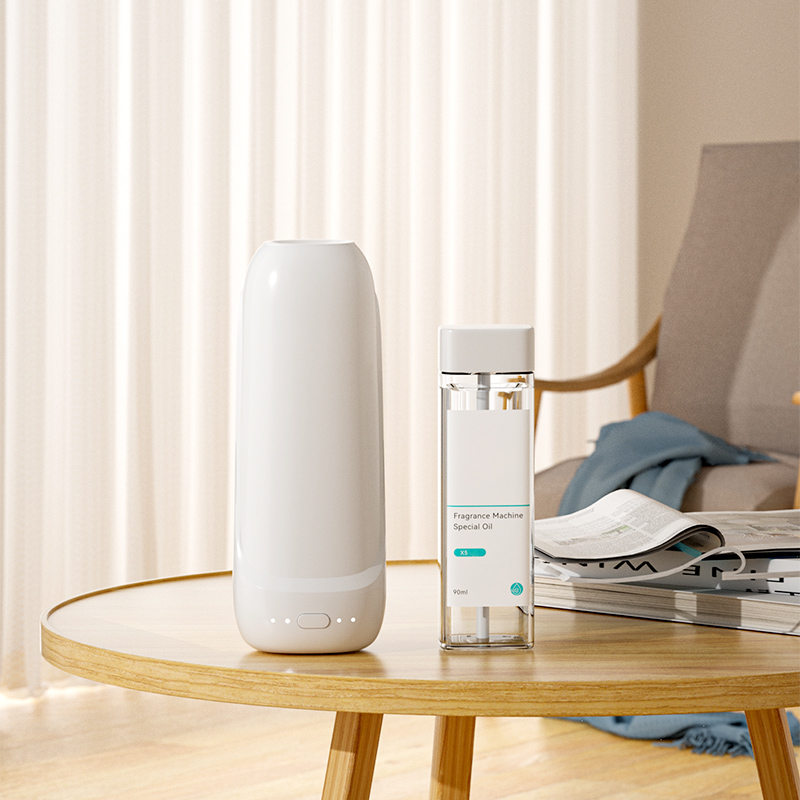
Selecting the right hardware requires looking beyond the basic diffusion method. You must evaluate how specific features translate into daily outcomes within a confined room. Power flexibility, run-time, and acoustic profiles dictate the user experience and determine whether the device integrates seamlessly into your daily routine.
Cord clutter ruins the aesthetic of a minimalist space and creates tripping hazards in tight quarters. A portable diffuser offers significant spatial benefits. Battery-operated and USB-C rechargeable models eliminate the need to tether the device to a wall outlet. This flexibility allows for dynamic placement. You can position the unit on floating shelves, use it as a dining table centerpiece, or move it from the home office to the bedroom effortlessly.
Modern units utilize lithium-ion batteries, providing consistent power output until depletion. USB-C standardization also means you can power the unit directly from a laptop, a monitor hub, or a standard phone charger. This reduces the number of bulky power adapters required on a desk. When evaluating battery-powered units, check the milliamp-hour (mAh) rating. A 2000mAh battery typically provides enough power for 4 to 6 hours of continuous ultrasonic diffusion or up to 12 hours on an intermittent setting.
The primary limitation of compact ultrasonic units is the inherent compromise between size and run-time. A smaller physical footprint dictates a smaller reservoir. Typical capacities range from 50ml to 100ml. A standard 100ml tank running continuously will deplete in roughly three to four hours. This requires frequent manual refills, which can interrupt a workday or a night's sleep.
To counter this, buyers must evaluate intermittent diffusion settings. Advanced compact models feature programmable timers, such as 30 seconds on followed by 30 seconds off, or 1 minute on followed by 2 minutes off. This technological solution effectively doubles or triples the run-time without requiring a larger tank. Intermittent settings also prevent olfactory fatigue by giving your olfactory receptors a break, ensuring the scent remains noticeable throughout the day. For a standard 8-hour workday, an intermittent setting on a 90ml tank provides continuous background fragrancing without requiring a midday refill.
Acoustic impact matters deeply in small bedrooms or home offices. In a tight space, even minor mechanical noises become amplified. Small ultrasonic units offer near-silent operation, typically registering below 30 decibels. The only sound is the occasional faint trickle of water and the whisper of the internal fan. This makes them ideal for bedside tables, meditation spaces, or therapy rooms.
Conversely, compact nebulizers rely on internal air pumps. These pumps generate an audible hum or vibration, often registering between 35 and 45 decibels. While not overwhelmingly loud, this constant drone can be distracting in a completely silent room. Fan-based evaporative models produce a distinct whirring sound similar to a laptop cooling fan. When selecting a device for a confined, quiet environment, acoustic stealth must be prioritized alongside physical size. Placing a vibrating nebulizer on a hollow wooden desk will amplify the sound; using a silicone mat underneath can dampen this acoustic transfer.
The perceived value and efficiency of any diffusion device depend heavily on user implementation. A high-quality unit placed poorly will underperform. Strategic placement maximizes scent dispersion while minimizing the physical intrusion of the device into your usable space.
You must position the unit relative to the natural airflow of the room. Placing a diffuser flush against a wall or hiding it behind large furniture obstructs the vapor trail. The mist will simply fall onto the immediate surface, creating a localized puddle of scent and potential moisture damage. Instead, position the unit in an open space with at least 12 inches of clearance above and around the nozzle.
Identify the HVAC currents in the room. Place the device near a return vent or in the path of a ceiling fan's downdraft. Leveraging these natural air currents carries the micro-particles across the room rapidly, optimizing dispersion without requiring a larger, more powerful machine. In a bedroom, placing the unit on a nightstand near the door allows the hallway draft to pull the scent into the room. In an office, keep it away from open windows where the scent will simply blow outside.
When horizontal surface area is exhausted, look vertically. Utilizing vertical space is a core strategy for modern rooms. Evaluate models designed specifically for this purpose. Wall-plug diffusers consume zero counter depth, utilizing the vertical plane of the wall outlet. Tall, narrow cylindrical profiles require less than two inches of base depth but elevate the mist nozzle higher into the room's air currents.
Elevating the device also protects it from accidental spills on crowded desks and keeps it out of reach of pets or children. If you have floating shelves, a battery-operated unit placed on a higher shelf allows the heavier essential oil particles to cascade downward, filling the room more evenly than a unit placed on the floor or a low coffee table.
Adopting compact diffusion technology introduces specific risks. Small spaces react differently to concentrated aromas and moisture. Understanding these pitfalls allows you to implement effective mitigation strategies to protect your environment and your hardware.
Using high-output nebulizing technology in a poorly ventilated, small room leads to rapid over-saturation. The scent becomes overwhelming, clinging to fabrics and potentially causing headaches or respiratory irritation. To mitigate this, select a mini diffuser specifically rated for your square footage. Utilize built-in timers to limit operation to short bursts.
Most importantly, adjust your oil drop ratios. Standard recommendations often suggest five to eight drops of essential oil per 100ml of water. In a small room under 100 square feet, reduce this to two or three drops. You can always add more oil if the scent is too weak, but you cannot easily remove excess scent from the air once it has saturated the room. Start with a conservative ratio and scale up based on the specific viscosity and potency of the oil you are using.
Small devices require meticulous cleaning. Compact water tanks feature tight corners and narrow openings, making them difficult to wipe down manually. Stagnant water and residual essential oils quickly breed mold, create sticky buildups, and degrade the plastic components over time. You must establish a strict cleaning protocol to ensure the ultrasonic plate continues to vibrate at optimal frequencies.
Ultrasonic models expel moisture. In cramped desk setups, this micro-condensation settles on nearby surfaces. Continuous exposure to moisture damages varnished wood furniture, warps MDF veneer, and poses a serious threat to exposed electronics, keyboards, and monitors. The oils themselves can also degrade certain plastics and finishes if allowed to pool.
To prevent surface damage, always place the unit on a protective coaster, a silicone mat, or a small ceramic tray. Direct the mist nozzle away from sensitive materials, paper documents, and electronics. If you must place a device directly next to a computer or expensive audio equipment, opt for a waterless nebulizer or a fan-based evaporative model to eliminate moisture risks entirely.
A compact essential oil diffuser is not merely a shrunken version of a standard unit. It is a specialized device that requires a deliberate choice regarding technology, placement, and output. You must balance the physical footprint against the required run-time and the specific dimensions of your room. Whether you prioritize the oil integrity of ultrasonic tech, the raw power of waterless nebulizing, or the zero-footprint appeal of evaporative methods, the right choice transforms a cramped space into an optimized aromatic environment.
When making your final selection, apply strict shortlisting logic. Choose a USB-powered portable unit for transient workspaces and travel. Opt for a low-profile ultrasonic model for bedside tables where silent operation and oil preservation are paramount. Select a waterless nebulizing unit for maximum scent delivery in medium-sized rooms where you refuse to sacrifice surface area.
Take the following steps to finalize your setup:
A: Coverage depends heavily on the underlying technology. Compact ultrasonic models typically cover 100 to 150 square feet effectively. Compact nebulizers, despite their small size, can push scent up to 400 square feet because they atomize pure oil without water. Always choose a model rated for your specific space to avoid overpowering the room.
A: The frequency is similar, but the urgency is higher. The concentration of essential oils in smaller 50ml to 100ml tanks leads to faster residue buildup on the ultrasonic plate. This necessitates strict weekly maintenance using a vinegar and water solution to prevent clogging and mold.
A: Yes. Many portable models feature built-in rechargeable lithium-ion batteries. Depending on the mist output settings and whether the device uses an active fan or an ultrasonic plate, battery life typically ranges from two to eight hours on a single charge.
A: Ultrasonic models pose a moisture risk due to micro-condensation settling on keyboards or monitors. If placing a device near electronics, recommend using waterless nebulizers or fan-based evaporative models. These eliminate the risk of water damage entirely.
A: While ultrasonic diffusers break down water into micro-particles similarly to humidifiers, their primary function is scent dispersion. They lack the tank capacity (usually under 100ml) to significantly alter room humidity levels compared to dedicated humidifiers, which hold liters of water.
A: Excessive heat can alter the delicate chemical structure of essential oils. While heat diffusers are highly compact and silent, this chemical alteration potentially diminishes the therapeutic aromatherapy benefits compared to cold-diffusion methods like ultrasonic or nebulizing technology.
A: Run-time depends on the output settings. On a continuous mist mode, a 100ml tank typically lasts three to four hours. If the device features an intermittent setting, that same tank can last up to eight hours before requiring a refill.


