
Views: 0 Author: Site Editor Publish Time: 2026-08-28 Origin: Site


The growing demand for untethered aromatherapy has flooded the market with portable devices, but the internal mechanics dictating their performance are rarely understood by buyers. Consumers frequently purchase a portable diffuser based on aesthetics, only to experience rapid battery drain, weak scent throw, or messy leaks during travel. The root cause is a mismatch between the user's environment and the device's underlying diffusion technology. To make a qualified purchasing decision, buyers must understand the internal engineering of these devices. This guide deconstructs the three primary technologies powering cordless diffusers, evaluating their mechanics, battery efficiency, and practical trade-offs.
Moving away from traditional wall plugs requires significant engineering adjustments. Tethered diffusers rely on consistent alternating current (AC) power from a wall outlet, which provides unlimited energy for high-draw components. Portable units must rely entirely on internal direct current (DC) power. Most modern devices use rechargeable lithium-ion batteries, specifically the 18650 or 21700 cell formats, or flat lithium-polymer pouches. Older or highly budget-focused models might still use replaceable AA or AAA alkaline batteries. Lithium-ion cells provide a higher energy density, allowing manufacturers to keep the device compact while delivering the 3.7 to 5 volts required to drive internal motors and circuit boards.
The primary engineering challenge lies in power management. Manufacturers must balance the power draw of motors, fans, and pumps against the battery capacity. Battery capacity is measured in milliampere-hours (mAh). A higher mAh rating generally means longer runtime. A standard mini essential oil diffuser battery operated typically houses a battery ranging from 1000mAh to 4000mAh. However, a powerful internal air pump will drain even a 4000mAh battery quickly. Engineers optimize the internal printed circuit board (PCB) to prevent rapid discharge, utilizing step-up converters to maintain consistent voltage as the battery drains.
To extend battery life, most portable units utilize intermittent operation controlled by Pulse Width Modulation (PWM). Programmed microcontrollers pulse the diffusion mechanism rather than running it continuously. The device might run for one minute and pause for two minutes. This cycling serves two specific purposes. First, it drastically reduces the overall power consumption, effectively doubling or tripling the functional runtime of the device. Second, it prevents olfactory fatigue. The human olfactory system quickly adapts to constant smells, tuning them out. Pulsing the aroma ensures the user continues to notice the scent profile over an extended period.
| Power Source Type | Typical Capacity | Voltage Output | Lifespan / Recharge Cycles | Best Application |
|---|---|---|---|---|
| Lithium-Ion (18650 Cell) | 2000mAh - 3500mAh | 3.7V (Nominal) | 300 - 500 Cycles | High-draw nebulizers and ultrasonics |
| Lithium-Polymer (LiPo) | 800mAh - 2000mAh | 3.7V (Nominal) | 300 - 400 Cycles | Ultra-slim evaporative models |
| Alkaline (AA / AAA) | 1000mAh - 2500mAh | 1.5V per cell | Single Use | Emergency or budget evaporative units |
Ultrasonic technology dominates the traditional diffuser market and has successfully transitioned into portable formats. The core component driving this system is a piezoelectric transducer. This is a small ceramic disc located at the base of the water reservoir, sealed with a silicone O-ring to prevent water from reaching the PCB below. When an electrical charge hits this ceramic disc, it changes shape rapidly. The PCB sends an alternating current to the disc at a frequency of roughly 2.4 million times per second (2.4 MHz). These high-frequency ultrasonic waves agitate the water and essential oil mixture resting on top of the disc. The intense kinetic energy breaks the surface tension of the liquid, shattering it into a micro-fine mist of particles measuring just a few microns in diameter.
Users often wonder how these devices create steam without a heating element. The mist produced is entirely cold. Heat alters the delicate chemical structure of essential oils, destroying volatile compounds and degrading the therapeutic profile. By using mechanical vibration instead of thermal energy, the oil's chemical integrity remains intact. A small internal DC brushless fan then pushes this cold mist up through the device's chimney and out into the room.
Sustaining 2.4 MHz vibrations requires a moderate power draw. A typical portable unit using ultrasonic technology offers balanced runtimes, usually between four to eight hours on a full charge. The internal reservoirs are small to maintain portability, usually holding 30ml to 50ml of water. Users must adjust their water-to-oil drop ratios accordingly. Two to three drops of oil are usually sufficient for these micro-reservoirs. Overloading the small water volume with too much oil can coat the ceramic disc, dampening the vibrations and halting mist production.
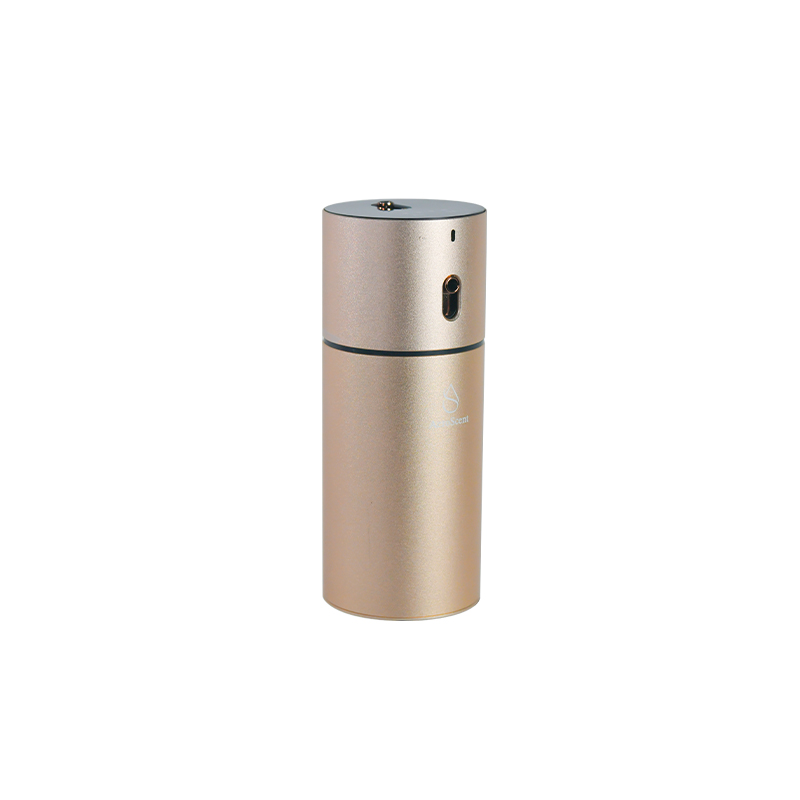
Nebulizing technology provides the most potent aroma delivery available in the portable market. It operates entirely on fluid dynamics, specifically Bernoulli’s principle and the Venturi effect. Inside the chassis sits a micro-air pump. When activated, this pump generates a stream of highly pressurized air. This air is forced through a very small, restrictive tube. As the air squeezes through this bottleneck, its velocity increases dramatically, creating a localized pressure drop or vacuum. This vacuum pulls pure essential oil upwards from the reservoir through a secondary capillary tube. When the oil meets the high-velocity air stream, it hits a baffle and shatters into microscopic nanoparticles. These particles are then blown out into the room, while larger, un-atomized droplets fall back into the reservoir.
Modern nebulizing units feature direct-to-bottle integration. You do not need to pour oil into a reservoir. Instead, you screw standard 10ml or 15ml essential oil bottles directly into the atomizing head of the device. The industry standard uses DIN18 threading, which matches most commercial essential oil bottles. This eliminates pouring messes and prevents cross-contamination of scents. It is a massive advantage for a cordless diffuser designed for travel. You simply attach the bottle, slide the atomizing head into the chassis, and turn the unit on.
This method has a high energy demand. The internal air pump requires significant voltage to maintain the necessary PSI (pounds per square inch) for atomization. Consequently, nebulizers have the heaviest battery drain among portable units. A 2000mAh battery might only power a nebulizer for two to four hours of continuous use. They also consume essential oil much faster than water-based alternatives because you are diffusing pure, undiluted oil directly into the air.
Evaporative technology relies on simple airflow mechanics rather than complex fluid dynamics or high-frequency vibrations. The internal structure is straightforward and highly durable. A micro-fan sits behind or below a replaceable absorbent pad. These pads are typically made from dense cellulose, felt, or synthetic sponge materials. You apply five to ten drops of essential oil directly onto this pad. When activated, the fan blades gently circulate air across the saturated material. This constant airflow accelerates the natural evaporation rate of the volatile oil compounds. The scent is then carried out of the device and into the surrounding environment.
This is the most energy-efficient diffusion technology available. Powering a small DC brushless fan requires minimal voltage and very low amperage. Because the power draw is so low, these devices boast extended battery life. A single charge on a mini battery diffuser using evaporative technology can often last for weeks under normal intermittent use. The lack of pumps or transducers also means there are very few moving parts to break, resulting in a highly rugged device suitable for harsh travel conditions.
The simplicity comes with specific trade-offs regarding scent delivery. The scent throw is relatively weak compared to nebulizers or ultrasonics. It relies entirely on the ambient air temperature and the fan's CFM (Cubic Feet per Minute) rating. Furthermore, the aroma profile changes over time. Essential oils are composed of various molecules with different molecular weights. Lighter top notes (like citrus) evaporate quickly and dominate the initial scent. Heavier base notes (like cedarwood) linger on the pad and release slowly. This fractionation alters the intended scent experience of complex blends.
Selecting the correct device requires evaluating specific performance dimensions against your physical environment. You must match the internal engineering to your intended use case to avoid rapid battery depletion or inadequate scent coverage.
Evaluate battery capacity versus runtime. Look directly at the mAh rating printed on the device or in the specifications. A 2000mAh battery will power an evaporative fan for days. That same 2000mAh battery might only power a nebulizing pump for three hours. Always calculate true runtime based on intermittent mist settings. Manufacturers often list the maximum runtime based on the lowest intermittent setting (e.g., 10 seconds on, 60 seconds off). Read the specifications carefully to understand continuous operation times versus intermittent operation times.
Consider scent throw and coverage area. Different technologies serve different spatial needs based on their output volume. Evaporative models are best for micro-environments under 50 square feet. Ultrasonic models effectively cover 50 to 150 square feet, depending on the fan speed pushing the mist. Nebulizing models can push dense, pure scent across 150 to 500 square feet. Choose the power level that matches your room size to avoid overwhelming a small space or under-scenting a large one.
Assess form factor, portability, and travel compliance. Check the physical dimensions and weight, especially if you plan to carry the device in a backpack or purse. Ensure the device uses USB-C charging standardization. This reduces the number of proprietary cables you need to carry and allows you to charge the device using standard laptop chargers or power banks. Address TSA regulations if you plan to fly. Liquids must comply with the 3-1-1 rule, meaning your essential oil bottles must be 3.4 ounces (100ml) or less. Internal lithium-ion batteries must meet airline safety standards for carry-on luggage, which generally restrict batteries over 100 Watt-hours (Wh). Most portable diffusers fall well below this limit, but verifying the specifications prevents confiscation at security checkpoints.
| Technology Type | Power Draw | Scent Throw & Coverage | Spill Risk (Travel) | Maintenance Level |
|---|---|---|---|---|
| Ultrasonic | Moderate (4-8 Hours) | Medium (50-150 sq ft) | High (Contains Water) | High (Descaling & Mold) |
| Nebulizing | High (2-5 Hours) | Strong (150+ sq ft) | None (Waterless) | Medium (Solvent Cleaning) |
| Evaporative | Low (Weeks) | Weak (<50 sq ft) | None (Waterless) | Low (Pad Replacement) |
Owning a portable diffuser requires strict adherence to specific maintenance protocols. Ignoring these routines leads to rapid mechanical failure, clogged components, and dead batteries. The most common operational issue involves oil viscosity compatibility. You must evaluate the thickness, or centipoise, of the essential oils you intend to use. Thick, resinous oils like Vetiver, Sandalwood, Myrrh, or Patchouli pose severe clogging risks. This is especially true for nebulizing models. The micro-tubes inside the atomizing head cannot handle highly viscous fluids and will jam. Always use thinner oils (like citrus or mint) or blend thick oils with a thinner essential oil to reduce the overall viscosity before running them through a nebulizer.
Cleaning protocols are non-negotiable to protect the internal mechanics. For nebulizers, you must run a solvent through the system periodically. Fill an empty 10ml bottle with 90% or higher isopropyl rubbing alcohol, attach it to the device, and run it for fifteen minutes in a well-ventilated area. This dissolves hardened essential oil residue inside the capillary tubes. For ultrasonic models, regular descaling is necessary. Mineral deposits from tap water will coat the ceramic transducer, insulating it and preventing the high-frequency vibrations from reaching the water. Wipe the water reservoir and the ceramic disc with a cotton swab dipped in a mild white vinegar solution to remove mineral buildup and prevent mold growth.
Battery degradation is a major implementation risk for any portable electronic device. Internal lithium-ion batteries have a finite lifespan, typically rated for 300 to 500 full charge cycles before their capacity drops below 80%. Leaving the device uncharged for long periods degrades the cell rapidly due to deep discharge. If the voltage drops too low, the internal protection circuit will permanently disable the battery to prevent a fire hazard. If you plan to store the diffuser for the off-season, charge it to approximately fifty percent capacity first. Do not leave it plugged in continuously once fully charged, as holding a lithium-ion cell at 100% voltage stresses the internal chemistry. Proper battery management extends the functional life of your device by years.
The effectiveness of a portable diffuser is entirely dependent on matching its internal technology to your physical environment and your tolerance for ongoing maintenance. Buying based on exterior design alone often results in mechanical failure or inadequate performance.
Use clear shortlisting logic when evaluating options. Choose an evaporative model for maximum battery life, rugged durability, and personal-space travel. Choose an ultrasonic model for versatile, stationary use where clean water is readily available and you want to add slight humidity to the air. Choose a nebulizing model for waterless, high-potency scent delivery in larger spaces or vehicles where spill risks must be eliminated.
Take the following next steps to secure the right device:
A: Ultrasonic diffusers use a piezoelectric transducer to create high-frequency vibrations, typically at 2.4 MHz. These rapid vibrations mechanically agitate the water and essential oil, breaking the surface tension and shattering the liquid into a micro-fine mist. Because this process relies entirely on kinetic energy rather than thermal energy, the resulting mist is completely cold. This preserves the delicate chemical compounds and therapeutic properties of the essential oil.
A: Battery life varies drastically by the internal technology and the mAh rating of the lithium-ion cell. Evaporative fan-based models draw minimal power and can last for weeks on a single charge. Ultrasonic models typically last between four to eight hours. Nebulizing models use high-powered air pumps to pressurize air and usually drain the battery within two to five hours of continuous use.
A: Yes, but you must avoid ultrasonic models. Car movements, turns, and sudden stops will cause water to spill from the reservoir, potentially short-circuiting the device or damaging your vehicle's interior. Instead, use waterless evaporative or nebulizing models. These eliminate spill risks entirely, rely purely on essential oil, and are engineered to handle transit safely.
A: It depends entirely on the internal technology. Ultrasonic diffusers absolutely require water to act as a carrier for the essential oil and to create the mist. However, nebulizing and evaporative diffusers are completely waterless. Nebulizers use pressurized air to atomize pure oil directly from the bottle, while evaporative models use a fan to blow air across an oil-soaked pad.
A: A blinking indicator light usually signals a mechanical fault or power management issue. The most common cause is low battery voltage failing to provide enough power to drive the transducer or air pump. It can also indicate that the water reservoir is empty, triggering the auto-shutoff sensor, or that the internal atomizing tubes are severely clogged with hardened oil residue.
A: You should never leave essential oils sitting in the device for extended periods. Essential oils are highly concentrated, volatile, and corrosive. Over time, they will degrade internal plastic components, eat through silicone O-rings, and harden inside micro-tubes. This causes permanent mechanical failure, leaks, and voids the manufacturer warranty.
A: Most modern cordless diffusers are charged via a USB-C port located on the base or back of the chassis. You connect it to a standard USB wall adapter, power bank, or laptop port. It is critical to use the correct voltage adapter specified by the manufacturer, typically 5V/1A or 5V/2A, to avoid overloading the internal charge controller and damaging the lithium-ion battery.


