
Views: 0 Author: Site Editor Publish Time: 2026-08-04 Origin: Site


Achieving a uniform, continuous olfactory experience across varying square footage without overwhelming occupants or creating dead zones remains the primary challenge in ambient scenting. Standard consumer diffusers consistently fail in large-scale applications. They rely heavily on water dilution or heat, resulting in uneven dispersion, rapid oil depletion, and an inability to combat the biological reality of olfactory fatigue. When a space requires reliable environmental control, standard evaporation methods simply cannot maintain the necessary concentration of fragrance molecules in the air.
To solve this, facilities and large estates rely on professional engineering. The transition from consumer gadgets to a verifiable aroma machine involves specific mechanical upgrades. Cold-air diffusion, smart connectivity, and direct HVAC integration provide the exact methods required to achieve measurable, consistent scent distribution. Understanding how these components interact with building airflow is the first step in designing a functional scenting strategy.
Scent molecules do not travel effectively on their own. They must ride existing air currents to navigate a building. The physical characteristics of a room directly dictate how fragrance behaves once it leaves the nozzle. Ceiling height, the cubic feet per minute (CFM) output of the ventilation system, and natural drafts all impact the suspension of fragrance molecules. In environments with high ceilings, thermal stratification often traps scent layers above the breathing zone if the particle size is too large or the injection velocity is too low. Hot air rises, and if the HVAC system does not provide enough downward velocity, the fragrance simply hovers near the ceiling.
Proper dispersion requires mapping the supply vents and return registers. You must ensure the fragrance follows the intended path of airflow rather than being immediately exhausted from the building. If a standalone unit sits too close to a high-velocity return vent, the HVAC system will suck the scent out of the room before occupants ever detect it. Field technicians always conduct a draft test to visualize these invisible currents before finalizing equipment placement.
The human olfactory system detects changes in the environment, not constant stimuli. When exposed to a continuous smell, receptor cells in the olfactory bulb become saturated. The brain quickly tunes out the scent to prioritize new, potentially dangerous odors. This biological mechanism, known as olfactory fatigue or noseblindness, ruins the perception of a consistent environment. You might think the machine stopped working, but your nose simply stopped registering the output.
A professional scent machine system bypasses this effect by utilizing interval dosing. By pulsing the fragrance into the room and then pausing, the system allows the concentration in the air to drop just enough to reset the olfactory receptors. When the next cycle introduces a fresh wave of scent, the brain registers it as a new stimulus. This run-and-pause rhythm is the only scientifically valid method for maintaining long-term scent perception.
Environmental consistency in scenting is highly measurable. It does not rely on subjective opinions about whether a room smells "good" or "strong." Instead, field technicians evaluate specific performance metrics across the designated zone. A successful deployment meets three strict criteria.
The foundation of environmental scenting relies entirely on cold-air diffusion, mechanically referred to as nebulization. This process uses an internal air compressor to generate a high-velocity stream of pressurized air. The air forces raw fragrance oil up a dip tube and through a microscopic atomizer nozzle. The resulting Venturi effect shears the heavy oil against a baffle, breaking it down into a dry nano-mist.
These particles typically measure under 1 micron in diameter. Because these particles are infinitely smaller and lighter than standard aerosol droplets, they achieve maximum hang-time. They behave exactly like a dry vapor, moving seamlessly with ambient air currents and providing uniform distribution. Any oil droplets that fail to atomize completely hit the baffle and fall back into the reservoir, ensuring only the lightest mist escapes the machine.
Understanding the mechanical differences between diffusion methods prevents costly specification errors. The industry draws a hard line between ultrasonic humidification and true nebulization. Ultrasonic units use water, which fundamentally changes how the scent behaves in a physical space.
| Feature | Ultrasonic Diffuser | Nebulizing fragrance diffuser machine |
|---|---|---|
| Mechanism | Vibrating piezoelectric disc in water | Pressurized air shearing raw oil |
| Output State | Heavy, wet mist (adds humidity) | Dry, invisible nano-mist (no moisture) |
| Fragrance Integrity | Diluted by water, alters scent profile | 100% pure oil, preserves exact notes |
| Coverage Area | Localized (typically under 400 sq. ft.) | Expansive (1,000 to 10,000+ sq. ft.) |
| Residue Risk | High (water and oil fallout on surfaces) | Zero (particles remain suspended) |
A common misconception is that high-capacity ultrasonic units can handle whole-home or large-scale scenting. In reality, the heavy water particles fall rapidly to the floor, creating wet zones. If you attempt to push ultrasonic mist through HVAC ductwork, the moisture will condense on the sheet metal, creating a breeding ground for mold. Waterless nebulization remains the strict industry standard for large-scale consistency.
Outdated technologies like heated elements and aerosol sprays fail to meet modern consistency standards. Heat alters the chemical structure of fragrance oils. It burns off delicate top notes like citrus or pine, leaving behind a heavy, distorted base scent that smells synthetic. Aerosol sprays rely on chemical propellants to deliver uneven bursts of heavy droplets. This leads to volatile organic compound (VOC) compliance issues and rapid surface accumulation. Neither method provides the continuous, controlled release required for professional environments.
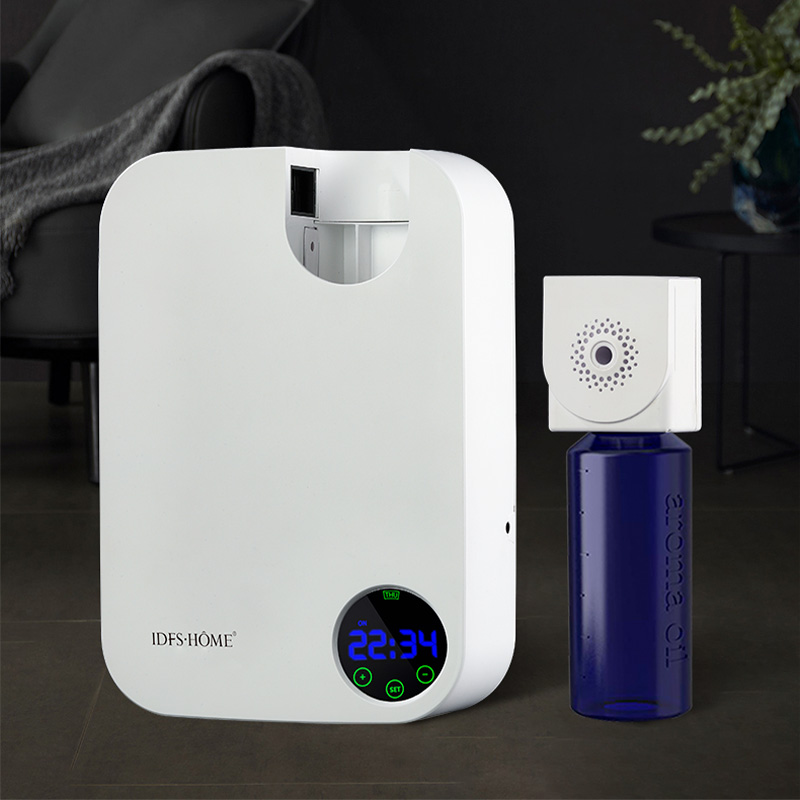
Not every environment supports or requires duct integration. Standalone units excel in specific use cases, such as open-plan retail floors without accessible ductwork, high-traffic lobbies, or facilities requiring distinct scent zones in adjacent rooms. The success of a standalone unit depends entirely on strategic placement.
Hardware must be positioned to leverage natural air currents. Technicians typically place them near entryways or supply vents where incoming air can catch the nano-mist and carry it into the center of the room. Placing a unit directly beneath a return-air vent is a common installation error. The return vent will immediately suck the fragrance out of the space, trapping the oil in the HVAC filter before it can circulate.
For whole-home applications or large square footage, injecting the nano-mist directly into the HVAC system is the most efficient distribution method. The building's air handler acts as the primary distribution vehicle, carrying the dry mist through the duct network and pushing it out of every supply register simultaneously. This guarantees that every room tied to that air handler receives the exact same concentration of fragrance.
Multi-zone setups expand on this concept. Large properties often utilize multiple air handlers to manage different wings or floors. By equipping each air handler with its own distinct unit, property managers can customize the olfactory experience by department. You can maintain a relaxing lavender profile in living areas or lounges while deploying an energizing citrus blend in fitness centers or workspaces.
HVAC integration introduces a specific mechanical risk: duct saturation. If the scent unit disperses oil while the air handler is turned off, the mist has nowhere to go. It will eventually settle inside the ductwork, wasting oil and creating a localized mess. To prevent this, professional installations utilize air flow sensors, commonly known as air switches.
These pressure-sensitive switches tap into the ductwork using a small pitot tube to monitor static pressure. The scent unit only receives power and begins atomization when the air switch detects that the HVAC fan is actively running. This synchronization prevents wasted consumables, eliminates the risk of oil pooling inside dormant ducts, and ensures fragrance is only released when there is active airflow to carry it.
Manual dials and basic timers lack the precision needed for environmental control. Modern hardware relies on Wi-Fi and Bluetooth connectivity to allow granular, app-based adjustments. Users configure specific work and pause intervals to match the exact airflow dynamics of the room. For example, a high-CFM environment might require 60 seconds of active diffusion followed by 60 seconds of rest, while a smaller room might only need 20 seconds of work and 120 seconds of rest.
Day-parting capabilities allow the system to adjust intensity based on daily routines or foot traffic peaks. A unit can run at a higher output during busy morning hours when doors are constantly opening, and scale back during low-traffic afternoons. Real-time remote monitoring provides facility managers with the ability to adjust settings across multi-location businesses without requiring on-site intervention.
Maintaining a consistent environment requires uninterrupted operation, which ties directly to consumable management. Calculating fragrance oil consumption requires evaluating the machine's output setting (measured in milliliters per hour), the daily operating hours, and the bottle capacity. Balancing high-intensity output against the physical capacity of the reservoir ensures the system does not run dry between scheduled maintenance intervals.
For example, if a commercial scent machine consumes 1.5ml of oil per hour of active diffusion, and runs for 10 hours a day, it uses 15ml daily. A standard 500ml bottle will last approximately 33 days under these exact conditions. Knowing this formula allows technicians to set accurate refill schedules, preventing the dead zones that occur when a machine runs empty.
Hardware and consumable safety dictate operational viability. Professional equipment must carry standard electrical certifications (CE, FCC) to ensure safe continuous operation. The fragrance oils themselves must comply with International Fragrance Association (IFRA) standards, ensuring they are free from harmful phthalates, heavy metals, and known allergens.
Proper atomization size directly mitigates the risk of HVAC duct residue. Because the cold-air diffusion process shears the oil into particles smaller than 1 micron, the mist behaves as a gas. It easily navigates sharp 90-degree duct bends and passes through metal registers without condensing on the sheet metal. If the particle size were larger, centrifugal force would cause the oil droplets to smash into the duct walls at every turn.
Successful HVAC integration requires specific site conditions. The installation point must be located on the supply side of the ductwork, strictly downstream from the air handler's fan and the primary air filter. Injecting scent before the filter is a catastrophic error. The filter media will trap 100% of the fragrance particles, destroying the filter's airflow capacity and wasting the oil. The unit also requires proximity to a standard electrical outlet, usually within six feet of the injection point.
Commercial variable air volume (VAV) systems present distinct roadblocks. VAV boxes constantly adjust airflow based on localized temperature demands. If a room reaches its target temperature, the VAV box closes the damper, shutting off airflow to that specific room. If the scent is injected at the main air handler, a closed VAV box means that room gets no scent, disrupting uniform distribution. In contrast, standard residential split systems or constant volume commercial systems provide predictable air currents, making them ideal candidates for seamless integration.
The most common cause of inconsistent scenting is neglected maintenance. Cold-air diffusion nozzles handle highly concentrated, viscous oils. Over time, these oils leave microscopic residues that restrict the atomizer's airflow. When the nozzle clogs, the machine's output drops drastically, leading to uneven coverage and eventual hardware failure.
Strict maintenance protocols prevent this degradation. Technicians must periodically flush the system by replacing the fragrance oil with a cleaning solvent, typically 90% isopropyl alcohol, and running the machine for 15 to 20 minutes. This dissolves blockages in the dip tube and clears the Venturi nozzle, restoring the unit to factory output levels. Routine cleaning is the only way to guarantee long-term operational consistency.
| Symptom | Likely Cause | Field Solution |
|---|---|---|
| Drastic drop in scent output | Clogged Venturi nozzle | Run 90% isopropyl alcohol through the unit for 15 minutes. |
| Pump runs, but no mist appears | Cracked or missing O-ring | Inspect and replace the silicone O-ring sealing the bottle to the nozzle head. |
| Scent fades after 30 minutes | Olfactory fatigue | Increase the pause interval on the duty cycle to allow receptors to reset. |
| Machine fails to turn on with HVAC | Air switch failure or disconnected pitot tube | Check the pressure tubing for kinks and verify the switch contacts are closing. |
A consistent scent environment is never achieved by simply purchasing a stronger fragrance. It requires matching cold-air diffusion technology to the specific airflow and square footage of the space. Relying on sub-micron atomization ensures the fragrance remains suspended, while smart controls and interval dosing prevent olfactory fatigue from ruining the experience. Standalone units provide the best control for targeted zones under 2,000 square feet where duct access is restricted. Smart HVAC-integrated systems are the mandatory choice for multi-zone, whole-home, or large-scale commercial environments requiring invisible, uniform coverage.
To move forward with a professional scenting strategy, execute the following steps:
A: It uses an internal compressor to generate high-velocity pressurized air, forcing raw fragrance oil through a microscopic nozzle. This process, known as nebulization, shears the oil into a dry nano-mist. The particles are lighter than air, allowing them to suspend and travel naturally with ambient air currents without leaving wet residue on surfaces.
A: Yes. Standard residential split systems are highly compatible. The machine is mounted near the air handler, and a flexible PTFE tube injects the nano-mist directly into the supply plenum. An air switch ensures the unit only runs when the HVAC fan is actively operating.
A: No, provided it uses true cold-air diffusion and is installed correctly. Because the particles are under 1 micron, they behave like a dry vapor and do not condense on sheet metal. Proper installation requires placing the injection tube downstream from the air filter to prevent clogging the media.
A: Sizing is based on cubic footage and airflow, not just square footage. You must account for ceiling height and HVAC CFM output. Manufacturers rate machines by maximum coverage area. Always select a unit with a capacity slightly larger than your space to avoid running the compressor at maximum output constantly.
A: This is olfactory fatigue. Your brain naturally tunes out constant smells to detect new environmental changes. To fix this, adjust the machine's duty cycle to pulse the scent (e.g., 30 seconds on, 60 seconds off). This allows the concentration to drop slightly, resetting your olfactory receptors.
A: The atomizer nozzle must be cleaned every 30 to 60 days, or whenever you change fragrance profiles. Fill an empty bottle with 90% isopropyl alcohol and run the machine for 15 to 20 minutes. This clears oil buildup, prevents clogs, and maintains consistent output.


