
Views: 0 Author: Site Editor Publish Time: 2026-09-10 Origin: Site


Determining the exact number of scenting units for a large facility often begins with a critical operational failure. Facility managers frequently purchase equipment based on sheer guesswork, relying on basic square footage metrics. This approach inevitably creates dead zones, overwhelming fragrance pockets, or wasted resources. Relying solely on manufacturer floor space claims is a deeply flawed metric for large environments because it ignores the physical reality of the space.
Under-scenting delivers zero return on your scent marketing efforts. Over-scenting alienates customers and generates employee complaints. You need a technical, evidence-based framework to calculate exact unit requirements. This calculation must evaluate cubic volume, HVAC integration, and airflow dynamics. It also requires understanding specific diffusion technologies and fragrance composition. We will map these variables accurately so you can deploy the correct volume of equipment for consistent, ambient scenting.
Cubic Volume Over Square Footage: Ceiling height and architectural layout dictate scent dispersion; calculations must be based on cubic feet, not just floor space.
HVAC vs. Standalone Efficiency: A single HVAC-integrated commercial aroma diffuser can often replace 3 to 5 standalone units, significantly reducing maintenance overhead and hardware costs.
Airflow is the Ultimate Variable: Air Changes per Hour (ACH) and HVAC return/supply vent placements drastically alter how many units are required to maintain a consistent scent profile.
Fragrance Weight Matters: The molecular weight of the chosen scent (e.g., light citrus vs. heavy woods) directly impacts dissipation rates and, consequently, the number of units needed.
Strategic Zoning Prevents "Scent Walls": Proper deployment requires mapping physical obstructions and transition zones rather than evenly spacing units on a grid.
Standard consumer metrics fail completely in large-scale applications. Manufacturers often test coverage in empty, sealed rooms. These test environments typically feature standard eight-foot ceilings. They lack active ventilation systems. Real-world facilities operate under entirely different physical conditions. Active foot traffic disrupts air patterns. Open doors introduce outside drafts. Complex ventilation systems constantly scrub the air.
The mathematical reality heavily favors cubic volume over square footage. Consider a 5,000 square foot lobby. If this lobby features a standard 10-foot ceiling, you are scenting 50,000 cubic feet of air. Now consider a 5,000 square foot atrium. This space features a 30-foot ceiling. You must now scent 150,000 cubic feet of air. The floor space remains identical. The air mass triples. Using square footage as your primary metric guarantees under-performance in high-ceiling environments. You will end up with a faint, barely noticeable fragrance that fails to impact the visitor experience.
Commercial scenting relies on cold-air diffusion technology. This process uses sub-micron nebulization. It forces high-velocity air across a small tube of essential oil, creating a venturi effect that breaks the liquid into microscopic dry mist particles. These particles are typically under one micron in diameter. Because they are so small, they behave more like a gas than a liquid. They suspend themselves in the air. They do not fall to the floor or leave an oily residue on surfaces. They travel on ambient air currents. Therefore, your calculation depends entirely on total air mass. You must measure the three-dimensional space to determine equipment needs accurately.
Space Type | Floor Area (Sq. Ft.) | Ceiling Height (Ft.) | Total Air Mass (Cubic Ft.) | Scenting Requirement |
|---|---|---|---|---|
Standard Office | 2,000 | 9 | 18,000 | Low Output |
Retail Showroom | 2,000 | 15 | 30,000 | Medium Output |
Hotel Atrium | 2,000 | 40 | 80,000 | High Output / Multiple Units |
Selecting the right hardware dictates your total unit count. Different technologies serve distinct volumetric needs. You must match the equipment type to the architectural reality of your building. Deploying the wrong type of machine leads to uneven coverage and excessive maintenance hours.
These systems tap directly into your central air supply. A single Commercial Aroma Diffuser provides whole-building consistency. They excel in spaces exceeding 5,000 square feet. The HVAC fan distributes the sub-micron particles evenly throughout the ductwork. This eliminates localized heavy spots. It requires professional installation. You need physical access to the main supply ducts. You must drill a small access hole into the sheet metal and insert a Teflon delivery tube. However, it offers the lowest ongoing maintenance burden. One central unit replaces multiple localized machines. You only have to check and refill one central reservoir.
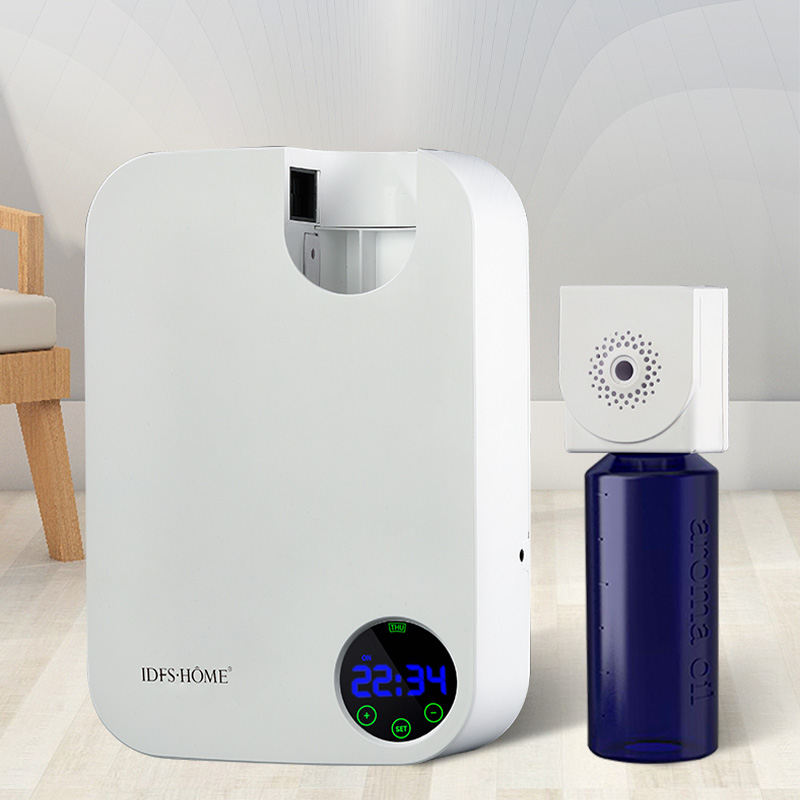
Standalone units operate independently of central air systems. A large area aroma diffuser is ideal for historic buildings lacking ductwork. They work well for specific localized zones. You might use them to scent a distinct retail section within a larger store. You will need multiple units for expansive spaces. This multiplies your refill labor. It also creates potential scent inconsistencies if units are not properly spaced. They require strategic placement near return vents to maximize circulation. They utilize internal fans to push the dry mist into the ambient environment.
These units provide highly directional scenting. They attach directly to walls or existing lighting tracks. Facility managers use them for long corridors. They work well in elevator banks or transition areas. Their cubic coverage per unit remains limited. They depend heavily on localized drafts to move the fragrance. You will need a higher density of these units to cover a large footprint. They serve best as supplementary devices rather than primary scenting engines. They are excellent for filling in architectural blind spots where central air fails to reach.
Deploying multiple standalone units requires synchronization. Smart ecosystems connect devices via Wi-Fi or Bluetooth. Facility managers can control intensity across the entire fleet from a single dashboard. They can set precise operating schedules. This prevents overlapping scent clouds. It ensures units only operate during business hours, conserving fragrance oil. IoT control is essential when managing more than three independent machines in a single facility. It allows you to adjust the output of individual machines based on real-time foot traffic patterns.

You cannot guess your way to perfect ambient scenting. Follow this systematic engineering approach. It ensures you deploy the exact number of units required for your specific architecture. Skipping any of these steps will result in uneven coverage.
Start with the fundamental formula. Multiply length by width by height. This gives you your total cubic volume. Large buildings rarely feature uniform ceilings. You must segment an irregular building into distinct volumetric zones. Calculate the lobby separately from the adjoining corridors. Calculate the retail floor separately from the warehouse transition zone. Add these zonal calculations together. This provides a realistic baseline for your total air mass. Do not rely on the square footage listed on your lease agreement.
Air Changes per Hour (ACH) measures how often HVAC systems replace indoor air. High ACH environments scrub the air rapidly. Fitness centers and medical facilities often feature high ACH rates. This constant filtration removes scent particles quickly. You will require higher output diffusers in these environments. Alternatively, you must deploy more units to replenish the scent actively. You must also account for drafts. Positive or negative pressure near main entrances pulls scent outdoors. Loading docks create similar vacuum effects. Place units strategically to counteract these pressure zones.
Fragrance oil is not a uniform variable. The molecular weight of your chosen scent alters your equipment needs. Top-heavy notes consist of small, volatile molecules. Citrus, mint, and eucalyptus fall into this category. They dissipate rapidly in large spaces. You may require a higher unit density to maintain a citrus profile. Base-heavy notes consist of larger, heavier molecules. Amber, leather, and deep woods linger significantly longer. They require fewer units to maintain a consistent presence. Adjust your unit count based on your specific fragrance family.
Define your operational outcome. Ambient scenting aims for a subtle, background presence. It requires fewer units running at lower intensity settings. Immersive scenting aims to define the brand experience aggressively. It requires a higher density of units. Masking scenting aims to neutralize existing malodors. This also demands higher output. Map your desired intensity before finalizing your hardware count. Lower intensity goals allow you to stretch the coverage area of a single machine.
Sub-micron scent particles travel on air currents. Physical barriers stop air currents. Walls, heavy drapery, and segmented rooms block fragrance distribution. You cannot push scent through a closed door. Outline your floor plan carefully. Identify structural blind spots. You will need localized "repeater" units in these isolated zones. Do not expect a single central unit to navigate complex, labyrinthine floor plans. Map your transition zones to ensure a seamless olfactory experience.
Applying the technical framework reveals how different environments demand unique hardware configurations. Let us examine three distinct commercial scenarios to understand how unit counts shift based on architectural realities.
Hotel lobbies present massive volumetric challenges. They feature soaring ceilings, expansive open floor plans, and constant door activity. A hybrid approach serves as the industry standard here. You deploy one main HVAC-integrated unit to establish an ambient base note throughout the space. You then add one standalone large area diffusers near the main entrance. This standalone unit creates a localized peak intensity. It hits guests immediately upon arrival, creating a strong first impression. The central HVAC unit maintains the background scent. This hybrid method ensures deep penetration without overworking a single machine.
Retail showrooms often feature distinct departments separated by partial walls and heavy merchandise displays. Central HVAC integration might seem ideal. However, segmented ductwork can cause uneven distribution. You must evaluate deploying four strategically placed standalone units instead. This allows you to zone the fragrance. You can adjust intensity for specific departments. The primary risk involves creating localized "scent walls." You must keep standalone units away from direct foot traffic. Position them near return air vents to encourage natural circulation. A commercial aromatherapy diffuser placed in a corner will utilize the room's natural air currents to fill the space evenly.
Gyms require aggressive odor neutralization. Their HVAC systems run constantly to manage humidity and body heat. The ACH rate is exceptionally high. Standard retail calculations fail here. The rapid air turnover strips fragrance from the environment in minutes. You must combat active odors and high ventilation rates simultaneously. This typically requires a 20 to 30 percent increase in unit density. You need high-capacity machines capable of continuous, heavy output. Placement near cardio zones requires careful calibration to avoid overwhelming breathing patrons. You want to neutralize the air, not choke the members with heavy perfume.
Deploying commercial scenting equipment involves inherent operational risks. Poor planning leads to maintenance nightmares and compromised air quality. You must anticipate these challenges before installation to ensure a smooth rollout.
Deploying numerous standalone units creates a massive maintenance burden. Refilling ten individual bottles monthly consumes significant labor hours. It disrupts facility operations and requires staff to climb ladders or interrupt customer experiences. Centralizing your system mitigates this risk. Two high-capacity HVAC units require a fraction of the refill time. If you must use standalone units, select models with large reservoir capacities. A 1000ml bottle extends your maintenance cycle significantly compared to a 500ml bottle. Plan your deployment around the labor required to maintain it.
Improper placement creates olfactory fatigue. Placing high-output units directly next to seating areas blasts customers with concentrated fragrance. Placing them immediately inside a low-ceiling entryway creates an overwhelming "scent wall." This generates immediate complaints and forces people to leave the area. You must utilize natural airflow. Position your equipment near HVAC return vents. The system will naturally pull the sub-micron particles and distribute them gently. Keep units at least ten feet away from prolonged stationary customer zones.
Tapping into ductwork requires technical precision. Improper installation damages your HVAC system. Installing the diffuser nozzle before the MERV filters is a critical error. The filters will strip the scent particles from the air immediately. The oil will clog the filter media rapidly. This strains the blower motor, restricts airflow, and voids equipment warranties. You must tap into the supply duct post-fan and post-filter. The nozzle must point in the direction of the airflow. Consult with a licensed HVAC technician before drilling into any ductwork to ensure you maintain static pressure integrity.
Multiple standalone units disrupt interior design. Visible hardware, power cords, and flashing LED lights ruin carefully curated aesthetics. You must integrate the equipment seamlessly. Utilize track-lighting adapters to elevate units out of sight. Employ wall-mounting brackets in discreet corners. Hide units within custom millwork or decorative planters. Ensure the output nozzle remains unobstructed. Concealing the hardware preserves the architectural integrity of your space while delivering the desired ambient experience.
Secure your architectural floor plans and calculate the exact cubic volume for each distinct zone within your facility.
Schedule a site survey with your HVAC technician to verify ductwork accessibility and identify safe post-filter injection points.
Map all high-airflow areas, including main entrances and loading docks, to determine where supplementary standalone units are necessary.
Request a professional volumetric calculation from a commercial scenting provider before finalizing any hardware deployment.
A: Manufacturers often claim coverage between 1,000 and 5,000 square feet. However, the true metric is cubic feet. Actual coverage depends heavily on your ceiling height, architectural layout, and ambient airflow. A unit covering 3,000 square feet with an 8-foot ceiling will cover significantly less floor space in a room with a 20-foot ceiling.
A: One large HVAC diffuser is generally better for spaces over 5,000 square feet. It provides seamless, even coverage and drastically reduces maintenance labor. You only refill one central reservoir. Multiple standalone units are better for segmented rooms, historic buildings without ductwork, or highly localized scent zoning.
A: Yes. Lighter citrus, mint, or floral notes have smaller molecular weights and dissipate much faster. You may require higher output settings or additional units to maintain their intensity. Heavy woody, amber, or leather notes linger longer in the air, often requiring fewer units to maintain a consistent presence.
A: IFRA-compliant cold-air diffusion uses pure oils and leaves no residue. It creates sub-micron particles that suspend in the air without introducing heavy allergens or volatile organic compounds typical of aerosol sprays. When properly calibrated, they are highly safe for commercial environments.
A: High ceilings drastically increase the total air mass. A 20-foot ceiling doubles the cubic volume of a standard room compared to a 10-foot ceiling. This effectively halves the square-foot coverage capability of a single unit. You must size your equipment based on this expanded cubic volume.
A: Position standalone units near HVAC return vents to aid natural circulation. Keep them away from open doors, exhaust fans, and loading docks. Never place them in direct, prolonged proximity to stationary customers or employee desks to prevent olfactory fatigue and localized scent walls.
A: Refill frequency depends on the unit's bottle capacity, usually 500ml or 1000ml. It also depends on the intensity setting, the total number of units deployed, and your daily operating hours. A properly calibrated 1000ml system typically requires maintenance only once every 30 to 45 days.


