
Views: 0 Author: Site Editor Publish Time: 2026-09-03 Origin: Site


The initial purchase of a scenting device is just the beginning. The real ongoing requirement lies in the daily consumption of essential or fragrance oils. Users frequently over-saturate their water tanks or nebulizer reservoirs. This leads to wasted oil, inflated monthly operating requirements, and potential respiratory irritation. Conversely, under-dosing fails to achieve the desired ambient scenting, leaving rooms smelling flat.
Establishing a predictable daily consumption rate requires understanding the mathematical relationship between diffuser technology, device capacity, and operational frequency. Water-based ultrasonic models and waterless nebulizing systems draw oil at vastly different rates. This guide provides a clear framework to calculate exact daily usage, evaluate the ongoing consumable requirements of different diffusion systems, and maximize the lifespan of your essential oil inventory without compromising scent quality.
Standard Measurement Baseline: A standard 15ml bottle of essential oil contains approximately 300 drops. Average daily consumption ranges from 0.25ml (5 drops) for light use to 2.5ml (50 drops) for continuous, heavy use.
Technology Dictates Consumption: Water-based ultrasonic models consume significantly less oil per hour than waterless nebulizing systems, though nebulizers offer higher scent concentration and efficiency in larger spaces.
Cost-to-Outcome Ratio: Optimizing oil usage depends on matching the device output to room square footage; using a mini tabletop diffuser in a large living room results in wasted oil due to rapid dissipation.
Safety and Saturation Limits: Essential oils are highly concentrated. Exceeding recommended daily drop counts does not linearly increase scent throw; it primarily accelerates olfactory fatigue, wastes product, and increases the risk of sensitization.
Calculating accurate oil consumption starts with establishing a standard measurement baseline. In the aromatherapy industry, the accepted conversion rate is approximately 20 drops per 1 milliliter (ml) of essential oil. This metric allows you to translate bottle volume into practical daily applications. Viscosity alters this conversion slightly. Thicker base notes like vetiver or patchouli yield larger, heavier drops, meaning you might only get 15 drops per ml. Highly volatile, thin top notes like sweet orange or lemon dispense smaller drops, occasionally pushing the count to 22 drops per ml. Using the 20-drop standard provides a reliable average for mixed blends and daily calculations.
The type of dispenser also impacts drop size. Standard orifice reducers built into retail bottles deliver relatively consistent drops. Glass pipettes draw larger volumes and create heavier drops. When auditing your daily usage, stick to the built-in orifice reducer to maintain a consistent baseline for your calculations.
The amount of oil required per session depends entirely on the water reservoir capacity of your specific unit. The standard baseline dictates adding 3 to 5 drops of essential oil per 100ml of water. If you operate a compact 100ml device, a single session consumes roughly 0.15ml to 0.25ml of oil. Scaling up to a standard 200ml ultrasonic device requires 6 to 9 drops per fill to maintain the correct water-to-oil ratio.
Pushing beyond these ratios does not improve the scent profile. It leaves an oily residue on the ultrasonic plate, dampens the mist output, and wastes valuable plant extracts. Over-saturating the water tank forces the ultrasonic disc to work harder to agitate the heavy liquid, which can prematurely burn out the internal motor.
Determining your exact daily consumption requires a simple formula. Tracking this metric allows you to forecast exactly when you will need to replenish your inventory. Follow these steps to calculate your daily draw:
Count the exact number of drops you add to the reservoir for a single session.
Multiply that number by the total number of sessions you run in a 24-hour period.
Divide the resulting total by 20 (the standard drops-per-ml conversion rate).
Record the final number as your daily milliliter usage.
For example, if you fill a 200ml tank twice a day using 8 drops per fill, your calculation is 16 drops divided by 20. This equals a daily consumption rate of 0.8ml. If you run a waterless system, the device interface usually dictates the ml-per-hour consumption rate based on the intensity setting, allowing you to skip the drop calculation entirely.
Mapping daily consumption to real-world timelines illustrates how quickly different usage habits deplete standard inventory sizes. A 15ml bottle holds roughly 300 drops. If you maintain a conservative usage rate of 10 drops per day, that single bottle will last exactly 30 days. If you run multiple devices or prefer continuous, heavy diffusion requiring 50 drops per day, that same 15ml bottle will run dry in just six days.
Understanding this timeline prevents unexpected shortages and helps you manage your consumable inventory efficiently. The table below outlines expected bottle lifespans based on varying daily drop counts.
Daily Usage (Drops) | Daily Volume (ml) | 15ml Bottle Lifespan | 30ml Bottle Lifespan | 100ml Bulk Lifespan |
|---|---|---|---|---|
5 drops | 0.25 ml | 60 Days | 120 Days | 400 Days |
10 drops | 0.50 ml | 30 Days | 60 Days | 200 Days |
20 drops | 1.00 ml | 15 Days | 30 Days | 100 Days |
30 drops | 1.50 ml | 10 Days | 20 Days | 66 Days |
50 drops | 2.50 ml | 6 Days | 12 Days | 40 Days |
The physical size of the water tank directly correlates with how much oil you must use to achieve proper scent dispersion. A compact 100ml unit requires only 3 to 5 drops to reach the optimal saturation point. A larger 500ml device demands 15 to 25 drops per fill to achieve the exact same scent intensity. Extreme large-capacity commercial reservoirs can require upwards of 200 drops per fill. Users often mistakenly buy oversized units for small rooms, forcing them to use 20 drops of oil just to balance the water ratio, resulting in massive product waste.
Session duration also heavily influences daily draw. Running a device for targeted 10 to 20-minute bursts is far more efficient for scent perception than running it continuously until the tank is bone dry. The human olfactory system adapts quickly to ambient smells. Continuous operation wastes oil because you stop noticing the scent after the first half-hour. Utilizing intermittent settings, such as 30 seconds on and 30 seconds off, effectively halves your daily oil consumption while maintaining a consistent ambient scent profile throughout the room.
Oil volume must map directly to the square footage and ceiling height of the target environment. A standard 150-square-foot bedroom with 8-foot ceilings requires no more than 5 drops of oil to achieve full coverage. Attempting to scent a 500-square-foot open-concept living space with vaulted ceilings requires 15 to 20 drops. If you place a low-output device in a massive room, the mist dissipates before reaching the walls. Users typically respond by dumping more oil into the tank, which fails to solve the coverage issue and only accelerates product depletion.
High-airflow environments force users to increase daily oil consumption to compensate for rapid scent dispersion. Rooms with active ceiling fans, open windows, or aggressive HVAC return vents pull the aromatic molecules out of the air almost immediately. If your device sits directly beneath an air conditioning vent, the mist gets sucked into the ductwork before it can settle in the room. Relocating the unit away from drafts allows the scent to linger naturally, reducing the need for constant re-application.
Room Size (Sq. Ft.) | Environment Type | Recommended Drops (Ultrasonic) | Expected Scent Duration |
|---|---|---|---|
Under 150 | Bathroom / Small Office | 3 - 5 drops | 2 - 4 hours |
150 - 300 | Standard Bedroom | 5 - 8 drops | 3 - 5 hours |
300 - 500 | Living Room / Kitchen | 10 - 15 drops | 4 - 6 hours |
500+ | Open Concept / Vaulted | 15 - 25 drops | Requires multiple units |
The physical properties of the oil itself dictate how often you need to replenish the tank. Heavier base notes like sandalwood, cedarwood, and frankincense dispense larger drops and contain dense molecules that linger in the air for hours. This longevity reduces the need for frequent re-application. Highly volatile top notes like grapefruit, bergamot, and eucalyptus evaporate rapidly. While they provide an immediate, intense burst of fragrance, they fade quickly, prompting users to run more cycles and consume more oil daily.
Quality and dilution factors play a massive role in consumption rates. Cheaper, pre-diluted oils mixed with carrier liquids like fractionated coconut oil or synthetic solvents require significantly higher daily volumes to achieve the same olfactory impact as pure essential oils. You might need 15 drops of a diluted blend to match the scent throw of 4 drops of a pure isolate. Investing in high-quality, undiluted extracts ultimately lowers your daily milliliter usage and extends the lifespan of your inventory.
Dirty equipment consumes more oil to produce less scent. Ultrasonic plates accumulate a thin layer of mineral scale from tap water and sticky resin from heavy essential oils. This buildup acts as an insulator, dampening the ultrasonic vibrations. When the vibration weakens, the device produces a thinner mist plume that fails to carry the oil molecules into the room.
Users often misinterpret this weak output as a lack of oil and add an extra 5 to 10 drops to the tank. This only compounds the problem by adding more resin to the dirty plate. Cleaning the reservoir and wiping the ceramic disc with rubbing alcohol once a week restores the vibration intensity. A clean unit requires fewer drops to achieve maximum scent dispersion, directly lowering your daily consumption rate.
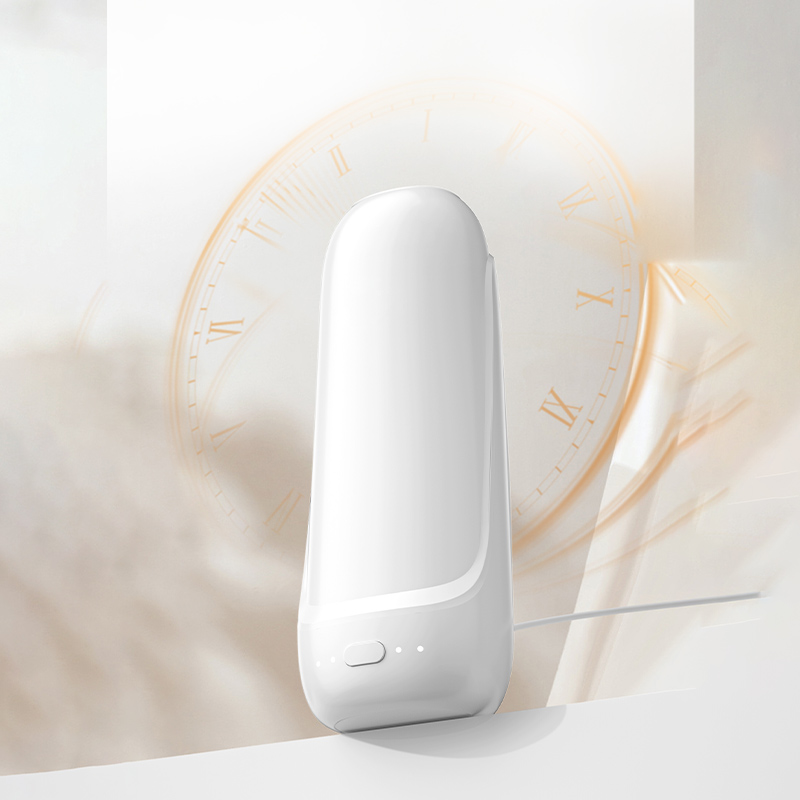
Ultrasonic technology relies on a vibrating ceramic plate to break water and oil into a fine mist. A mini tabletop diffuser represents the most oil-efficient category available. These compact units are ideal for localized scenting on desks, nightstands, or bathroom counters. Because they utilize small water reservoirs, they require minimal oil to achieve proper saturation.
The typical consumption rate for these devices hovers between 0.15ml and 0.45ml per day, assuming one to two daily cycles. This translates to just 3 to 9 drops. The primary trade-off is coverage limitation. While highly efficient, they are physically incapable of scaling to open-concept living spaces. Attempting to use a compact ultrasonic unit in a large room leads to frustration and wasted oil as the user continuously runs the device trying to achieve impossible coverage.
Nebulizing systems operate without water or heat. They use pressurized air and the Bernoulli principle to atomize pure essential oil directly from the bottle into micro-particles. A waterless aromatherapy diffuser is required for therapeutic-grade saturation and large-room coverage without altering indoor humidity levels. Because they do not dilute the oil, the scent profile remains incredibly potent and true to the raw botanical extract.
This technology consumes pure oil directly from the source bottle, leading to a much higher consumption rate. Depending on the intensity setting, a nebulizer can use 1ml to 3ml per day. This equates to 20 to 60 drops daily. The trade-off is the highest daily running requirement among standalone units. Operating a nebulizer requires strict adherence to built-in interval timers to prevent massive oil waste. Leaving a nebulizer running continuously on a high setting can drain a 15ml bottle in a matter of days.
HVAC scent systems integrate directly into a building's ductwork, utilizing cold-air diffusion technology to distribute nano-particles evenly throughout the entire floor plan. These systems are designed for whole-home scenting and operate on a completely different scale than standalone room units. They provide the most consistent, invisible ambient scenting available.
Consumption for HVAC systems is measured in monthly milliliters rather than daily drops. A typical residential system might consume 100ml to 500ml per month, which equates to roughly 3ml to 16ml per day. While this represents high bulk-oil consumption, it offers the most consistent volume-to-square-foot efficiency for massive spaces. Operating these systems requires sourcing oils in large aluminum canisters rather than standard retail glass bottles to maintain a practical refill schedule.
Understanding your daily consumption allows you to accurately project your monthly operating volume. Walk through a simple projection model: determine your volume per milliliter, multiply it by your daily milliliter usage, and multiply that by 30 days. If your daily usage is 1ml, your monthly operating requirement equals two 15ml bottles. This framework highlights exactly how much your ambient scenting habit demands each month.
Evaluating bulk purchasing logic becomes critical once your daily consumption crosses the 1ml threshold. If you run multiple ultrasonic units or a single nebulizing system daily, relying on 15ml retail bottles is highly inefficient. Transitioning to 100ml or 500ml bulk aluminum canisters drastically reduces the frequency of reordering. Users operating waterless systems should exclusively source bulk oils to maintain a reasonable monthly operating volume.
A single drop of essential oil represents pounds of raw plant matter. This extreme concentration factor means that 5 to 7 drops per diffusion cycle is generally the absolute maximum required for standard residential rooms. Adding 20 drops to a small ultrasonic tank does not make the room smell better; it creates an overwhelming, heavy atmosphere that can trigger headaches and respiratory irritation. A home aroma diffuser is designed to provide subtle background ambiance, not to aggressively saturate the environment.
Olfactory fatigue is a biological mechanism where the nose stops registering a scent after 15 to 30 minutes of continuous exposure. The scent molecules are still present in the air, but your brain tunes them out to prevent sensory overload. Users frequently mistake this fatigue for a weak output. They mistakenly add more oil to the tank, wasting product and creating a toxic concentration of volatile organic compounds in the room.
Address user confusion regarding operational frequency. A device does not need to run continuously from morning until night. Evaluating whether a unit should be run daily or limited to a few times a week depends on the occupants. Allowing the olfactory system to rest prevents sensitization. Running a device for 30 minutes, turning it off for an hour, and repeating the cycle provides excellent ambient scenting while drastically cutting daily oil consumption.
Exceeding daily diffusion limits carries distinct safety risks, particularly in homes with pets and small children. Cats, for example, lack specific liver enzymes required to process certain phenols and terpenes found in citrus, pine, and eucalyptus oils. Heavy, continuous diffusion allows these compounds to settle on fur, leading to ingestion during grooming. Outlining strict saturation limits protects vulnerable occupants from accidental toxicity.
The most effective mitigation strategy is adopting a "less is more" protocol. Start with half the recommended drops. Utilize interval timers built into the device to maximize scent perception while minimizing the physical oil draw. If you cannot smell the oil after 20 minutes, step outside for fresh air to reset your olfactory receptors before deciding to add more drops to the reservoir.
Audit your current daily usage by logging the exact start and end dates of your next 15ml bottle.
Program your device to run on intermittent intervals (e.g., 30 seconds on, 30 seconds off) to reduce daily oil draw and prevent olfactory fatigue.
Relocate your unit away from HVAC return vents, ceiling fans, and direct sunlight to maximize scent hang time and reduce re-application frequency.
Clean the reservoir and misting plate weekly with rubbing alcohol to ensure maximum output efficiency from your oil drops.
A: A standard 100ml water tank requires 3 to 5 drops of essential oil for optimal scent dispersion. A larger 200ml tank requires 6 to 9 drops to maintain the correct water-to-oil ratio. Exceeding these amounts wastes oil and leaves a heavy residue on the ultrasonic plate.
A: A 15ml bottle contains approximately 300 drops. If you use 10 drops per day, the bottle will last 30 days. If you run multiple devices or use a heavy setting requiring 30 drops daily, the bottle will be empty in exactly 10 days.
A: Using a device 2 to 3 times a week is optimal for preventing olfactory fatigue and sensitization. If you choose to run it daily, limit active diffusion to 30-minute intervals followed by 60 minutes of rest to allow the air to clear.
A: Yes, daily use is safe if you adhere to strict time limits and proper dilution ratios. Continuous, all-day diffusion is not recommended as it increases the risk of respiratory irritation and exposes pets to high concentrations of volatile organic compounds.
A: You are likely running the device on a continuous setting rather than an intermittent timer. Additionally, placing the unit near an air vent causes the scent to dissipate rapidly, prompting you to add more oil. Switch to interval modes to conserve product.
A: Yes. Waterless nebulizing systems pull pure essential oil directly from the bottle without diluting it in water. They can consume 1ml to 3ml of oil per day, whereas ultrasonic models typically use less than 0.5ml daily.
A: Limiting use to 3 or 4 days a week helps maintain your sensitivity to the scent. On active days, strictly use intermittent timers. If you stop noticing the smell, turn the unit off rather than adding more drops to the reservoir.


