
Views: 0 Author: Site Editor Publish Time: 2026-07-17 Origin: Site


The most common point of failure in aromatherapy implementation is incorrect oil-to-water ratios, leading to either undetectable scent throw or rapid device degradation. Users and commercial operators frequently guess how many drops to use, resulting in wasted expensive oils, clogged ultrasonic plates, and compromised indoor air quality. First-time users often struggle with basic setup order and dosage mechanics, pouring liquids haphazardly and wondering why the output falls flat. Establishing a baseline drop count requires evaluating your specific device capacity, the diffusion technology in use, and the physical properties of the oils. This guide breaks down the technical variables to help you optimize consumption and protect your hardware investment. We will examine the exact mechanics of water-based dispersion, the impact of fluid viscosity on transducer plates, and the mathematical scaling required for larger reservoirs.
The established baseline for water-based diffusion is 3 to 5 drops of oil per 100ml of water. This standard balances noticeable scent throw with safe inhalation levels while protecting the internal components of your essential oil diffuser. When you use fewer than 3 drops in a 100ml unit, the scent profile becomes virtually undetectable. The minimal amount of oil disperses too thinly across the water's surface, and the resulting vapor lacks the concentration needed to register in the human olfactory system.
Conversely, pushing the dosage to 5–10 drops per 100ml creates a robust, high-intensity dose. You should reserve this higher concentration strictly for larger rooms with excellent ventilation. Exceeding 10 drops in a standard 100ml reservoir forces the oil to pool heavily on the surface. Because essential oils are hydrophobic, they do not mix with water. A thick layer of oil creates a physical barrier that the ultrasonic transducer struggles to penetrate, causing the device to overheat and eventually fail.
As reservoir sizes increase, you must scale your drop count proportionally. Failing to adjust the ratio results in weak mist output or wasted product. A larger tank dilutes the oil further, requiring a higher total drop count to maintain the same parts-per-million concentration in the vapor.
| Reservoir Capacity | Subtle/Therapeutic Dose | High-Intensity Dose | Primary Use Case |
|---|---|---|---|
| 100ml | 3 - 5 drops | 6 - 8 drops | Bathrooms, small offices, bedside tables. |
| 200ml | 6 - 10 drops | 11 - 15 drops | Standard bedrooms, closed-door meeting rooms. |
| 300ml | 9 - 15 drops | 16 - 20 drops | Living rooms, medium-sized open spaces. |
| 500ml | 15 - 20 drops | 21 - 30 drops | Large open-concept areas, commercial lobbies. |
User confusion frequently surrounds multi-oil recipes. If a blend recipe calls for 2 drops of lavender and 2 drops of lemon, the total is 4 drops. This cumulative total matches the 100ml baseline perfectly. You do not add 4 drops of each oil. To scale these ratios for a 300ml tank, you multiply the total recipe by three. You would add 6 drops of lavender and 6 drops of lemon, bringing the total to 12 drops. This mathematical scaling maintains the correct proportion without over-saturating the mixture.
There is a hard physical limit to how much oil can properly disperse in water without a chemical emulsifier. When you add too many drops, the oil coagulates. This thick layer chokes the device. The ultrasonic plate, which typically vibrates at 2.4 million times per second, relies on the specific density of water to create a vortex. Heavy oil pooling dampens these vibrations, preventing the plate from atomizing the liquid into a fine mist and leaving a sticky, corrosive residue inside the tank.
You must always add water to the reservoir before adding the essential oil drops. Adding oil first coats the dry ultrasonic transducer plate at the bottom of the tank. When water is added afterward, the oil remains trapped against the plate, creating immediate mechanical resistance. This leads to weak mist production and forces the motor to work harder, significantly shortening the lifespan of the unit.
Overfilling the water reservoir restricts the physical space needed for the ultrasonic disc to create a mist column. The vibrating plate needs a specific volume of air above the water to generate the pressure required to lift the mist out of the device. If you fill past the max line, the water absorbs the kinetic energy, and the device cannot propel the vapor into the room. Even with the correct oil drop count, an overfilled tank renders the unit entirely ineffective.
Water quality directly impacts diffusion efficiency. Tap water contains dissolved minerals like calcium and magnesium that alter the surface tension of the water-oil barrier. Distilled water provides a cleaner base, allowing the oil to disperse more evenly across the surface. Heavy mineral content in tap water leaves hard scale deposits on the ultrasonic plate. This scale acts as an insulator, dampening the high-frequency vibrations and requiring aggressive cleaning protocols to restore optimal mist output.
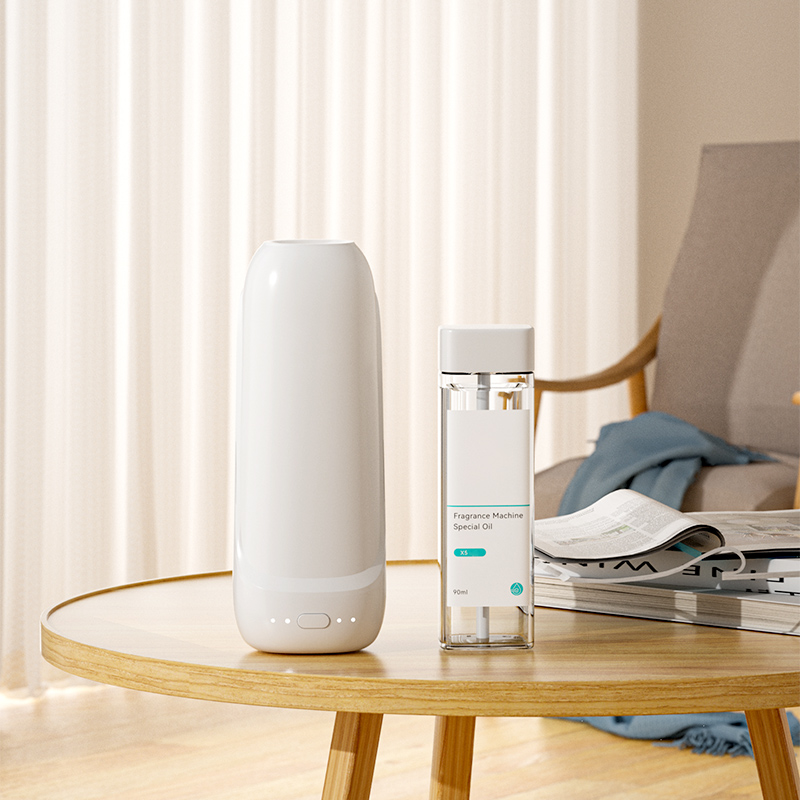
An ultrasonic aroma diffuser uses a ceramic disc that vibrates at ultrasonic frequencies to break down water and oil into micro-particles. Maintaining the exact water-to-oil ratio is critical for this disc's lifespan. Too much oil creates a viscous layer that dampens the vibrations, leading to poor performance and eventual hardware failure. These devices are highly sensitive to fluid density, making the 3-5 drop per 100ml rule an absolute operational requirement rather than a mere suggestion.
Nebulizing diffusers utilize pressurized air and Bernoulli's principle to atomize pure essential oil directly from the bottle. These systems do not use water, so the standard drop count rules do not apply. Instead, the oil bottle attaches directly to the internal pump. This results in a significantly higher hourly oil consumption rate, known as the burn rate. They deliver a highly potent scent profile suitable for large areas but require careful monitoring and frequent bottle replacements to avoid excessive operational costs.
Evaporative and heat diffusers rely on passive diffusion methods rather than active atomization. A fan blows ambient air through a fibrous pad soaked in oil, or a low-wattage heating element gently warms the oil to accelerate evaporation. Drop counts for these devices are dictated entirely by the absorption capacity of the pad or the surface area of the heating dish. You simply add enough drops to saturate the pad without causing drips, usually between 10 and 15 drops depending on the material thickness.
You must match your diffuser capacity and drop count to the square footage and airflow of the room. A 100ml unit with 3-5 drops suits a small 150 sq. ft. room like a bathroom or a closed office. For a large, open-concept living space, you need a 500ml unit with 15-20 drops to achieve adequate coverage. High airflow from HVAC systems, ceiling fans, or open windows disperses the vapor rapidly, requiring higher drop counts to maintain a noticeable scent profile.
Different oils possess vastly different molecular weights and behave differently when subjected to ultrasonic vibrations. You must adjust your drop count based on the specific physical properties of the oil you are using.
| Oil Category | Examples | Volatility | Viscosity | Drop Count Adjustment |
|---|---|---|---|---|
| Top Notes | Lemon, Sweet Orange, Peppermint | High (Evaporates quickly) | Low (Thin, watery) | Add 1-2 extra drops for sustained scent. |
| Middle Notes | Lavender, Tea Tree, Eucalyptus | Medium | Medium | Use standard baseline (3-5 drops/100ml). |
| Base Notes | Vetiver, Patchouli, Sandalwood | Low (Lingers for hours) | High (Thick, sticky) | Reduce by 1-2 drops to prevent clogging. |
Always adjust drop counts based on the occupants of the room. Reduce the dosage to 1-2 drops per 100ml in environments with children, pregnant individuals, or pets. Strong concentrations of vaporized volatile organic compounds (VOCs) can cause respiratory irritation, headaches, or nausea. Ensure adequate ventilation when diffusing any essential oil, regardless of the drop count, by keeping a door slightly ajar or running an exhaust fan.
Businesses running multiple units daily must forecast essential oil consumption accurately to maintain profitability. Track the daily burn rate per unit to estimate monthly requirements. If a spa runs five 300ml diffusers for eight hours a day, requiring two refills each, they are consuming roughly 150 drops (approx. 7.5ml) of oil daily. This hard data helps in budgeting and ensures you never run out of supplies during peak operational hours.
Evaluate when to transition from standard consumer units to commercial HVAC-integrated diffusers. If your daily oil consumption and the labor costs associated with manually refilling dozens of small units exceed the upfront investment of a centralized system, it is time to upgrade. HVAC units connect directly to large oil canisters, offering precise digital control over scent distribution and significantly lowering long-term maintenance and labor costs.
When sourcing an essential oil diffuser bulk order for a commercial facility, focus strictly on hardware consistency and warranty terms. Commercial use puts immense strain on the internal motors and transducer plates. Procuring identical units ensures that your staff only needs to learn one maintenance protocol and that replacement parts are interchangeable. Establish standardized cleaning schedules across all locations to ensure hardware longevity and consistent scent delivery.
Using too much oil causes heavy residue to harden on the ultrasonic transducer. This buildup acts as a physical dampener against the high-frequency vibrations necessary to create mist. Over time, the internal motor works harder to compensate for the resistance, drawing more electrical current and generating excess heat. This thermal stress leads to weak mist output, melted internal plastic housings, and eventual complete motor failure.
Olfactory fatigue, commonly known as "nose blindness," occurs when your olfactory receptors adapt to a constant smell and stop sending signals to your brain. Over-saturating a room with too many drops leads users to continually add more oil because they falsely believe the scent has faded. This compounds the problem, wasting expensive inventory and drastically increasing the risk of respiratory irritation for anyone newly entering the space.
Excessive vaporized volatile organic compounds (VOCs) from essential oils negatively impact indoor air quality. There is a strict threshold where these compounds transition from providing therapeutic benefits to becoming airborne respiratory irritants. Pumping 30 drops of oil into a small, unventilated room creates a dense particulate load that can trigger asthma, allergies, and severe headaches. Proper dosage and mechanical ventilation are absolute requirements to maintain a healthy indoor environment.
Implement a standard cleaning protocol to reset the device after heavy oil usage or when switching between highly viscous base notes. Run a cleaning cycle with equal parts distilled water and white vinegar for 30 minutes in a well-ventilated area. The acetic acid in the vinegar dissolves hardened oil residue and mineral scale. Afterward, wipe the ultrasonic plate gently with a cotton swab to restore the hardware to optimal working condition.
A: For a 300ml diffuser, use 9 to 15 drops of essential oil. This scales the standard 3-5 drops per 100ml baseline appropriately, ensuring a balanced scent throw without overwhelming the device or the room.
A: Yes. Using too much oil can clog the ultrasonic plate, cause rapid sensor wear, and lead to device failure. It also increases the risk of respiratory irritation and olfactory fatigue for anyone in the room.
A: Yes. Highly volatile top notes like citrus evaporate quickly and may need an extra drop. Viscous base notes like patchouli linger longer and require fewer drops to prevent clogging the device.
A: The industry standard is 3 to 5 drops per 100ml of water. Using fewer than 3 drops usually results in an undetectable scent, while more than 5 can be overpowering in a standard-sized room.
A: The drop count in a recipe represents the cumulative total. If a recipe calls for 2 drops of lavender and 2 drops of lemon, you add 4 drops total to your 100ml reservoir, not 4 drops of each.
A: You may be experiencing olfactory fatigue, using too few drops, or overfilling the water past the max line. A dirty ultrasonic plate covered in oil residue will also prevent proper mist generation.
A: It is generally not recommended to run it continuously all day. Use intermittent diffusion, such as 30 minutes on and 30 minutes off, to prevent olfactory fatigue and stay within safe exposure limits.


