
Views: 0 Author: Site Editor Publish Time: 2026-08-03 Origin: Site


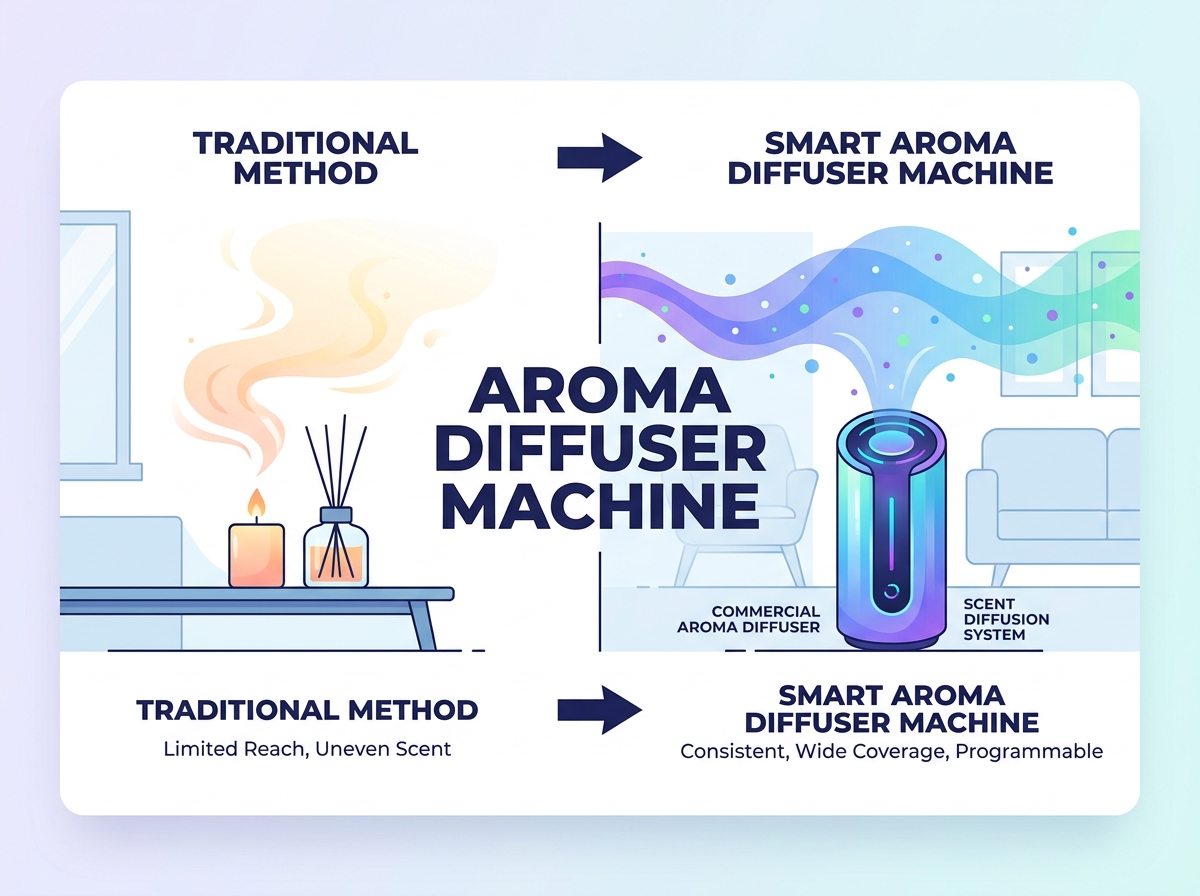
The transition from consumer-grade air fresheners and aerosols to engineered ambient scenting solves a major problem in large residential and commercial spaces. Relying on heat-based or water-based diffusers in expansive areas results in inconsistent fragrance distribution, diluted scent profiles, rapid oil degradation, and potential moisture damage. You end up with sticky residue on surfaces and a scent that fades just a few feet away from the unit. To fix this, facilities upgrade to a professional aroma diffuser machine. This hardware utilizes cold-air nebulization and direct HVAC integration to deliver precise, residue-free, and highly scalable indoor fragrance. By treating ambient scenting as a mechanical component of indoor environmental quality, these systems provide a controlled olfactory atmosphere that actively improves the space without the drawbacks of legacy methods.
Understanding the mechanical differences between diffusion technologies dictates how you select hardware for large spaces. Traditional ultrasonic devices operate essentially as humidifiers. They require a reservoir of water mixed with a few drops of essential oil. A small ceramic disc vibrates at ultrasonic frequencies, creating a water vapor that carries the scent into the air. While functional for a small bedroom, this method dilutes the fragrance profile and introduces unnecessary humidity into the environment. If you run multiple ultrasonic units in a sealed commercial space, you risk promoting mold growth inside drywall and ceiling tiles.
Heat-based diffusers use thermal energy to evaporate oils. Applying heat to delicate essential oils fundamentally alters their molecular structure. Heat burns off the lighter top notes, like citrus and bergamot, leaving behind a distorted, sometimes acrid base scent. It also creates a sticky residue as the heavier oil compounds cook onto the surrounding surfaces.
A professional aroma scent diffuser bypasses these issues entirely by utilizing pressurized air. This process, known as cold-air nebulization, operates without water or heat. By removing thermal energy and aqueous dilution from the diffusion process, the chemical preservation of the essential and fragrance oils is guaranteed. The exact aromatic profile intended by the perfumer remains intact from the reservoir to the room. You get a cleaner, more authentic olfactory experience that maintains its structural integrity regardless of the volume of the space being scented.
| Technology Type | Operating Mechanism | Residue Risk | Scent Integrity |
|---|---|---|---|
| Ultrasonic | Water vibration via ceramic disc | High (moisture fallout) | Diluted |
| Heat-Based | Thermal evaporation | Medium (sticky oil residue) | Degraded (burns top notes) |
| Cold-Air Nebulization | Pressurized air and scatter fan | Zero (dry mist) | 100% Preserved |
The core engineering of cold-air nebulization relies on fluid dynamics and high-velocity airflow. Inside the unit, an internal air compressor generates pressurized air. This air is forced through a microscopic tube submerged in the pure fragrance oil. As the pressurized air meets the liquid at the nebulizer head, it creates a Venturi effect—a vacuum that pulls the oil upward. The oil is then blasted against a specialized baffle or scatter fan, shearing the liquid into an ultra-fine, dry mist.
This process breaks the oil down into nanoparticles, typically measuring between 0.5 and 2.5 microns in diameter. The physics of this dry mist make professional systems superior for large-scale deployment. Because the particles are incredibly small and lightweight, they achieve a significantly longer hang time in the air compared to the heavier water droplets produced by ultrasonic units. A 50-micron water droplet falls to the floor in seconds, whereas a 0.5-micron oil particle floats for hours, riding the natural ambient air currents of the room to ensure even dispersion across massive floor plans.
Most importantly, this sub-micron dry mist leaves absolutely zero residue. The particles are too small to condense or settle heavily on surfaces. Facilities run these systems continuously without risking oily buildup on hardwood floors, luxury furniture, delicate fabrics, or expensive retail inventory.
Selecting the appropriate hardware requires moving beyond basic square footage estimates. A rigorous framework for matching machine output capacity must focus on room volume, specifically cubic footage. You calculate this by multiplying length, width, and ceiling height. A 2,000-square-foot room with standard eight-foot ceilings requires vastly different output than a 2,000-square-foot lobby with vaulted twenty-foot ceilings. Calculating the total cubic volume ensures the selected unit has the necessary pump strength to fill the space without overworking the motor.
Environmental factors heavily influence scent distribution. Evaluating airflow patterns and natural ventilation impacts is a mandatory step in the deployment process. High-velocity HVAC returns, frequently opened exterior doors, and cross-ventilation from open windows rapidly strip fragrance from the air. If a space has a high rate of Air Changes per Hour (ACH), you need a machine with a higher output capacity to maintain the desired scent concentration.
Conversely, micro-zoning capabilities are essential for confined spaces. Selecting specialized, low-output standalone units for highly localized areas prevents the fragrance from becoming overwhelming. Bathrooms, elevator cabs, or small waiting rooms require precision control. Deploying a high-capacity machine in these micro-zones, even on its lowest setting, results in an overpowering atmosphere that causes discomfort.
The decision between localized units and integrated systems dictates the entire installation strategy. Standalone or wall-mounted units are highly effective for retrofitting existing spaces, targeting smaller specific zones, or deploying scent in buildings with no accessible ductwork. These units operate independently, plugging directly into standard wall outlets. They offer flexibility, allowing facility managers to physically relocate the scent source as floor plans or seasonal displays change.
For comprehensive, whole-building coverage, HVAC-connected systems are the definitive choice. These systems inject the dry mist directly into the supply ductwork of the central air system. The primary advantage is an invisible installation. The hardware remains hidden in the mechanical room, while the fragrance is distributed evenly through the existing air registers. This guarantees a uniform olfactory experience across massive floor plans without cluttering the visual aesthetics of the space.
Technical requirements for HVAC integration demand careful planning. Installers must account for the static pressure within the ductwork. If the duct pressure exceeds the output pressure of the scent machine, the mist will be forced back into the unit, causing severe internal damage. Proper duct injection points must be identified to ensure the mist is carried efficiently into the occupied zones.
Consistent ambient scenting relies heavily on intelligent automation. Professional units allow administrators to program specific day and time parting schedules. A retail environment might require higher scent intensity during peak weekend foot traffic and lower intensity during quiet weekday mornings. Automated scheduling ensures the fragrance output perfectly matches operational hours, preventing wasteful diffusion when the building is empty.
Adjusting concentration levels is also a critical tactic to mitigate scent fatigue. Olfactory adaptation occurs when permanent occupants or staff become desensitized to a continuous smell. By programming the machine to operate on a duty cycle—such as running for 60 seconds and pausing for 120 seconds—the system prevents the olfactory receptors from shutting down. This intermittent diffusion strategy keeps the scent noticeable and fresh for both employees and newly arriving guests.
Engineered scenting leverages specific natural profiles to actively influence occupant psychology. The olfactory bulb has a direct neural link to the amygdala and hippocampus, the brain regions responsible for emotion and memory. By strategically selecting fragrance oils, spaces trigger immediate psychological responses. Introducing lavender and chamomile profiles in a spa environment actively lowers heart rates and promotes stress relief. Infusing a fitness center with sharp citrus and peppermint notes stimulates energy, alertness, and physical exertion.
The measurable impact of a relaxing or stimulating atmosphere directly translates to user behavior. In retail environments, a carefully curated ambient scent increases consumer dwell time. Shoppers naturally linger longer in spaces that smell inviting, increasing the likelihood of interaction with merchandise. In the hospitality sector, signature scents elevate the perceived luxury of a hotel lobby. Guests associate the unique fragrance with cleanliness, exclusivity, and premium service, forging a strong, memorable brand connection that encourages repeat visits.
High-traffic commercial spaces present unique operational challenges that dictate hardware selection. A commercial aroma diffuser must be sized to handle massive cubic volumes while maintaining strict brand consistency across multiple franchise locations. Retailers and hoteliers require robust, industrial-grade internal pumps capable of running continuously for extended hours without overheating or losing output pressure.
Physical security is another major consideration. Machines deployed in public-facing areas must feature tamper-proof hardware. Lockable oil compartments and password-protected digital interfaces prevent unauthorized individuals from altering the scent intensity or stealing the high-capacity oil canisters.
Compliance and safety regulations strictly govern public space scenting. Facility managers must ensure the selected fragrance oils comply with Volatile Organic Compound (VOC) limits established by local environmental agencies. All oils utilized in commercial settings should carry certification from the International Fragrance Association (IFRA), guaranteeing they are free from known respiratory irritants, allergens, and harmful synthetic additives.
The residential sector demands a different approach, prioritizing seamless architectural integration alongside functional output. Homeowners investing in professional scenting solutions rarely want the hardware visible. Balancing aesthetic integration with performance involves utilizing specialized HVAC units hidden in basements or attics, or deploying sleek, minimalist standalone units that blend perfectly with modern interior design.
Zoning strategies are highly specific in residential properties. A uniform scent across an entire home is rarely the goal. Homeowners utilize targeted diffusion instead. Higher intensity settings are programmed for entryways and foyers to create an immediate, welcoming impact as guests arrive. Living areas and bedrooms require a much more subtle, ambient diffusion to maintain a relaxing environment without becoming cloying or disruptive to daily living. You might install a dedicated unit for the primary suite HVAC zone and a separate, higher-output unit for the main floor living spaces.
Integrating a scent diffusion system directly into central air systems carries specific mechanical risks. Incorrect installation frequently leads to complete scent loss within the ductwork or damage to the HVAC components. If the injection nozzle is placed too close to a sharp 90-degree bend in the duct, the dry mist impacts the sheet metal, condenses back into a liquid, and pools inside the ventilation system. This wastes fragrance oil and degrades duct seals over time.
Mitigation requires strict adherence to installation protocols. Professional site surveys map the airflow prior to deployment. The injection tube must be placed post-fan and post-coil to ensure the mist is pushed outward into the room rather than sucked backward into the mechanical components. Installers must verify compatibility with Variable Air Volume (VAV) systems. Because VAV systems constantly adjust airflow based on temperature demands, the scent machine must be calibrated to match these fluctuations to prevent sudden spikes or drops in fragrance concentration.
Despite the advanced technology, these systems are mechanical devices processing viscous liquids, making routine maintenance non-negotiable. The reality of cold-air nebulization is that nozzle clogs and internal pump wear are inevitable if the equipment is neglected. Essential oils, particularly those derived from heavy resins or woods like sandalwood and patchouli, slowly build up inside the microscopic nebulizer pathways.
Establishing a strict baseline maintenance schedule is critical for long-term reliability. Facilities teams must execute these steps to keep the hardware operational.
A common operational risk is underestimating the ongoing consumption of high-quality, undiluted fragrance oils. Because these machines do not use water to stretch the liquid, they rely entirely on the pure oil reservoir. Running a high-capacity machine at maximum intensity 24 hours a day will rapidly deplete even the largest canisters.
Mitigation relies on precise mathematical forecasting. Facility managers calculate expected consumption rates based on the specific machine settings. Most professional units provide a consumption metric, such as milliliters per hour at a specific percentage of intensity. By multiplying this consumption rate by the programmed operating hours per month, administrators accurately forecast their replenishment cycles. This ensures the facility never experiences a lapse in ambient scenting due to empty reservoirs and allows for optimized inventory management of the fragrance oils.
A: A humidifier adds moisture to the air using water, often utilizing ultrasonic vibrations. A professional aroma diffuser machine uses cold-air nebulization to break down pure fragrance oils into a dry mist without using any water or heat, ensuring no humidity is added to the room.
A: It uses an internal compressor to generate pressurized air. This air is forced through a small tube containing pure fragrance oil, blasting the liquid against a scatter fan. This process shears the oil into microscopic, sub-micron nanoparticles that float naturally on ambient air currents.
A: Yes. Professional systems inject dry mist directly into the supply ductwork of central HVAC systems. This requires professional installation to ensure the injection point is placed correctly downstream from the fan and coils to distribute the scent evenly throughout the building.
A: Longevity depends entirely on the machine's programmed intensity, duty cycle, and operating hours. A standard 500ml bottle operating at a moderate intensity for 10 hours a day typically lasts between 30 to 45 days before requiring replenishment.
A: No. Because the nebulization process creates an ultra-fine dry mist composed of sub-micron particles, the scent remains suspended in the air. The particles are too small and lightweight to condense or settle, leaving zero oily residue on surfaces.
A: Standard maintenance requires flushing the nebulizer head with 99% isopropyl alcohol once a month to prevent oil buildup. You should also check the air intake filters quarterly and inspect the internal pump annually to ensure optimal air pressure is maintained.
A: Yes, provided you use high-quality oils that are IFRA compliant. These certified oils are rigorously tested to ensure they are free from harmful volatile organic compounds, respiratory irritants, and toxic synthetic additives.


