
Views: 0 Author: Site Editor Publish Time: 2026-08-02 Origin: Site


Scenting a bathroom presents unique environmental challenges. Fluctuating humidity, limited ventilation, scarce counter space, and proximity to water create a demanding setting for any electronic device. Standard living room diffusers often fail in these spaces. They feature oversized footprints that crowd small vanities and disrupt daily routines. Cord management quickly becomes a safety hazard when routed near sinks and showers. Furthermore, large-capacity ultrasonic models risk exacerbating mold growth by pumping excess moisture into an already damp room.
You need a specialized approach to maintain a fresh, inviting space without compromising safety or hygiene. We will explore a technical evaluation framework for selecting a bathroom essential oil diffuser tailored to confined areas. This guide covers diffusion technology, spatial constraints, power requirements, material safety, and maintenance realities to help you find the exact fit for your home.
Full bathrooms equipped with showers and bathtubs experience rapid spikes in relative humidity. During a hot shower, the ambient humidity can easily exceed 90 percent. Adding a traditional large-capacity ultrasonic diffuser to this environment introduces even more water vapor into the air. A standard 500ml unit can disperse half a liter of water over a few hours. In a confined 50-square-foot space, this excess moisture has nowhere to go, especially if the exhaust fan lacks the necessary cubic feet per minute (CFM) rating to clear the air efficiently.
Excessive condensation settles on mirrors, drywall, and ceilings. Over time, this constant dampness leads to peeling paint, warped cabinetry, and the rapid proliferation of mold and mildew spores. Mold requires moisture, warmth, and a food source (like drywall paper) to thrive. Pumping additional water vapor into the room accelerates this process. The baseline success criteria for any scenting device in a full bathroom is simple: it must provide effective scent dispersion with zero-to-minimal moisture addition. Devices must elevate the room's fragrance profile without turning the space into a damp, sticky environment.
Bathroom vanities offer limited real estate. Between hand soap, toothbrushes, and daily grooming tools, a bulky appliance simply gets in the way. A compact footprint is non-negotiable. You need a device that sits flush against the wall or occupies a minimal diameter on the counter. Many standard diffusers measure over six inches wide, which easily dominates a pedestal sink or a narrow apartment vanity.
Electrical safety presents an even stricter constraint. Routing power cords across wet countertops or near sinks violates basic safety principles. Water and trailing wires create immediate shock hazards. While modern bathrooms feature Ground Fault Circuit Interrupter (GFCI) outlets to prevent electrocution, relying on them to save you from poor cord management is a bad practice. Unoptimized spaces require cordless, direct-plug, or entirely passive solutions. Eliminating the cord not only cleans up the visual aesthetic but fundamentally secures the environment against electrical accidents.
| Environmental Factor | Standard Living Room | Full Bathroom | Impact on Diffuser Choice |
|---|---|---|---|
| Relative Humidity | 30% - 50% | 60% - 95%+ | Requires waterless or low-output models to prevent mold. |
| Available Space | Abundant (tables, shelves) | Highly restricted (vanity edges) | Demands compact footprints under 4 inches in diameter. |
| Ventilation | High (HVAC, large windows) | Low (closed doors, small fans) | Requires intermittent timers to prevent scent saturation. |
| Electrical Hazards | Low (dry environment) | High (proximity to water) | Favors cordless, battery-operated, or passive designs. |
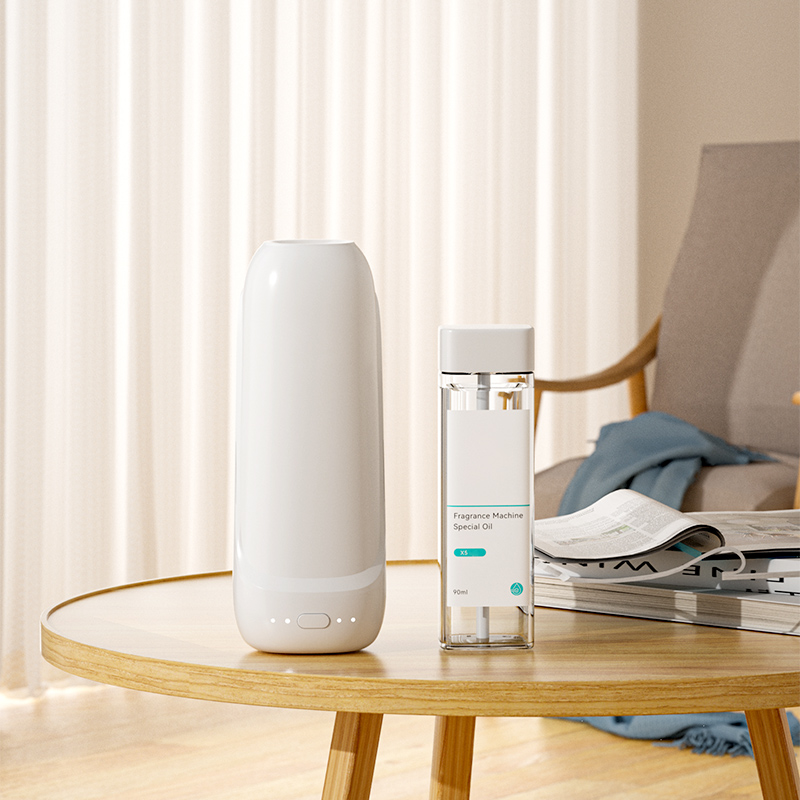
Nebulizing diffusers operate using pressurized air and Bernoulli's principle. A small internal pump forces air through a narrow tube, creating a vacuum that pulls pure essential oil from the attached bottle. The oil is then atomized into microscopic droplets and dispersed directly into the room without a single drop of water. This mechanical process preserves the therapeutic integrity of the oil without diluting it.
This technology offers distinct advantages for humid environments. It adds zero moisture to the air. The scent throw is highly potent, delivering immediate odor-masking capabilities the second you turn it on. Many modern nebulizers feature programmable timers, allowing you to customize the exact intensity and duration of the fragrance. You can set the device to run for two minutes and pause for ten, maintaining a perfect ambient scent.
However, trade-offs exist. Nebulizers can be louder than other types, often emitting a distinct motor hum or vibration during operation. They consume essential oils at a faster rate because they do not dilute the fragrance with water. They also carry a higher upfront cost. These units work best in well-ventilated bathrooms where you need strong, immediate scent control. They are ideal for users seeking a durable, "Buy-It-For-Life" (BIFL) investment with robust internal mechanics.
Ultrasonic technology relies on a small piezoelectric transducer located at the base of a water reservoir. When powered, this ceramic disc vibrates at ultrasonic frequencies—typically around 2.4 million times per second. These rapid vibrations agitate the water and essential oil mixture, breaking it down into a fine, cool mist that is pushed out into the room by a small internal fan.
These devices are highly affordable and come in a vast array of designs. A well-designed mini aroma diffuser often includes integrated warm white LED lights. This dual functionality allows the unit to serve as a convenient nighttime illuminator, guiding you in the dark without requiring you to turn on harsh overhead vanity lights.
The primary drawback is the addition of humidity. Because they use water, they require frequent reservoir changes and rigorous cleaning to prevent bacterial growth. They fit perfectly in half-baths or powder rooms that lack a shower. In dry climates, a small 100ml capacity unit provides just enough scent without overloading the room's moisture threshold.
Passive diffusion requires no electricity, no moving parts, and no heat. It relies entirely on natural evaporation. Reed diffusers use capillary action to draw scented oils up through porous wooden or synthetic sticks. Ceramic and stone diffusers absorb oils into their unglazed, porous surfaces and slowly release the aroma into the surrounding air over several days.
The benefits for a bathroom are substantial. They operate in complete silence. They require zero maintenance beyond occasional refilling. They add absolutely no moisture to the room. Visually, they offer an earthy, minimalist aesthetic that blends seamlessly into modern decor, looking more like a small sculpture than an appliance.
The main limitation is control. Passive diffusers provide a continuous but subtle scent. You cannot turn them off, nor can you quickly intensify the fragrance to mask sudden odors. They are also vulnerable to dust accumulation on the reeds or stone surfaces, which can clog the pores and stop the diffusion process. These are best suited for ultra-small spaces, guest bathrooms, or users who prioritize a set-and-forget approach using high-quality materials.
When selecting a bathroom diffuser, physical dimensions dictate usability. Tabletop models must feature a base diameter of under 4 inches to sit comfortably on standard vanities alongside other items. Space-efficient form factors, like compact orb diffusers or slim vertical cylinders, maximize available surface area without feeling intrusive.
Wall-mounted and direct-plug units completely remove the device from the counter. Direct-plug models plug straight into a GFCI outlet, acting much like a traditional nightlight but dispensing pure essential oils. This placement flexibility keeps the device safe from water splashes, frees up your workspace, and prevents the unit from being accidentally knocked into the sink.
Your choice of power source directly impacts convenience and safety. Continuous plug-in power provides uninterrupted operation but requires careful cord management. If your bathroom lacks conveniently placed outlets, a corded model becomes a liability and a tripping hazard.
USB-rechargeable battery models offer excellent autonomy. You can place them on a high shelf, a windowsill, or the back of the toilet tank far from water sources. Modern units utilize lithium-ion batteries that hold a charge for weeks. Operating a cordless model on an intermittent mode can yield up to a month of use before requiring a recharge. Passive systems entirely bypass the power issue, making them the most versatile option for older bathrooms with limited electrical infrastructure.
The materials constructing your room scent machine matter deeply for both health and longevity. Essential oils are highly concentrated plant extracts. They act as natural solvents. Citrus oils, in particular, contain d-limonene, which will rapidly melt and degrade cheap, standard plastics like ABS. This degradation ruins the device and can leach harmful chemical compounds into the air alongside your fragrance.
Look for non-toxic certifications. Ensure any plastic components in contact with the oil are BPA-free and made from medical-grade polypropylene (PP) or high-density polyethylene (HDPE), which resist chemical degradation. If choosing a passive model, verify that ceramics are lead-free.
Aesthetically, materials like matte stone, frosted glass, and high-grade resin elevate the space. They transform the device from a cheap appliance into a sophisticated piece of interior decor. These materials also offer superior chemical resistance against harsh bathroom cleaning sprays like bleach or ammonia.
Scent throw refers to how far and how strongly a fragrance travels from the device. In confined spaces—typically under 50 square feet for a small bathroom—a powerful continuous output quickly causes olfactory fatigue. Your nose becomes blind to the scent, or worse, the concentration becomes overwhelming and induces headaches.
Intermittent timers are mandatory for small spaces. You need a device that allows you to control the output intervals. A standard setup for a bathroom involves running the device for 5 minutes and pausing for 15 minutes. This maintains a pleasant, consistent background aroma without saturating the air. This control mechanism extends the life of your oils and ensures the room remains inviting.
Bathrooms are inherently high-bacteria environments. When you introduce an ultrasonic diffuser with a standing water reservoir, you create an ideal breeding ground for microbes. Biofilm—a slimy buildup of bacteria and fungi—can develop inside the water tank within days if left unattended. You may also notice pink mold (Serratia marcescens) forming around the water line.
Ultrasonic models require a strict cleaning schedule to remain safe. Follow these steps to maintain hygiene:
Neglecting this routine turns your scent machine into a bacteria dispersal unit, blowing microbes directly into the air you breathe.
Diffusing high concentrations of essential oils in small, closed rooms poses respiratory risks. Without proper airflow, volatile organic compounds (VOCs) accumulate. Always keep the bathroom door slightly ajar or run the exhaust fan on low while actively diffusing strong scents to ensure adequate air exchange.
Pet safety requires strict attention. Cats and dogs are highly sensitive to airborne essential oils. Cats, in particular, lack the liver enzyme glucuronosyltransferase needed to break down phenols found in oils like eucalyptus, tea tree, and peppermint. Diffusing these in a confined space where a pet might enter can lead to severe toxicosis, lethargy, and respiratory distress. If pets have access to the bathroom, stick to safer options or rely on passive diffusers placed well out of reach.
Sourcing high-quality, pure essential oils prevents internal clogging of the diffuser mechanics. Synthetic fragrance oils contain carrier lipids and artificial additives that gum up nebulizer nozzles and coat ultrasonic plates with a sticky residue. Select clean scent profiles like lemon, sweet orange, or lemongrass. These offer natural odor-neutralizing properties, smell crisp, and leave minimal residue behind.
The ideal device for your space depends entirely on the room's humidity levels, outlet availability, and your personal aesthetic preferences. There is no single universal solution, but applying a structured evaluation ensures you make a safe, effective choice. To finalize your setup, follow these actionable next steps:
A: Using a standard large-capacity ultrasonic diffuser in a full bathroom is not recommended. These devices add significant moisture to the air. In a room already exposed to shower steam, this excess humidity promotes condensation, peeling paint, and mold growth. If you prefer ultrasonic technology, use a small 100ml model exclusively in dry powder rooms.
A: For bathrooms lacking accessible electrical outlets, passive diffusers are excellent choices. Reed diffusers or porous ceramic stones require zero power and provide continuous, subtle fragrance. Alternatively, you can use a USB-rechargeable battery-operated nebulizer, which allows you to place the device anywhere without worrying about cord routing.
A: It is safe only if the device features an automatic shutoff mechanism or an intermittent timer. Leaving a continuous mist running in a small, unventilated space overnight can cause respiratory irritation. Models equipped with auto-shutoff and warm ambient nightlights are ideal for safe, overnight bathroom use.
A: Bathroom diffusers require a stricter cleaning cadence due to high humidity and airborne bacteria. For ultrasonic models, empty the water and wipe the reservoir dry daily. Perform a deep clean with a vinegar soak once a week. Waterless nebulizers should be cleaned monthly with rubbing alcohol to prevent oil clogs.
A: Waterless diffusers are excellent because they do not add humidity, making them perfect for damp bathrooms. However, their scent output is highly concentrated. To use them effectively in small spaces, you must choose a model with adjustable intermittent timers to prevent the fragrance from becoming overpowering.
A: High-terpene, crisp oils are the most effective for neutralizing odors. Lemon, lemongrass, sweet orange, peppermint, and eucalyptus offer clean, fresh scents with natural antimicrobial properties. Avoid heavy, lingering floral scents or thick resinous oils, as they can feel cloying in small, enclosed spaces.


