
Views: 0 Author: Site Editor Publish Time: 2026-08-06 Origin: Site


The functional limitation of traditional essential oil diffusers is their reliance on continuous wall power. This restricts placement and utility in dynamic environments like vehicles, bathrooms, and travel accommodations. Selecting a portable unit requires navigating a market saturated with exaggerated runtime claims, poor atomization technology, and devices that sacrifice scent throw for mobility. Users frequently encounter devices that leak during transit, fail to disperse fragrance effectively, or die after only a few hours of operation.
This guide establishes a technical evaluation framework to identify the best battery essential oil diffuser based on power architecture, diffusion technology, realistic spatial coverage, and overall value. By understanding the mechanics behind waterless atomization, battery capacity, and fluid dynamics, you can select a system that delivers consistent, high-quality fragrance without the constant need for a power outlet.
Evaluating portable fragrance systems requires moving beyond basic aesthetics and examining the engineering compromises inherent in mobile devices. Every untethered unit balances power availability against atomization output. When we test these units for field use or vehicle integration, we look directly at the hardware specifications rather than the marketing copy.
Establishing the baseline compromise between a device's physical footprint, its battery capacity, and the density of the scent plume it generates is a mandatory first step. A larger internal battery extends operational time but increases the overall weight and dimensions of the unit. Conversely, a high-output air pump produces a dense, immediate fragrance cloud but rapidly depletes stored power.
Manufacturers calibrate the duty cycle to stretch a limited power supply across days or weeks of use. The duty cycle is the ratio of active diffusion time to resting time. For example, a unit programmed to run for 10 seconds and rest for 110 seconds operates on a roughly 8% duty cycle. This intermittent operation allows a small battery to last for weeks, whereas continuous operation would drain the same battery in hours.
Continuous atomization demands significant energy. This necessitates high-capacity Lithium-ion (Li-ion) batteries over standard replaceable alkaline cells. Alkaline batteries suffer from severe voltage sag under the continuous load of an air pump or ultrasonic plate. This voltage drop leads to weak output and rapid failure.
Li-ion architecture provides a stable voltage curve. The atomization strength remains consistent whether the battery is at 90% or 20% capacity. Many high-performance units utilize standard 18650 Li-ion cells internally, providing an excellent balance of energy density, discharge rate, and physical size. This stable power delivery allows modern units to function reliably in varied environments.
Devices intended for transit or placement in high-movement areas require specific physical engineering. Evaluating the center of gravity prevents daily frustrations. A tall, top-heavy unit placed in a vehicle cup holder will tip during sharp turns. Engineers must place the heavy battery cells at the very bottom of the chassis to anchor the device.
Leak-proof engineering is equally vital. A true mobile unit must withstand being knocked over or stored sideways in a travel bag. If raw essential oils seep into the internal circuitry, they will dissolve the printed circuit board (PCB) coatings and destroy the device. High-quality units feature silicone O-rings and locking mechanisms that seal the oil bottle completely from the external environment.
Consumers often desire decorative designs featuring cone-shaped profiles, faux wood grain, or ceramic housings. These materials conflict directly with the practical needs of a mobile device. Ceramic and glass are heavy and shatter easily during transit. Faux wood finishes often peel or dissolve when exposed to stray drops of essential oil.
The most effective portable units utilize lightweight, shatter-proof materials. Brushed aluminum offers excellent durability and a premium feel. High-grade polymers like polyoxymethylene (POM) or polyethylene terephthalate (PET) resist the corrosive nature of pure essential oils while surviving the physical impacts of daily travel.
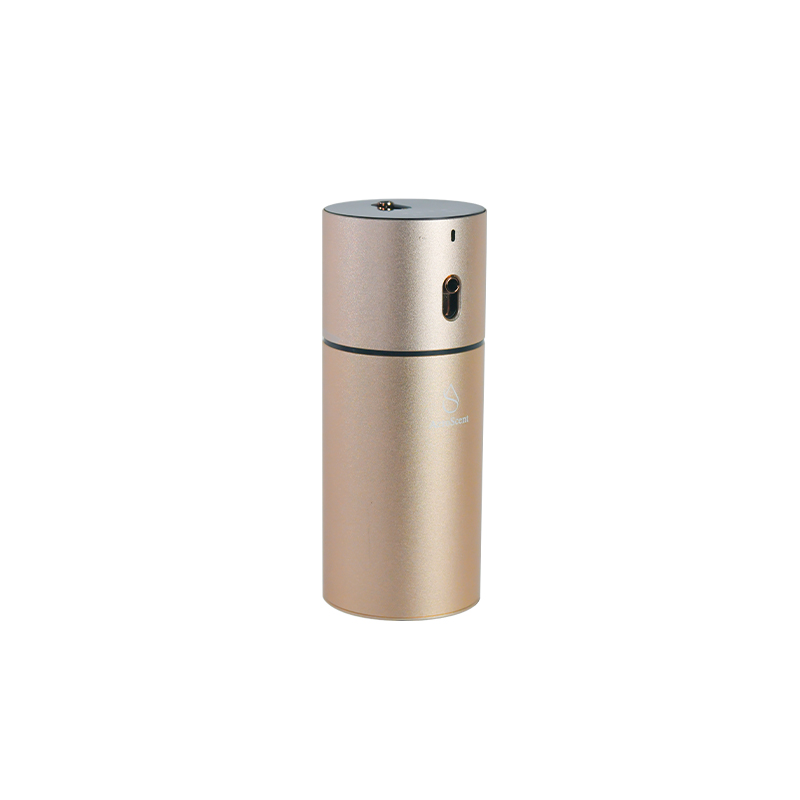
The method a device uses to disperse oil dictates its power consumption, maintenance requirements, and suitability for travel. The industry relies on two primary technologies, but only one truly excels in a mobile format.
Waterless nebulization represents the current standard for untethered fragrance delivery. This technology relies on fluid dynamics rather than water suspension, utilizing the Venturi effect to aerosolize liquids.
Mechanism: A micro air pump forces pressurized air through a small tube. This high-velocity air creates a vacuum that pulls pure essential oil directly from the attached bottle up through a secondary tube. The oil hits a physical baffle at high speed and shatters into microscopic particles. The device then blows these micro-particles into the environment. This process uses no heat and requires no water reservoir.
Battery Efficiency: Eliminating the need to vibrate a heavy water reservoir drastically extends battery life. An air pump operating on an intermittent cycle draws significantly less continuous power than an ultrasonic plate. This efficiency allows a portable diffuser to operate for up to a month on a single charge under normal daily use.
Spill Mitigation: The inherent travel advantage is the closed-loop, water-free system. Without a tank of water, there is nothing to spill. The oil remains securely threaded into the atomization head. You can toss these units into a backpack, lay them flat in a suitcase, or leave them in a moving vehicle without fear of liquid damage.
Ultrasonic diffusion is the traditional method used in stationary home units. It adapts poorly to mobile environments due to high power requirements and physical instability.
Mechanism: These systems use a piezoelectric transducer located at the bottom of a water reservoir. The transducer vibrates at ultrasonic frequencies (typically around 2.4 MHz). This rapid vibration agitates the water and a few drops of suspended oil until they break the surface tension and release as a fine mist. A small internal fan then pushes this mist out of the top of the unit.
Portable Limitations: The high power draw of ultrasonic plates results in significantly shorter battery lifespans. A typical battery-operated ultrasonic unit will only run for 2 to 6 hours before requiring a recharge. The energy required to continuously vibrate a mass of water simply exceeds the capacity of small internal batteries.
Travel Risks: The constant risk of water spillage is a major liability. If an ultrasonic unit tips over during transit, water easily bypasses the internal baffles. This water floods the internal electronics, permanently damaging the battery components and the transducer. They are strictly stationary devices that happen to have a battery for moving from room to room.
Selecting the right unit requires looking past marketing aesthetics and examining the specific hardware specifications that dictate daily performance.
Battery specifications are measured in milliampere-hours (mAh). Understanding this metric allows you to calculate realistic runtimes. A 2000mAh battery powering a nebulizing pump on a low setting can easily last over 50 hours. Conversely, the same battery powering an ultrasonic plate continuously will drain in under four hours.
| Technology Type | Average Battery Size | Power Draw (Active) | Estimated Runtime (Intermittent) |
|---|---|---|---|
| Waterless Nebulizer | 2000mAh - 4000mAh | Low (Air Pump) | 50 - 120 Hours |
| Ultrasonic Hybrid | 3000mAh - 5000mAh | High (Piezo + Fan) | 3 - 8 Hours |
| Micro-Diffuser (Car) | 500mAh - 1000mAh | Very Low (Micro Pump) | 15 - 30 Hours |
The charging infrastructure is equally important. USB-C standard ports are mandatory for modern devices. USB-C allows for travel convenience, enabling users to charge their diffuser with the same cables used for laptops and smartphones. It supports faster charge cycles and eliminates the frustration of proprietary barrel jacks that are easily lost and difficult to replace.
Evaluate whether the unit supports pass-through charging. High-quality circuitry allows the device to operate safely while plugged in. It powers the air pump directly from the cable while simultaneously trickle-charging the battery. Poorly designed units will overheat or degrade the battery if operated while plugged into a wall adapter.
Deconstructing the "600 sq ft" marketing myth is necessary when evaluating a battery aroma diffuser. While the internal pump might theoretically produce enough particles to fill that space over many hours, battery-operated units lack the high-velocity fans needed to push scent across large rooms quickly. They rely entirely on ambient air currents.
Ambient room airflow and HVAC placement heavily impact the effective reach of a portable unit. Placing the device near an air intake, a cracked window, or a small desk fan dramatically increases its coverage area. Without ambient airflow, the scent plume tends to settle within a 10-foot radius of the device.
Understand the difference between localized personal scenting and whole-home fragrance systems. Portable units excel at creating personal scent bubbles in micro-environments like vehicle cabins, office cubicles, or small hotel bathrooms. They are not designed to replace HVAC-integrated scenting systems for large open-concept living spaces.
Pure essential oils are highly concentrated plant extracts. Oils rich in terpenes, like lemon, sweet orange, and grapefruit, act as natural solvents. They will rapidly degrade, melt, or crack brittle, low-grade plastics. Assessing the build quality means looking for materials that can withstand direct contact with oils over years of use.
Ensuring the device's internal threading accepts standard essential oil bottles is a major usability factor. The industry standard is DIN18 threading. A device that accepts standard 10ml and 15ml bottles prevents brand lock-in. You can attach bottles directly from your preferred essential oil suppliers rather than decanting liquids into proprietary reservoirs or buying expensive pre-filled pods.
Optional ambient lighting, color-changing LEDs, and illuminated interfaces impact the overall runtime of a rechargeable diffuser. While LEDs are relatively efficient, running a bright light continuously alongside an air pump will noticeably reduce the time between charges. If battery life is your primary concern, keep the lights off.
Devices must allow users to completely disable all lights. A pulsing blue power indicator might look modern on a desk, but it becomes highly disruptive when the unit is placed on a bedside table or used in a dark hotel room. True stealth modes are a hallmark of thoughtful device engineering, allowing the unit to operate in total darkness.
The market segments into distinct archetypes based on intended use cases and underlying technology. Identifying your primary use case dictates which archetype you should select.
These are premium units designed for frequent travelers and luxury hospitality standards. They utilize pure nebulization and feature robust aluminum or high-density polymer casings. They often boast runtimes exceeding 100 hours on intermittent settings. They are the optimal choice for hotel rooms, extended road trips, and users prioritizing maximum scent density with minimal charging frequency. They provide a completely dry, spill-proof experience.
These units take traditional 100ml to 300ml water reservoir designs and retrofit them with internal batteries. They are generally larger, heavier, and require frequent water refills. They are best for stationary home use where users want to temporarily move the unit to a patio, bathroom, or yoga mat without losing the humidification aspect. They are not recommended for vehicle use or packing in luggage due to the high risk of water leakage.
Ultra-compact, cup-holder-friendly units feature lower output pumps and smaller internal batteries. They often include motion sensors that activate the device only when the vehicle is moving to conserve power and oil. They are best for personal scent bubbles, daily commutes, and highly localized aromatherapy. Their limited output makes them ineffective in spaces larger than a standard vehicle cabin or a small office cubicle.
Understanding the operational realities of portable fragrance systems ensures realistic expectations regarding maintenance, oil usage, and hardware longevity.
Waterless nebulizers consume pure essential oil faster than ultrasonic units. Because they do not dilute the oil with water, the fragrance output is much stronger, but the physical liquid depletes more rapidly. Users running a nebulizer on a continuous high setting can empty a 10ml bottle in a matter of days. Utilizing intermittent timers is essential to manage consumption while maintaining ambient scent.
Planning for the inevitable decay of built-in lithium-ion batteries is necessary. Like smartphones, these devices typically endure 300 to 500 full charge cycles before the battery capacity noticeably degrades. Operating the device in extreme temperatures accelerates this chemical degradation. Leaving a unit in a freezing car overnight or baking it in direct summer sunlight will permanently damage the cells. Keeping the device between 20% and 80% charge when storing it for long periods helps extend the battery's multi-year lifespan.
A major usability factor is the choice between open and closed ecosystems. Some manufacturers design diffusers that only accept proprietary scent pods or uniquely threaded bottles. This locks the user into a specific ecosystem, limiting fragrance variety and availability. Open systems that accept standard 10ml, 15ml, or 30ml essential oil bottles offer greater flexibility, allowing users to source their preferred botanical extracts from any supplier.
Consistent performance requires adherence to specific maintenance protocols. Neglecting these routines leads to mechanical failure, clogged nozzles, and poor scent output.
Over time, essential oils oxidize and become sticky, clogging the microscopic atomization nozzle. Thick oils accelerate this process. To maintain peak performance, you must perform a routine alcohol flush.
Strict drying and cleaning regimens are required to prevent bacterial growth in water reservoirs. If an ultrasonic unit is used in a warm, unventilated car and left with standing water, mold and bacteria will rapidly colonize the tank. The device will then aerosolize these pathogens into the air during its next use.
Understanding fluid dynamics is crucial for waterless systems. Thick, highly viscous oils are highly likely to cause mechanical failure in low-power portable units. The miniature air pumps lack the pressure required to shatter these dense resins into micro-particles. Users must dilute thick oils with lighter carrier oils or stick to low-viscosity options to prevent permanent clogs.
| Viscosity Level | Common Essential Oils | Suitability for Portable Nebulizers |
|---|---|---|
| Low (Thin) | Lemon, Sweet Orange, Eucalyptus, Peppermint, Tea Tree | Excellent. Atomizes cleanly with minimal clogging. |
| Medium | Lavender, Rosemary, Chamomile, Ylang Ylang | Good. Requires standard monthly alcohol flushing. |
| High (Thick/Resinous) | Vetiver, Sandalwood, Patchouli, Myrrh, Cedarwood | Poor. Will clog micro-pumps rapidly. Must be diluted. |
Selecting and blending high-quality, hotel-inspired essential oils ensures they atomize cleanly in battery-operated systems without overwhelming small spaces. Lighter top notes flow easily through nebulizing nozzles. These oils create a crisp, clean ambient environment that mimics luxury hospitality settings without taxing the internal pump mechanism.
Waterless, USB-C rechargeable units represent the most reliable and effective architecture for true portable fragrance needs. They significantly outperform battery-operated ultrasonic models in both safety and longevity. By eliminating water, these devices remove the risk of spills during transit and drastically reduce the power draw, allowing for weeks of intermittent use on a single charge.
Base the final purchasing decision on three factors: your primary environment, your tolerance for oil consumption, and the necessity of standard bottle compatibility. A unit designed for a vehicle cup holder will prioritize motion sensors and compact design, while a unit meant for hotel travel will prioritize maximum battery capacity and robust casing materials.
To optimize your portable fragrance setup, follow these next steps:
A: Battery life depends entirely on the diffusion technology and usage settings. A waterless nebulizing diffuser running on an intermittent setting can last 50 to 120 hours. Conversely, a battery-powered ultrasonic diffuser running continuously will typically drain its battery in 2 to 6 hours due to the high power draw of vibrating water.
A: Yes. Waterless diffusers are vastly superior for travel because they eliminate the water reservoir. This removes the risk of water spilling onto the device's internal circuitry or ruining items in your luggage. They also operate much longer on a single charge, making them ideal for long road trips.
A: It is generally not recommended. Portable diffusers contain lithium-ion batteries, which degrade rapidly when exposed to extreme heat above 110°F. Prolonged exposure to high temperatures inside a parked car can cause the battery to swell, permanently reducing its capacity or creating a fire hazard. Always remove the device from direct sunlight.
A: Weak output is usually caused by a clogged atomization nozzle or low battery voltage. Essential oils oxidize over time, leaving sticky resins that block the micro-tubes. Run a few milliliters of rubbing alcohol through the device for 10 minutes to dissolve the blockage. Additionally, ensure the battery is fully charged.
A: Yes, waterless diffusers consume pure essential oil faster than ultrasonic models because they do not dilute the scent with water. To manage consumption, you must use the device's intermittent timer settings. Running a waterless unit on a continuous setting can empty a standard 10ml bottle in just a few days.
A: If the device features an open system with standard threading, you can use any brand of pure essential oil. However, you must avoid highly viscous oils like Sandalwood or Patchouli, as they are too thick for small portable pumps to atomize. Avoid diffusers that require proprietary scent pods.
A: Many portable units include LED lighting for aesthetic appeal. While LEDs are energy-efficient, running them continuously alongside the air pump will noticeably reduce your total runtime. For maximum battery life and undisrupted sleep in hotel rooms, choose a device that allows you to completely disable all ambient lights.


