
Views: 0 Author: Site Editor Publish Time: 2026-09-06 Origin: Site


Stepping into a luxury hotel lobby triggers an immediate physiological response. This reaction stems directly from olfactory science. Hospitality brands leverage the brain's limbic system to create lasting memories. They build brand loyalty through a signature scent that makes spaces feel instantly cleaner and more inviting. The olfactory bulb connects directly to the amygdala and hippocampus, meaning scent drives emotion faster than sight or sound.
Attempting to replicate this experience in residential or commercial spaces often fails. Buyers typically rely on low-grade synthetics, improper diffusion methods, or unbalanced scent profiles. These retail products fade quickly or leave a harsh chemical residue in the air. True luxury requires a highly engineered approach. The technical differences between off-the-shelf air fresheners and commercial-grade hotel fragrance oil are vast. Understanding these distinctions provides a clear framework for evaluating quality, safety, and delivery systems.
Composition Matters: True luxury scents rely on complex olfactory architecture (top, middle, and base notes) rather than single-note essential oils, balancing natural extracts with stable, safe synthetics.
Delivery Dictates Quality: Heat and water degrade high-quality aroma oils; cold-air diffusion is the industry standard for preserving scent integrity and achieving scalable coverage.
Compliance is Non-Negotiable: Commercial-grade oils must adhere to International Fragrance Association (IFRA) standards to ensure safety for continuous inhalation, pets, and HVAC systems.
Total Cost of Ownership: High-quality, highly concentrated oils have a higher upfront cost but offer a lower burn rate and prevent hardware damage compared to diluted alternatives.
Defining the success criteria for a luxury scent requires looking beyond subjective preference. A successful environmental fragrance must deliver longevity, consistency, and a complete lack of chemical undertones. Retail alternatives often fail these criteria because they lack structural complexity. They rely on heavy solvents that evaporate unevenly. Commercial hotel oils are engineered for linear dispersion. This ensures the scent smells exactly the same at hour ten as it does at minute one.
High-end fragrances are built on a precise molecular framework. This structure dictates how the scent interacts with the air over time. The architecture consists of three distinct layers, each with specific evaporation rates and molecular weights. When you walk into a high-end lobby, you are experiencing a carefully timed release of these molecules.
Note Level | Molecular Weight | Evaporation Time | Common Ingredients | Primary Function |
|---|---|---|---|---|
Top Notes | Light | 15 to 30 minutes | Citrus, Bergamot, Fresh Greens | Provides the immediate initial impression and brightness. |
Heart (Middle) Notes | Medium | 2 to 4 hours | Jasmine, Rose, Spices, Herbs | Forms the core identity and character of the fragrance. |
Base Notes | Heavy | 24+ hours | Sandalwood, Amber, Musk, Oud | Anchors the scent, providing depth and long-lasting warmth. |
Top notes are the lightest molecules in the blend. They provide the initial impression but flash off quickly. Heart notes consist of florals, spices, and herbs. They have a medium molecular weight and remain suspended in the air for several hours, forming the recognizable core of the scent. Base notes are the heavy, anchoring molecules. They evaporate very slowly. Base notes anchor the luxury hotel scent, providing depth and warmth long after the top notes fade. Without a strong base, a fragrance feels thin and disappears rapidly.
A common misconception is that pure, unadulterated natural products are inherently superior for environmental scenting. Relying solely on raw natural extracts creates significant operational problems. Pure extracts are highly volatile. Their scent profiles change drastically based on crop yields, weather conditions, and soil quality. A lavender crop harvested in France during a dry season will smell entirely different from one harvested during a wet season. This makes batch consistency impossible for global brands that require their properties in Tokyo to smell exactly like their properties in New York.
Commercial aroma oils use safe, lab-created synthetics alongside natural extracts. Synthetics provide structural stability. They act as scaffolding, holding the volatile natural notes in place for even dispersion. Lab-created molecules often have a lower allergenic profile than raw botanicals because the specific proteins that trigger allergies are removed during synthesis. The carrier ratios also matter. High-quality formulations use premium solvents that evaporate cleanly without leaving a sticky residue on surfaces, furniture, or diffuser nozzles.
Buyers need objective ways to measure the quality of a fragrance oil before pouring it into an expensive machine. Visual inspection, physical testing, and safety documentation provide the most reliable metrics for evaluation.
The concentration of raw aromatic compounds determines the oil's strength and longevity. Retail oils are frequently pre-diluted with water, alcohol, or cheap carrier oils like dipropylene glycol (DPG). These fillers reduce the manufacturing cost but ruin the diffusion process. You can often identify diluted mixtures by their thin, watery consistency or a strong initial smell of rubbing alcohol.
Pure oil blends possess a specific viscosity. They are thicker than water but fluid enough to travel through a nebulizing nozzle. If an oil is too thick, it will clog the micro-tubes inside the diffuser. This requires frequent maintenance and shortens the lifespan of the hardware. High-quality commercial oils are precisely calibrated to balance maximum scent concentration with optimal fluid dynamics for nebulization. A simple field test involves placing a single drop of oil on a piece of standard printer paper. A high-quality, properly formulated oil will leave a clean, translucent ring. Oils heavily diluted with water or cheap solvents will warp the paper or leave a greasy, opaque stain.
Indoor air quality is a major health concern and a significant liability for property managers. The International Fragrance Association (IFRA) sets strict global guidelines for the safe use of fragrance materials. IFRA standards dictate the maximum allowable concentration of specific molecules to prevent respiratory irritation and allergic reactions.
Commercial-grade oils must carry IFRA certification. This documentation proves the oil is safe for continuous inhalation in enclosed spaces. Volatile Organic Compound (VOC) compliance is equally critical. Premium oils are formulated to fall well below regulatory VOC thresholds. This ensures they do not contribute to indoor air pollution. In modern smart buildings, high VOC levels will trigger HVAC air quality sensors, causing the building management system to unnecessarily increase outside air intake, which destroys energy efficiency and drives up utility bills.
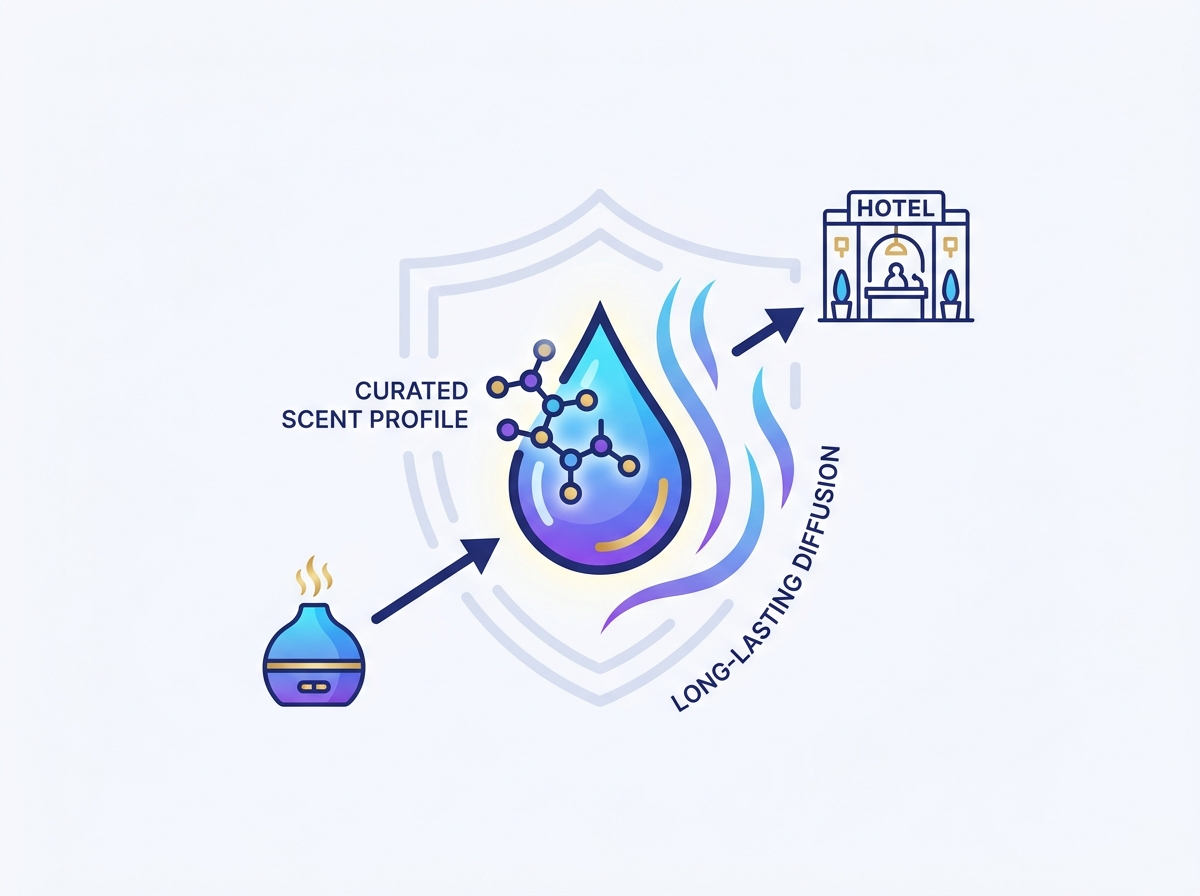
Hospitality brands do not choose scents at random. They select specific olfactory profiles to drive targeted psychological outcomes. Understanding these categories helps buyers match the right scent to the intended function of their space.
Woody and resinous profiles are heavy, grounded, and complex. They rely heavily on base notes to create an atmosphere of permanence and luxury. Because the molecules are larger and heavier, these scents tend to linger on upholstery and heavy drapes, creating a lasting environmental footprint.
Profile Notes: Sandalwood, Oud, Cedar, Amber, and Vetiver.
Brand Alignments: These profiles are the signature of brands like W Hotels, EDITION, and various luxury boutique properties.
Use Cases: These scents excel in evening-focused hospitality spaces. They are ideal for luxury residential living rooms, private clubs, and spaces designed to feel intimate, warm, and grounded.
Fresh profiles are designed to elevate mood and signal absolute cleanliness. They are lighter, relying heavily on top and heart notes to create a vibrant atmosphere. Because these molecules are lighter, they require more frequent diffusion to maintain their presence in a large room.
Profile Notes: White Tea, Bergamot, Lemongrass, Green Bamboo, and Yuzu.
Brand Alignments: These scents are heavily utilized by brands like Westin and Marriott.
Use Cases: Fresh profiles are perfect for spas, modern minimalist hotels, bathrooms, and fitness centers. The primary goal here is to make the space feel tangibly cleaner, brighter, and more energetic.
Floral profiles offer timeless elegance. They are designed to lower stress and evoke a sense of traditional luxury and comfort. They strike a balance between the fleeting nature of citrus and the heavy permanence of woods.
Profile Notes: Jasmine, Fig, Rose, Lily of the Valley, and Lavender.
Brand Alignments: Signature to legacy luxury brands like Four Seasons and St. Regis.
Use Cases: These scents are highly effective in resort lobbies, bedrooms, and transition spaces. They evoke calm, relaxation, and a sense of refined comfort.
The highest quality oil is useless if delivered through the wrong hardware. The diffusion method dictates how the scent molecules interact with the air. Selecting the right system is just as important as selecting the right fragrance.
Cold-air diffusion, also known as nebulization, is the commercial standard. This technology uses the Venturi effect, forcing highly pressurized air through a small nozzle to pull the scent diffuser oil up a micro-tube. The oil is sheared against a baffle, breaking it into dry nanoparticles typically smaller than one micron. These particles are so small they remain suspended in the air for hours, bouncing off air molecules through Brownian motion rather than falling to the floor. Nebulization uses no heat and no water, preserving the exact molecular structure of the fragrance.
Ultrasonic diffusers use water and ultrasonic vibrations to create a mist. This method dilutes the oil, weakening the scent profile. The water droplets are heavy and fall to the floor quickly, limiting coverage and potentially damaging hardwood floors or electronics with excess moisture. Heat diffusers are even worse. Heat alters the chemical composition of the oil, burning off the delicate top notes and leaving a flat, distorted base scent.
Diffusion Method | Mechanism | Scent Integrity | Best Use Case |
|---|---|---|---|
Cold-Air Nebulization | Pressurized air creates dry nanoparticles | Maximum (Preserves all notes) | Large spaces, HVAC, commercial lobbies |
Ultrasonic | Water and vibration create heavy mist | Low (Dilutes and alters scent) | Small bedrooms, adding humidity |
Heat / Candles | Thermal evaporation | Poor (Burns delicate top notes) | Ambiance, localized micro-spaces |
Passive (Reeds/Stones) | Natural air circulation | Moderate (Slow, uneven release) | Closets, powder rooms, desks |
For whole-home or whole-building scenting, HVAC integration is the most efficient solution. These systems connect directly to the ductwork, utilizing the building's existing airflow to distribute the scent evenly across thousands of square feet.
Implementing HVAC scenting requires technical evaluation. Installers must assess the static pressure of the ductwork. The injection tube must be installed after the air handler and the MERV filter, but before the branch ducts. If installed before the filter, the filter media will catch all the nanoparticles, wasting the oil and clogging the HVAC system. Programmable consumption rates are essential. High-end HVAC diffusers allow users to set specific run times and intensity levels, wiring the diffuser to an air switch or fan relay so the scent is only active when the HVAC fan is actually running.
Not every space requires mechanical diffusion. Passive diffusion offers a highly effective, budget-friendly option for micro-spaces. This category includes premium reed diffusers, unglazed ceramic stones, and porous lotus flowers.
Passive diffusion relies on natural air currents to lift the scent. It is ideal for small, localized areas like walk-in closets, powder rooms, and entry consoles. These methods require no heat, no water, and no electrical plugs. While they cannot scent a large living room, they provide a consistent, subtle background fragrance in confined areas.
Calculating the real cost of scenting a space requires looking past the initial purchase price of a bottle. Value is determined by efficiency, hardware protection, and the quality of the atmospheric experience.
Premium oils carry a higher price per ounce than retail alternatives. However, the metric that matters is the monthly consumption rate. A cheap, diluted oil requires a diffuser to run at maximum intensity to achieve any noticeable effect. This results in a rapid burn rate, emptying a bottle in days.
Highly concentrated commercial oils are highly efficient. A cold-air diffuser only needs to run at a 20% to 30% duty cycle (for example, running for two minutes and resting for eight minutes) to fill a room with premium oil. Consequently, a 120ml bottle of high-grade oil often lasts significantly longer than a 250ml bottle of diluted retail oil, making the premium option more economical over time.
Consumers can achieve a 5-star olfactory experience without the expense of full HVAC integration. The most effective strategy is pairing high-grade commercial oils with standalone, room-specific cold-air diffusers. Placing a standalone unit in a high-traffic area, like a main entryway or central living room, creates a strong initial impression. You can then use cost-effective passive reed diffusers in secondary spaces like bathrooms to carry the scent theme throughout the property.
Using low-grade oils introduces significant financial and operational risks. Cheap oils often contain heavy resins and improper solvents that crystallize inside the diffuser hardware. This clogs the nebulizing nozzles, requiring frequent replacement of parts. If used in an HVAC system, cheap oils can degrade air filters prematurely and leave sticky residues inside the ductwork. Poor-quality synthetics carry health liabilities, frequently causing headaches and respiratory irritation for occupants.
Deploying a commercial scenting strategy involves specific operational risks. Understanding how to mitigate these issues ensures a safe, consistent, and pleasant environment.
Safety is paramount when introducing airborne particles into a home. Many raw essential oils are highly toxic to cats and dogs. Cats, for instance, lack a specific liver enzyme required to break down phenols found in pure eucalyptus, tea tree, and citrus oils. Inhaling these raw compounds can cause severe liver damage.
Formulated commercial oils mitigate this risk by carefully controlling the concentration of these specific compounds to meet safety standards. Mitigation still requires proper placement. Diffusers must be placed out of reach of children and pets. Spaces must remain well-ventilated, and users should monitor pets for any signs of irritation when introducing a new scent profile.
Olfactory fatigue is a biological mechanism where the brain stops registering a continuous scent. The scent receptors in the nose become saturated, and the brain filters out the smell to focus on new environmental changes. This leads users to mistakenly believe their diffuser is broken or the oil has lost its potency.
The mitigation strategy is simple: never run a diffuser continuously. Implement strict scent schedules. Programming a diffuser to run for 30 minutes on and 30 minutes off prevents receptor saturation. This interval strategy keeps the scent noticeable to occupants while cutting oil consumption in half.
Cold-air diffusers require regular maintenance to maintain optimal scent throw. Without cleaning, oil residue builds up inside the micro-tubes, reducing output and eventually destroying the pump.
Turn off the diffuser and unplug it from the power source.
Unscrew the oil canister and pour any remaining fragrance oil back into its original storage bottle.
Fill the empty canister with a quarter inch of pure rubbing alcohol (90% isopropyl or higher).
Reattach the canister and run the diffuser on its highest setting for 15 minutes in a well-ventilated area to flush the nozzle.
Empty any remaining alcohol and allow the canister to air dry completely before refilling it with fragrance oil.
Measure the exact square footage and ceiling height of your target space to determine the required diffuser capacity and output settings.
Order a discovery sample set to test how different fragrance profiles interact with your specific indoor airflow, temperature, and existing odors.
Verify the IFRA compliance documentation from the manufacturer before running any scent continuously in occupied residential or commercial areas.
Establish a strict maintenance schedule, flushing your cold-air diffuser nozzles with rubbing alcohol every 30 to 60 days to prevent crystallization.
A: Pure essential oils are single-extract natural compounds derived directly from plants. They are highly volatile and inconsistent from batch to batch. Hotel fragrance oils are complex, formulated blends. They combine natural extracts with safe, lab-created synthetics. This engineering provides structural stability, consistent diffusion, and specific emotional resonance that raw oils cannot achieve.
A: IFRA-compliant formulated oils are generally safer than raw essential oils, which can be highly toxic to animals. However, caution is required. Specific notes like tea tree or eucalyptus should be avoided. Always place diffusers out of reach, ensure the area is well-ventilated, and monitor pets for any signs of sensitivity.
A: No. Commercial-grade oils are specifically designed for waterless cold-air diffusers. Adding these thick, concentrated oils to a standard water humidifier will clog the machine's filter and damage the ultrasonic plate. Furthermore, water alters the chemical profile, ruining the intended scent.
A: Consumption depends heavily on machine settings and room size. As a realistic baseline, a 120ml bottle used in a standalone cold-air diffuser running 8 hours a day at a medium intensity typically lasts between 30 to 45 days.
A: Hotels require massive scalability and strict adherence to fire safety codes, which prohibit open flames. Cold-air nebulizers break oil into dry nanoparticles that stay suspended in large lobbies without leaving residue. While reeds are excellent for consumer micro-spaces, they cannot scent a 5,000-square-foot commercial area.


