
Views: 0 Author: Site Editor Publish Time: 2026-09-16 Origin: Site


The commercial market is saturated with heavily diluted or synthetic fragrances marketed as pure essential oils. This deceptive practice leads to poor scent throw and potential respiratory irritation. Consumers and facility managers struggle to identify which formulations provide consistent aromatic performance. You need solutions that will not damage diffuser hardware, cause olfactory fatigue, or introduce toxic compounds to indoor environments. Selecting the right blends requires moving beyond basic scent preferences. You must evaluate chemical composition, note synergy, hardware compatibility, and verifiable purity standards. Understanding these mechanics ensures your chosen aromas deliver the intended atmospheric shift safely and effectively. We will break down exactly how to audit, mix, and deploy these oils for maximum performance.
Purity Dictates Performance: Authentic aromatherapy essential oil blends require GC/MS (Gas Chromatography/Mass Spectrometry) testing to verify the absence of synthetic adulterants that cause diffuser clogging and headaches.
Structural Synergy is Required: High-performing blends rely on a precise ratio of Top (volatile), Middle (balancing), and Base (fixative) notes to ensure a sustained scent throw over time.
Hardware Compatibility Matters: The viscosity of your chosen scent diffuser oil must match your equipment—heavy resins can destroy ultrasonic and nebulizing diffusers, while highly volatile citrus oils evaporate too quickly in reed diffusers.
Outcome-Driven Selection: Formulations should be evaluated based on the desired environmental shift (e.g., energizing workspaces, seasonal transitions, or relaxing residential areas) using established olfactory families.
A successful blend must maintain its aromatic integrity from the first minute of diffusion to the last. It must avoid the flat, one-dimensional smell characteristic of poorly formulated mixtures. Achieving this requires a structural approach to blending. You cannot simply mix pleasant smells together and expect a cohesive result. The chemical constituents of each oil dictate how it behaves once released into the air. Understanding these mechanics allows you to evaluate commercial Essential Oil Blends accurately.
Every oil possesses a specific evaporation rate based on its molecular weight. This rate determines its classification as a top, middle, or base note. A balanced formulation requires a precise combination of these three categories to ensure the scent does not disappear after ten minutes or smell excessively heavy.
Top Notes (15-25% of blend): These are highly volatile compounds with low molecular weights. Examples include Lemon, Grapefruit, Peppermint, and Lime. They provide the initial aromatic impact but evaporate quickly. They consist primarily of light monoterpenes.
Middle Notes (30-40% of blend): These form the structural core of the aroma. Examples include Lavender, Rosemary, Ylang Ylang, and Lemongrass. They bridge the fleeting top notes and the heavy base notes. They often contain balancing alcohols and esters, taking longer to oxidize and evaporate.
Base Notes (45-55% of blend): These are heavy, complex molecules like sesquiterpenes. Examples include Cedarwood, Patchouli, and Vetiver. They act as fixatives. They slow the evaporation of lighter oils, anchoring the scent profile for hours.
Evaluating how different chemical families interact dictates the success of the formulation. Terpenes, esters, and phenols all behave differently when atomized. High-phenol oils like Clove or Thyme offer strong odor-neutralizing properties but possess sharp, clinical scents. You must balance these aggressive profiles with softening floral or woody esters. This conceptual trade-off maintains the functional value of the blend while ensuring a pleasant aroma.
Synergy occurs when the combined chemical constituents create a new, harmonious scent profile that outperforms its individual parts. Without this structural synergy, the blend will separate in the air. You will smell the lemon for five minutes, followed by an hour of overwhelming patchouli. Proper blending locks the molecules together, releasing a unified scent over a longer duration.
Essential Oil | Note Classification | Chemical Family | Evaporation Rate |
|---|---|---|---|
Grapefruit | Top | Monoterpenes | Fast (1-2 hours) |
Peppermint | Top | Ketones/Alcohols | Fast (1-2 hours) |
Lavender | Middle | Esters/Alcohols | Medium (2-4 hours) |
Lemongrass | Middle | Aldehydes | Medium (2-4 hours) |
Cedarwood | Base | Sesquiterpenes | Slow (5+ hours) |
Vetiver | Base | Sesquiterpenols | Very Slow (8+ hours) |
You must know how to audit commercial blends or source individual oils for custom mixing. Relying solely on marketing claims often leads to purchasing compromised products. Evaluating quality requires looking at specific dimensions that directly impact hardware performance and human health.
Third-party lab testing is a non-negotiable evaluation metric. Gas Chromatography/Mass Spectrometry (GC/MS) testing breaks down an oil into its individual chemical components. This report verifies authenticity and identifies common adulteration practices. Suppliers often cut pure oils with synthetic linalool to mimic Lavender. Others dilute expensive oils with odorless carrier oils like fractionated coconut oil or dipropylene glycol (DPG).
These practices ruin diffusion performance. Carrier oils do not evaporate properly in cold-air nebulizers. They leave a heavy, sticky residue that ruins internal micro-tubes. Always demand batch-specific GC/MS reports before purchasing bulk quantities. If a supplier refuses to provide a current report, source your oils elsewhere.
Understanding the cost versus value trade-off dictates your purchasing strategy. Synthetic oils are cheaper and often have a stronger initial scent throw. However, they lack aromatherapeutic benefits. They also carry higher risks of indoor air pollution, often releasing volatile organic compounds (VOCs) like phthalates into the HVAC system or room environment.
You must also avoid the hybrid trap. Many commercial combinations mix pure aromatherapy essential oil with synthetic fragrance oils. This false economy compromises therapeutic value and significantly increases the risk of hardware resin buildup. Synthetics and pure oils possess different specific gravities. When left in a reservoir, they separate. The heavier synthetic compounds sink to the bottom, clogging the intake tubes of nebulizing diffusers or coating the piezoelectric plates of ultrasonic units.
You must assess the thickness of the oil before use. Thick, resinous oils like Vetiver, Myrrh, or Sandalwood possess high viscosity. They move slowly at room temperature. If used undiluted in specific hardware, they will cause mechanical failure. These heavy base notes require specific dilution ratios with lighter top or middle notes to ensure proper atomization. Failing to account for viscosity leads to clogged intake tubes, burnt-out ultrasonic plates, and voided equipment warranties.
Check the specific gravity of the oil on the safety data sheet (SDS).
Invert the bottle at room temperature. If the oil takes more than three seconds to form a drop, it is highly viscous.
Dilute highly viscous oils with high-monoterpene top notes (like sweet orange or lemon) at a 1:4 ratio before running them through a nebulizer.
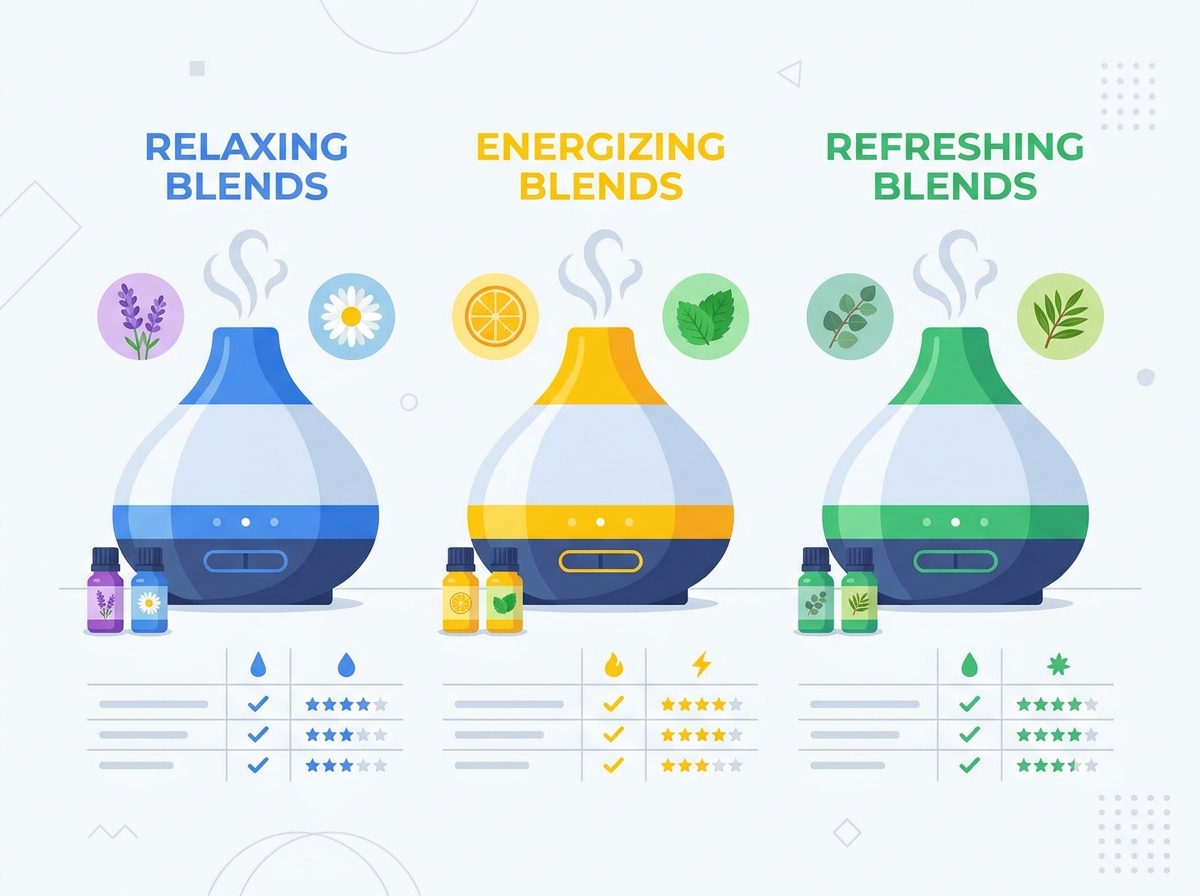
Selecting the right formulation depends entirely on your functional requirements. Proven, chemically balanced combinations deliver specific environmental shifts. You must match the olfactory profile to the intended use case, factoring in room size and airflow.
These blends rely heavily on the Citrus and Mint families. They are highly volatile and provide immediate sensory impact. They work well in high-traffic areas where you want a clean, sharp aroma.
Profile: Citrus and Mint families.
Standard Formulation: 3 drops Grapefruit, 3 drops Lemon, 2 drops Peppermint.
Alternative Formulation: 3 drops Grapefruit, 3 drops Lemongrass. This provides a bolder, longer-lasting throw due to the heavier Lemongrass middle note.
Evaluation: These are best for morning use or office environments. Because they consist primarily of top notes, they have a high evaporation rate. They require more frequent replenishment in the diffuser to maintain the scent profile.
These formulations utilize Floral and Woody families to create a stable, long-lasting aroma. They are designed to linger in the air without overwhelming the senses.
Profile: Floral and Woody families.
Standard Formulation: 4 drops Lavender, 3 drops Cedarwood, 2 drops Rosemary.
Evaluation: This is a proven year-round best seller. It is ideal for sustained, subtle scenting in residential or spa settings. The high base-note concentration from the Cedarwood ensures excellent longevity. The Rosemary prevents the Lavender from becoming too heavy or cloying, adding a slight herbaceous lift to the middle notes.
These blends alter the ambiance of a space to match seasonal expectations without relying on synthetic candles or plug-in air fresheners.
Summer/Tropical Profile: 3 drops Grapefruit, 3 drops Ylang Ylang, 2 drops Lime. This combination delivers a fresh, bright aroma. It completely avoids the heavy, synthetic coconut or vanilla notes commonly found in commercial summer fragrances.
Holiday/Winter Profile: 3 drops Fir Needle, 2 drops Peppermint, 2 drops Rosemary. This provides a crisp, coniferous scent. It mimics fresh winter air and opens the respiratory tract.
These blends do not just mask odors; their chemical constituents actively neutralize airborne scent molecules. They are highly effective in kitchens, bathrooms, and utility rooms.
Profile: Herbaceous and Coniferous families.
Standard Formulation: 3 drops Fir Needle, 3 drops Rosemary, 2 drops Lemongrass.
Evaluation: This functions by neutralizing airborne odors. The high monoterpene content interacts with volatile odor compounds. It offers excellent year-round utility for areas prone to dampness or lingering food smells.
Blend Category | Primary Chemical Family | Volatility Level | Ideal Deployment Area |
|---|---|---|---|
Energizing/Focus | Monoterpenes / Ketones | High (Fast Evaporation) | Offices, Gyms, Kitchens |
Relaxation/Grounding | Esters / Sesquiterpenes | Low (Slow Evaporation) | Bedrooms, Spas, Lounges |
Odor Elimination | Aldehydes / Monoterpenes | Medium (Moderate Evaporation) | Bathrooms, Pet Areas, Basements |
Seasonal (Winter) | Pinenes / Oxides | Medium (Moderate Evaporation) | Living Rooms, Entryways |
Selecting the right blend requires understanding your deployment method. Scalability and hardware integration dictate which oils will perform best. Using the wrong scent diffuser oil in your equipment leads to poor performance, mechanical failure, and wasted product.
These units use water and a piezoelectric ceramic disc vibrating at ultrasonic frequencies to create a fine mist. They are the most common consumer option for single-room scenting.
Requirements: Water-based diffusion requires oils that disperse well when agitated. You must use pure, undiluted essential oils.
Limitations: Highly acidic citrus oils, like Lemon and Lime, contain d-limonene. This compound acts as a solvent and will degrade cheap ABS plastic reservoirs over time. If you use heavy citrus blends, ensure your diffuser uses medical-grade, corrosion-resistant plastics (like PP or PET). Never use carrier-oil diluted blends here. The heavy carrier oil will float on the water, coat the ultrasonic plate, and stop the vibrations entirely.
Nebulizers use pressurized air and Bernoulli's principle to atomize pure essential oil directly into the environment without water or heat. They break the oil down into nanoparticles.
Requirements: They use pure essential oil exclusively. They require low-viscosity blends to function properly. Thick resins will clog the delicate glass or metal micro-tubes instantly.
Trade-offs: Nebulizers deliver the strongest, purest scent throw available. They do not alter the chemical composition of the oil with heat or water. However, they consume oil at a significantly higher rate. They are ideal for large, open spaces or HVAC integration requiring rapid, high-volume scenting.
Reed diffusers rely on capillary action to draw oil up wooden or synthetic reeds and disperse it into the air passively.
Requirements: You cannot use pure essential oil. It requires a carrier oil base. Fractionated coconut oil, sweet almond oil, or a specialized DPG reed diffuser base facilitates the capillary action up the reeds.
Best Practices: Bright, bold middle notes like Lemongrass or Peppermint are highly effective for energizing reed diffuser lines. They travel easily up the reeds. They blend well with both woods and florals, providing a consistent, passive scent throw.
Limitations: Heavy base notes like Vetiver or thick resins like Benzoin can clog the microscopic channels within the reeds. This stops diffusion entirely. Reed diffusers require regular flipping of the sticks and complete replacement of the reeds every two to three months as they become saturated with dust and heavy oil molecules.
Deploying essential oils in shared spaces requires strict adherence to safety protocols. You must mitigate implementation risks to protect occupants, prevent respiratory distress, and maintain hardware integrity.
Not all natural substances are safe. Many essential oils are highly toxic to cats and dogs because they lack specific liver enzymes (the glucuronidation pathway) to metabolize the compounds. You must identify and avoid diffusing Tea Tree, Eucalyptus, Citrus, Peppermint, Wintergreen, and Pine around pets. Airborne droplets land on their fur, which they then ingest during grooming.
For infants and toddlers, their respiratory systems are highly sensitive. Establish safe diffusion timeframes. A standard protocol is 30 minutes on, followed by 60 minutes off. Never run a diffuser continuously in a closed room with young children. Ensure the room has adequate HVAC ventilation or an open window to prevent the concentration of volatile organic compounds from reaching irritating levels.
Continuous diffusion leads to olfactory fatigue, commonly known as noseblindness. Your scent receptors become saturated, and your brain downregulates the signal. You stop smelling the aroma, even though the oil is still heavily concentrated in the air. This often leads users to add more oil to the reservoir, increasing the risk of sensitization, headaches, and mucosal irritation.
The primary mitigation strategy is rotating blend profiles weekly. Switch from a citrus-heavy blend to a woody blend. This forces your olfactory system to process new chemical compounds, maintaining sensory impact without overexposure. Utilize diffusers with built-in interval timers to automate the resting periods.
Neglecting hardware maintenance ruins the aromatic integrity of future blends. You must implement strict cleaning schedules. This prevents resin buildup, bacterial growth, and mold in water reservoirs.
Unplug the unit and empty any remaining water or oil from the reservoir.
For ultrasonic diffusers, wipe out the reservoir with a microfiber cloth and 70% isopropyl alcohol weekly to remove the oily film.
Use a cotton swab dipped in alcohol to gently clean the ceramic ultrasonic plate at the bottom of the tank.
For nebulizers, remove the oil bottle and attach a cleaning bottle filled with 10ml of 99% isopropyl alcohol.
Run the nebulizer on its highest setting for 15 minutes to dissolve and blow out any hardened resin inside the micro-tubes.
Define your environmental goal and measure the square footage of your target space to determine the required oil volatility.
Verify hardware compatibility by cross-referencing the specific gravity and viscosity of your chosen oils with your diffuser's mechanical specifications.
Request batch-specific GC/MS purity testing reports from your supplier to guarantee the absence of synthetic adulterants and carrier oils.
Purchase sample sizes to test scent throw, note synergy, and longevity in a single ultrasonic unit before committing to large volumes.
Establish a strict weekly cleaning schedule using isopropyl alcohol to prevent resin buildup and maintain accurate scent profiles.
A: The most effective baseline is the 30/50/20 rule. Allocate 30% of your drops to volatile top notes, 50% to balancing middle notes, and 20% to heavy base notes. This structure ensures a cohesive aroma that does not evaporate too quickly or smell excessively heavy.
A: No. You must only use pure, undiluted essential oils. Carrier-oil diluted blends and synthetic fragrance oils should be strictly avoided in ultrasonic hardware. They leave a greasy residue that clogs the ultrasonic plate and can cause cheap plastic reservoirs to degrade and leak.
A: A standard baseline is 5 to 10 drops of pure essential oil per 100ml of water. Adjust this based on the size of your room and the inherent potency of the oil. Strong oils like Peppermint require fewer drops than softer oils like Sweet Orange.
A: This happens due to varying evaporation rates. Highly volatile top notes like grapefruit evaporate within the first 30 minutes. Once they dissipate, the heavier middle and base notes, like cedarwood or patchouli, become dominant, fundamentally shifting the scent profile.
A: Several common oils are toxic to pets. You should strictly avoid diffusing Tea Tree, Wintergreen, Pine, Peppermint, and Eucalyptus around dogs and cats. Their livers cannot process the specific chemical compounds, which can lead to severe neurological and respiratory issues.
A: DIY blending is highly cost-effective and allows for complete customization. However, pre-mixed options offer convenience and professional formulation. High-quality pre-mixed blends ensure precise chemical synergy and structural balance, saving you the trial and error of formulating from scratch.


