
Views: 0 Author: Site Editor Publish Time: 2026-09-09 Origin: Site


Ambient scenting drives customer perception, dwell time, and brand recall. Deploying scent effectively in complex commercial environments requires precise spatial planning to maximize marketing efficiency. Relying on underpowered residential units or misplacing commercial systems leads to uneven scent distribution. You waste fragrance consumables, cause scent fatigue, and suffer a negative return on investment. The physical behavior of scent particles demands a strategic approach to air volume and movement. To achieve consistent, brand-aligned ambient scenting, facility managers and operational leaders must evaluate their specific spatial dynamics. You need to assess square footage, cubic volume, connected rooms, and foot traffic. This evaluation determines where and how a Commercial Aroma Diffuser should be deployed. Understanding the architecture of your space ensures uniform fragrance coverage without overwhelming your guests or employees.
Spatial Dynamics Dictate Technology: The choice between standalone units and HVAC-integrated systems relies entirely on cubic volume, ceiling height, and existing ductwork infrastructure.
High-Traffic Zones Yield Highest ROI: Lobbies, hallways, and primary transition areas benefit the most from commercial scenting by establishing immediate brand identity and leveraging natural human movement for dispersion.
Airflow is the Primary Variable: Open staircases, vaulted ceilings, connected rooms, and exhaust vents can severely disrupt scent distribution, requiring strategic, centralized placement rather than purely aesthetic positioning.
Operational Scalability Matters: Effective implementation requires balancing desired scent intensity with maintenance accessibility, consumable costs, and indoor air quality compliance.
Measuring by square footage alone guarantees poor equipment selection. Floor space tells only half the story when planning a scenting strategy. Scent particles travel in three-dimensional space, filling the entire volume of a room. A 2,000 square foot lobby with a standard 9-foot drop ceiling contains 18,000 cubic feet of air. That exact same 2,000 square foot footprint with a 25-foot vaulted atrium contains 50,000 cubic feet of air. If you buy equipment based solely on the floor plan, your scent will dilute into the upper canopy of the room, leaving the ground level smelling like nothing.
Commercial diffusion systems atomize oil into sub-micron particles that disperse evenly throughout the available air volume. You must calculate the total three-dimensional space to ensure proper fragrance saturation. Baseline coverage expectations vary significantly based on equipment grade and output capacity. Cost-effective, commercial-grade standalone units typically cover up to 1,100 to 1,500 square feet under standard ceiling heights. Industrial units designed for massive spaces handle 5,000 square feet or more. Always multiply your square footage by your ceiling height to determine the true workload required from your diffusion equipment.
Measure the length and width of the primary floor space.
Identify the highest ceiling point, accounting for domes or vaulted sections.
Multiply the total square footage by the average ceiling height to find the cubic volume.
Factor in adjacent open corridors that lack physical doors, as air will naturally flow into these spaces.
Air behaves like water. It flows along the path of least resistance. Natural and mechanical airflow patterns heavily influence diffusion efficiency across different zones. HVAC supply vents push air down, while return vents pull air up and out. If you place a diffuser directly beneath a heavy return vent, the HVAC system will suck the fragrance out of the room before anyone smells it. You must map these invisible currents to understand how scent will behave in your specific environment.
Architectural features pose specific challenges to uniform scent distribution. Open stairwells act as massive chimneys. Warm air rises, carrying your scent particles up to the second or third floor, leaving the ground floor completely bare. Exterior doors often create negative pressure drafts. When the doors open, outside air rushes in and pushes the conditioned, scented air backward. Treat airflow mapping as a critical pre-purchase evaluation step. Identifying these architectural hurdles prevents dead zones and ensures uniform coverage across your facility.
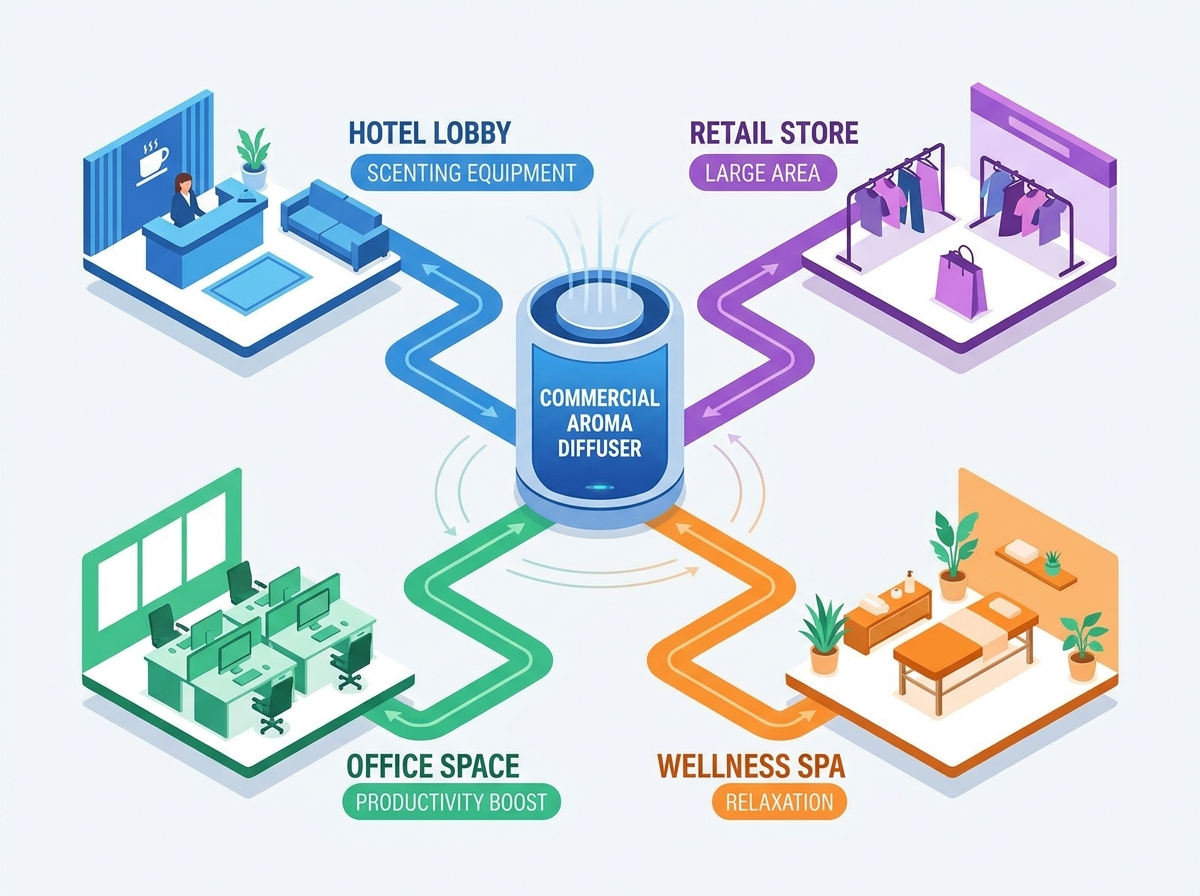
Hotels rely heavily on ambient scenting to establish brand identity. The moment a guest walks through the front doors, the olfactory experience begins. You need robust hotel scenting equipment to handle the massive air volume of a standard lobby. These spaces deal with constant door openings, luggage carts, and heavy foot traffic. High-capacity systems ensure the scent remains stable despite these constant environmental disruptions.
You also have to manage operational odors. Lobbies often connect to indoor pool areas, restaurants, and street-level valet zones. Chlorine, cooking grease, and exhaust fumes easily bleed into the reception area. A properly calibrated system masks these intrusive smells. Place the units near elevator banks. The mechanical movement of the elevator cars creates a piston effect, pushing and pulling scented air up through the building shafts and into the upper hallways.
Retail environments use scent to increase dwell time. Shoppers stay longer and browse more when the environment smells pleasant. However, retail spaces present unique airflow challenges. High-density visual merchandising, tall shelving units, and promotional displays block natural air currents. Air curtains blasting down over the main entrance will instantly destroy any scent profile near the front of the store.
To overcome this, you need a large area air diffuser positioned strategically within the sales floor. Mount the equipment high on the walls or integrate it into the HVAC ductwork to ensure the fragrance cascades down over the shelving rather than getting trapped in the aisles. Keep the intensity subtle. The goal is a background ambiance that elevates the perceived value of the merchandise without distracting the customer.
Shared workspaces require a delicate approach. You are dealing with a captive audience of employees who sit in the same room for eight hours a day. Heavy, overpowering fragrances trigger complaints and headaches. You must use a highly controllable commercial scent diffuser that allows for minute adjustments to the output settings.
Focus on clean, energizing profiles like citrus or light woods to boost alertness, while avoiding heavy florals. Use scent to neutralize stale air in conference rooms and mask odors from communal breakrooms. Map the HVAC zones carefully. Many modern offices use Variable Air Volume boxes that change the airflow based on temperature demands. Your scenting strategy must account for these fluctuating air currents to maintain a barely perceptible yet effective fragrance level.
Gyms and clinics have entirely different objectives. Fitness centers fight a constant battle against sweat, humidity, and the off-gassing of rubber floor mats. Standard air fresheners just mix with the sweat, creating a terrible hybrid odor. You need active odor-neutralizing compounds that bind to the malodor molecules and pull them out of the air.
Healthcare waiting rooms use scent to reduce patient anxiety. A sterile environment feels cold and intimidating. A subtle hint of lavender or chamomile warms the space. However, you must adhere to strict hypoallergenic standards. Use only waterless cold-air diffusion. Water-based ultrasonic units introduce moisture into the air, which promotes mold growth in the ductwork. Stick to certified oils free of synthetic propellants to create a clean, safe, and reassuring environment.
Standalone units provide flexibility. You plug them into a standard wall outlet, program the timer, and let them run. They work perfectly for spaces under 1,500 square feet or older buildings lacking accessible central ductwork. You can move them around as your floor plan changes. However, they rely entirely on ambient room airflow to push the scent around. If you put the unit in a stagnant corner, the scent stays in that corner.
Lower initial hardware costs and zero installation labor required.
Immediate deployment with simple plug-and-play functionality.
Highly portable for changing retail layouts or seasonal displays.
Visible footprint requires careful placement to match interior aesthetics.
Creates a higher concentration of fragrance immediately surrounding the nozzle.
Requires manual oil bottle replacements at every individual machine location.
For spaces exceeding 2,000 square feet, HVAC integration is the logical choice. These systems tap directly into the supply plenum of your air handler. The diffuser atomizes the oil into a dry mist and injects it into the ductwork downstream of the air filter. The building's existing fan pushes that mist through every connected supply register, guaranteeing perfectly even coverage across massive floor plans.
Delivers perfectly uniform fragrance across thousands of square feet.
Keeps all hardware and oil bottles hidden in secure mechanical rooms.
Prevents tampering by unauthorized staff or curious customers.
Requires professional installation by a technician familiar with duct static pressure.
Scent distribution stops completely when the HVAC fan cycles off.
Allows facility managers to service a single large oil reservoir instead of multiple small ones.
System Characteristic | Standalone Commercial Units | HVAC-Integrated Systems |
|---|---|---|
Optimal Coverage Area | Under 1,500 square feet | 2,000 to 10,000+ square feet |
Installation Requirements | Standard 110v/220v wall outlet | Ductwork penetration and static tube insertion |
Hardware Visibility | Visible on floors, walls, or shelving | Concealed entirely in mechanical rooms |
Distribution Mechanism | Internal fan and ambient room drafts | Building air handler and supply registers |
Maintenance Workflow | Service multiple units across the floor | Service one central unit in the utility room |
Look at your floor plan. Open-concept spaces thrive on centralized deployment. One powerful machine pushing scent from a central location utilizes the natural convection currents of the room. It simplifies your maintenance route and prevents overlapping fragrance zones where two different machines fight for dominance. This approach ensures a consistent scent profile across large, unobstructed areas.
Compartmentalized layouts demand a decentralized approach. If your space consists of long, winding corridors with heavy fire doors, a single central unit will fail. The physical barriers block the scent particles. In these scenarios, you must deploy multiple smaller units. Space them out evenly along the corridor. Map the square footage of each isolated zone and assign a properly sized diffuser to that specific area to maintain fragrance intensity.
Placement dictates performance. Never place a diffuser near an exhaust fan. Bathrooms, commercial kitchens, and janitorial closets feature heavy exhaust systems that create negative pressure. If you place your equipment too close to these zones, the exhaust fan sucks the fragrance out of the building before it ever reaches your guests. Identify the natural flow of air from supply vents to return vents, and place your diffuser in the path of that positive airflow.
Similarly, avoid placing units directly beneath HVAC return grilles. The return grille pulls air back to the filter. You want to place your equipment near the supply registers, where the air blows out into the room. Let the supply air catch the dry mist and carry it across the floor space. Utilize human movement as well. High-traffic bottlenecks naturally stir the air, helping to disperse the scent particles further into the room.
You have to refill the fragrance oil. Depending on your run times and intensity settings, this happens every 30 to 90 days. If you hide a standalone unit on top of a 12-foot cabinet, your staff will ignore it. Nobody wants to drag a ladder out during business hours. The machine runs dry, the pump overheats, and the equipment fails. You must balance aesthetic discretion with practical accessibility.
Mount wall units at eye level in low-visibility corners. If you use floor-standing models, tuck them beside heavy furniture where they blend in, but keep the access panel completely unobstructed. Establish a clear maintenance schedule and assign responsibility to specific staff members. Regular cleaning of the atomizer nozzle prevents clogging and ensures consistent output over the lifespan of the equipment.
Olfactory fatigue happens when the human nose adapts to a constant smell. After 15 minutes in a scented room, your staff stops smelling the fragrance. They assume the machine is empty and turn the intensity dial up to maximum. When new guests walk in, the smell hits them like a brick wall. Never let floor staff adjust the equipment. Lock the settings and trust the initial calibration.
Use programmable duty cycles to prevent nose blindness effectively.
Set the machine to run for 120 seconds to build the initial scent profile.
Program a 60-second pause to let the scent settle and dissipate slightly.
Allow the cycle to repeat, creating a subtle wave effect rather than a constant blast.
Program the internal timer to shut the machine down completely after business hours to conserve oil.
Cold-air diffusion is the only acceptable technology for commercial environments. It uses a high-pressure air pump to force oil through a Venturi nozzle. This breaks the liquid into a dry, sub-micron mist. The particles are so small they float in the air for hours without leaving any residue on your furniture, windows, or inventory. This waterless, residue-free technology preserves the chemical integrity of the essential oils.
Never use heat-based or water-based ultrasonic diffusers in a commercial setting. Heat destroys the chemical profile of the essential oils, altering the smell. Water-based units introduce heavy moisture into the air. If you pump moisture into your HVAC ductwork, you grow mold. Always demand IFRA-certified oils. This certification guarantees the fragrance contains no harmful VOCs, synthetic propellants, or known allergens, protecting you from liability and ensuring a safe breathing environment.
Measure the cubic volume of your target areas by multiplying square footage by ceiling height to determine the exact output capacity required.
Map out connected rooms, open stairwells, and HVAC vents to identify potential airflow disruptions and negative pressure zones.
Track foot traffic patterns to pinpoint optimal centralized placement locations away from exterior drafts and return vents.
Verify that all selected fragrance oils meet IFRA certification and VOC compliance standards before loading them into your equipment.
Schedule a comprehensive site audit with your facility management team before requesting a vendor consultation or equipment trial.
A: Coverage ranges from cost-effective standalone units covering up to 1,100 square feet to industrial HVAC-integrated systems capable of scenting over 5,000 square feet or entire buildings. You must always factor in ceiling height to calculate the true cubic volume required for even distribution.
A: Yes, many commercial units are designed to tap directly into HVAC ductwork. They utilize the building's existing air handler and supply registers to push a dry micro-mist evenly across multiple connected rooms, keeping the hardware completely hidden.
A: Place equipment in central, high-traffic areas where natural airflow assists distribution. Avoid placing them directly next to exterior doors, entryways, or return air vents to prevent the scent from being blown outside or sucked into the exhaust system.
A: Cold-air diffusion uses pressurized air to break oils into a dry micro-mist without water or heat. This ensures consistent scent intensity, preserves the oil's chemical integrity, and prevents mold growth or oily residue on commercial surfaces.
A: Vaulted ceilings and open staircases drastically increase the cubic volume of a room and alter natural airflow. They require a centrally located diffuser with a much higher output capacity to prevent the scent from dissipating upward and away from the ground level.
A: Yes, provided they utilize waterless cold-air technology and IFRA-compliant, hypoallergenic fragrance oils. These certified oils are free of harmful VOCs and synthetic propellants, ensuring a safe, non-irritating environment for patients and employees.


