
Views: 0 Author: Site Editor Publish Time: 2026-06-18 Origin: Site


Creating a memorable first impression goes far beyond visual aesthetics and background music. Commercial scenting relies on precise fluid dynamics and intelligent HVAC integration to shape guest experiences. Decentralized room sprays often fail in large environments. They create uneven scent clouds and leave frustrating gaps in coverage. This inconsistency pushes facility managers and corporate real estate planners to seek robust ambient scenting solutions. Transitioning to an automated aroma diffuser office hotel system requires understanding sub-micron diffusion technology. You also need to grasp indoor air quality compliance and ongoing maintenance realities. We will explore the mechanics behind cold-air nebulization. We will examine the distinct advantages of HVAC-connected delivery versus standalone units. Finally, you will learn how to evaluate equipment specifications. This ensures safe, continuous, and residue-free fragrance distribution across your commercial properties.
Consumer ultrasonic devices rely heavily on water to function. They leave mold-prone dampness and distribute scent unevenly across large open spaces. Commercial venues demand continuous, zero-residue coverage. You must protect expensive interior assets and maintain strict hygiene protocols. This operational necessity brings us to the underlying science of cold-air nebulization.
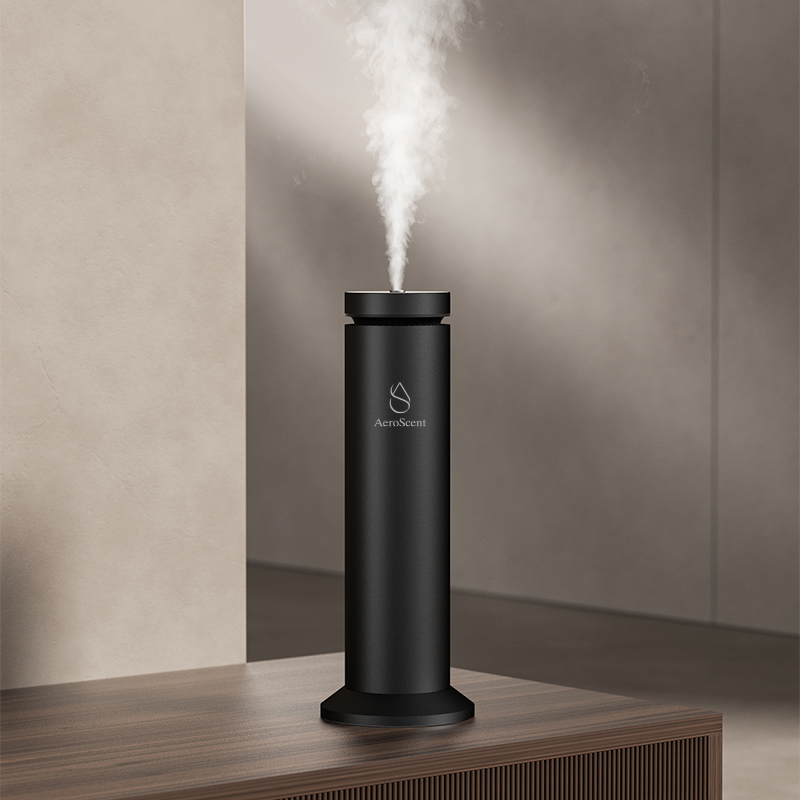
High-velocity pressurized air forces essential and aroma oils through a specialized nebulizer baffle. This intense physical process breaks the liquid into dry mist particles. These sub-micron particles typically measure well under one micron in diameter. To put this in perspective, a single human hair measures roughly seventy microns across. The sheer smallness of these dry mist particles completely changes how fragrance behaves in an open room.
Why does this advanced nebulization matter for your facility operations?
Facility managers often encounter severe issues when attempting to scale up residential technology. A common mistake involves placing large water-based humidifying diffusers in high-end hotel lobbies. The resulting water vapor settles on marble floors, creating dangerous slip hazards. Furthermore, the moisture damages surrounding drywall over time. Commercial cold-air systems eliminate these risks entirely. They operate completely waterless, utilizing pure fragrance oils.
| Feature | Ultrasonic (Consumer) | Cold-Air Nebulization (Commercial) |
|---|---|---|
| Carrier Method | Water and ultrasonic vibrations | Pressurized air (Waterless) |
| Particle Size | Large, heavy droplets | Sub-micron nanoparticles |
| Residue Risk | High (dampness and white dust) | Zero (dry mist leaves no trace) |
| HVAC Compatibility | Incompatible (damages ducts) | Highly compatible and safe |
Selecting the correct delivery architecture determines the ultimate success of your ambient scenting program. We generally categorize commercial scenting solutions into two primary deployment models. You must evaluate your building's layout before choosing a specific pathway.
HVAC-connected systems plumb directly into the main supply duct or Air Handling Unit (AHU). They utilize your building's existing airflow volume to distribute scent seamlessly. They work best for expansive hotel lobbies, open-plan corporate floors, and large multi-zone buildings. You achieve an invisible, highly unified scenting experience. Guests never see the actual hardware producing the fragrance.
However, HVAC integration demands rigorous technical planning. Success requires proper static pressure assessment by a qualified technician. You must coordinate the diffusion cycles directly with existing HVAC runtimes. For example, if your air conditioning fan shuts off at night, the diffuser must also pause. Injecting dry mist into a dormant duct can cause unnecessary oil accumulation. Best practices dictate installing the injection tube post-filtration to ensure the scent does not get trapped in your HEPA filters.
Standalone or wall-mounted units operate using different mechanics. Installers place them directly in specific, targeted areas. They distribute fragrance utilizing internal fans or natural ambient airflow. They are perfect for elevator banks, restrooms, and long transitional corridors. You also rely on them heavily in older historical buildings lacking modern central air conditioning.
The primary success criterion for standalone units involves highly strategic placement. You must avoid localized hotspots. Do not install a wall-mounted unit directly at eye level in a narrow hallway. The immediate fragrance cloud will overwhelm anyone walking past. Instead, mount units higher up on walls. Keep them far away from prominent return-air exhaust vents, which will just suck the scent out of the room instantly.
| Deployment Architecture | Ideal Commercial Application | Primary Strategic Advantage | Key Installation Requirement |
|---|---|---|---|
| Direct HVAC Integration | Lobbies, multi-zone offices, casinos | Invisible hardware, highly uniform coverage | Requires duct access and static pressure verification |
| Standalone / Wall-Mounted | Restrooms, elevator banks, hallways | Quick, targeted installation with zero ductwork | Needs careful spatial placement to prevent scent hotspots |
Comparing commercial scenting vendors requires a highly objective approach. You must look past aesthetic hardware designs and focus squarely on operational specifications. Evaluating an office/hotel diffuser properly ensures long-term reliability and guest satisfaction. You need hardware that performs consistently under heavy commercial demands.
First, examine programmability and control features. Modern enterprise environments require dynamic flexibility. You should prioritize Bluetooth or Wi-Fi connected units. They must offer robust multi-event scheduling capabilities. Consider a busy hotel environment. You might program a lower scent intensity during quiet, off-peak morning hours. Conversely, you can automatically trigger a much higher intensity during the afternoon check-in rush. This dynamic scheduling maximizes the impact of your sensory branding.
Next, you must verify the coverage capacity very carefully. Many vendors quote simple square footage limits. You should remain highly skeptical of these flat numbers. Demand verified cubic footage ratings instead. Commercial architecture typically features incredibly high ceilings. A 2,000 square foot lobby with a ten-foot ceiling behaves entirely differently than a 2,000 square foot atrium with a thirty-foot ceiling. Volumetric measurements accurately reflect the real-world operational capacity of the internal air pump.
Finally, assess the specific oil consumption rates. You need transparency here. Request the exact milliliter-per-hour burn rate at your desired target intensity. Different fragrance oils have different viscosities. Thicker oils often burn at different rates than lighter citrus blends. Understanding this metric directly impacts your ongoing operational forecasting.
Corporate HR departments and hospitality management teams face increasing scrutiny regarding environmental safety. You must prioritize tenant and guest well-being while actively mitigating potential liability. Introducing any chemical compound into a commercial breathing space requires strict adherence to international safety protocols.
Any enterprise-grade fragrance must carry an International Fragrance Association (IFRA) certification. IFRA compliance ensures thoroughly tested, safe dilution thresholds. This governing body strictly mandates the exclusion of banned allergens and harmful synthetic compounds from the formulation. Using uncertified oils exposes your occupants to respiratory irritation and potential allergic reactions.
You must also closely consider Volatile Organic Compounds (VOCs). Reputable commercial systems utilize specialized solvents and advanced carriers. These carefully engineered components meet stringent state and federal VOC regulations. For example, systems deployed in California must comply with strict CARB (California Air Resources Board) limits. Compliant formulations keep your indoor air quality safely within legal and healthy boundaries.
Demand complete allergen transparency from every potential vendor you evaluate. Require them to provide official Safety Data Sheets (SDS) for all fragrance cartridges. You should review these comprehensive documents thoroughly prior to widespread deployment. Share them with your facility's environmental health and safety officer. Transparency builds trust. It protects your occupants from unexpected sensitivities and shields your organization from liability claims.
Deploying an ambient scenting program involves several critical implementation factors. You must plan for hidden operational realities to ensure smooth daily function. Purchasing the hardware represents only the first step in a successful sensory branding strategy.
Consider your ongoing maintenance workflows very carefully. Who will physically change the fragrance cartridges when they run empty? You can choose self-managed refills. This internal workflow involves buying oil in bulk and relying on your existing custodial staff. It offers more independence but requires strict internal tracking. Alternatively, you can select vendor-managed service contracts. In this scenario, dedicated scent technicians visit your property monthly to swap cartridges and recalibrate pumps. This guarantees optimal performance but introduces external scheduling coordination.
You must also actively plan for scent fatigue. Operations teams often call this physiological phenomenon "scent blindness." Daily office workers or long-term hotel staff will eventually stop noticing a static fragrance. Their olfactory receptors simply adapt to the baseline environment. You should program variable intensity cycles to combat this. Have the machine drop to a very low output for an hour, then pulse higher. You can also periodically rotate distinct seasonal fragrances. This keeps the ambient scent noticeable without dangerously increasing the sheer volume of oil pumped into the air.
Apply a rigorous shortlisting logic during the final procurement phase. Prioritize vendors offering a 30-day single-zone pilot program. You need to test airflow compatibility in real time. Monitor tenant reactions and check your HVAC filters for any unexpected residue. Always run this limited trial before committing to a massive, portfolio-wide rollout. This prudent approach guarantees the technology aligns perfectly with your existing building infrastructure.
A commercial scenting implementation represents a genuine infrastructure upgrade. It is never just a simple cosmetic addition. Treating it as a critical facility system ensures long-term operational success and enhances the overall guest experience.
Your final decision hinges heavily on balancing your desired coverage area against your acceptable maintenance overhead. You must strategically choose between direct HVAC integration for large lobbies or localized standalone units for targeted zones. You also need to finalize a maintenance workflow that suits your internal staffing capabilities.
Take proactive action by requesting a thorough HVAC schematic review today. Ask your shortlisted scent marketing providers to conduct a localized pilot test on your property. Verify the airflow compatibility, review the safety data sheets, and experience the technology firsthand before making your final commitment.
A: No, provided it utilizes true cold-air nebulization. The sub-micron particles remain perfectly suspended in the air. They do not condense into liquid form inside ducts, ensuring your HVAC filters and sheet metal remain completely undamaged and residue-free.
A: Lifespans are highly variable based on your programmed intensity and total building size. However, standard enterprise cartridges ranging from 500ml to 1000ml typically require replacement every 30 to 60 days under normal commercial operation schedules.
A: This is usually not recommended or allowed under standard warranties. Commercial nebulizers are meticulously calibrated for specific oil viscosities. Incorrect formulations can easily clog the delicate micro-baffles, cause uneven diffusion, and immediately void your service agreements.


