
Views: 0 Author: Site Editor Publish Time: 2026-06-08 Origin: Site


Enterprise scenting is far more than scaling up an oversized home humidifier. It represents a strategic facility investment. You need industrial-grade technology to create lasting impressions. However, commercial spaces like hotels, retail stores, and large event venues face unique challenges. You often struggle with inconsistent fragrance dispersion, sticky residue buildup, and highly complex airflow dynamics. A poorly executed fragrance strategy can alienate customers or damage expensive inventory. We will deconstruct the exact mechanics behind a commercial scent diffuser machine. You will learn how technical specifications map directly to operational efficiency. We will explore maintenance realities and show you how to maximize your business return on investment.
To understand commercial fragrance delivery, we must examine the underlying physics. Commercial machines do not operate like consumer-grade devices. They rely entirely on a process called cold-air nebulization. High-velocity pressurized air forces essential oils through a specialized atomizer. This mechanical action shears the liquid into a dry mist. The resulting nanoparticles typically measure under one micron in diameter. Because they are so small, these particles defy immediate gravity. They float on natural air currents and remain suspended in your environment for hours.
You might wonder why businesses avoid cheaper, traditional dispersion methods. Heat and water fundamentally fail in B2B environments. Ultrasonic devices rely on water to carry fragrance into the air. This introduces excess moisture into your building. Over time, constant moisture risks mold growth inside air ducts. It can damage delicate inventory, warp wood floors, and ultimately dilute the fragrance profile. Your space smells weaker and feels uncomfortably humid.
Heat-based methods present an entirely different set of operational risks. Applying heat alters the chemical composition of pure essential oils. The delicate top notes burn off too quickly. This degrades the scent profile and leaves behind an unpleasant, scorched odor. Furthermore, heating volatile organic compounds creates potential fire hazards. Facilities management teams strictly prohibit open-heat elements in high-traffic commercial zones.
By switching to cold-air nebulization, you achieve a highly profitable business outcome. A dry, waterless mist ensures prolonged suspension in the ambient air. You experience significantly lower consumable costs because you use less oil to achieve the same coverage. Best of all, a dry mist guarantees zero damage to electronics, upholstery, or expensive HVAC ductwork.
| Diffusion Technology | Operating Mechanism | Residue Risk | Commercial Viability |
|---|---|---|---|
| Cold-Air Nebulization | Pressurized air atomizes pure oil | Zero | Excellent (Standard for enterprise) |
| Ultrasonic | Vibrating disc creates water vapor | High (Moisture & scale) | Poor (Damages inventory/HVAC) |
| Heat / Evaporative | Warming element vaporizes oil | Medium (Sticky buildup) | Poor (Alters scent profile, fire risk) |
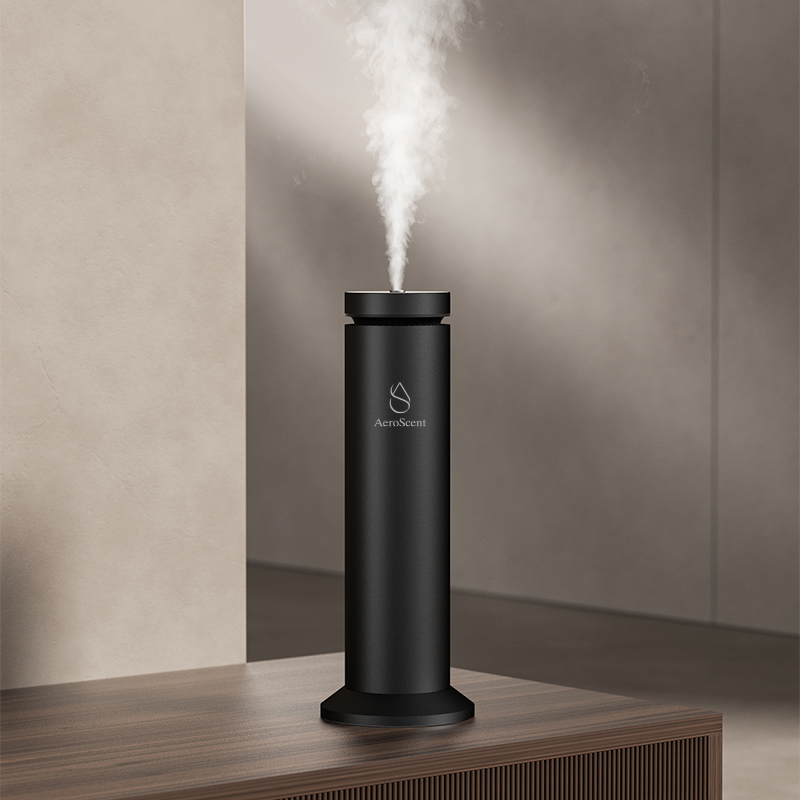
Reviewing hardware specifications often feels like reading a foreign language. However, these numbers dictate exactly how a system performs in your space. Coverage capacity stands out as the most critical metric. Manufacturers typically rate machines by square footage. You will see models advertised for 1,000 square feet and others for 10,000 square feet.
You must look past the two-dimensional floor plan. Square footage ratings assume standard eight-foot ceilings. Commercial spaces usually feature high, vaulted, or open-truss ceilings. A 2,000-square-foot hotel lobby with a 20-foot ceiling actually contains 40,000 cubic feet of air. You must calculate actual cubic volume to ensure proper scent density. Failing to account for high ceilings results in weak, unnoticeable fragrance.
Programmable duty cycles represent another crucial technical specification. Commercial systems never run continuously. Instead, they utilize variable scheduling to manage ambient intensity. A typical duty cycle might run the atomizer for 30 seconds and pause for 60 seconds. This cycle serves two vital functions.
First, duty cycles conserve expensive fragrance during off-peak hours. You can program the machine to lower output during closing hours or periods of low foot traffic. Second, these cycles prevent olfactory fatigue, commonly known as scent blindness. When a human nose encounters a constant odor, the brain eventually tunes it out. Pulsing the fragrance creates subtle peaks and valleys in the air. This keeps the scent noticeable to employees who work full shifts in the building.
Safety remains a top priority when discussing output. Residue and particulate safety depend heavily on submicron atomization. Cheap machines spit larger droplets into the air. These heavy droplets fall quickly to the floor. In a busy retail environment, this creates oily films on merchandise. Worse, it causes slippery floors, opening your business up to severe slip-and-fall liabilities. Industrial-grade nebulizers prevent this by keeping particles so small they evaporate before touching any surface.
Once you understand the nebulization technology, you must choose a delivery architecture. Your building layout entirely dictates the efficiency of your fragrance strategy. We categorize delivery systems into two primary formats: localized units and integrated systems.
Standalone and wall-mounted units offer incredible flexibility. They work best in lobbies, retail boutiques, elevators, and segmented zones. If you manage a car dealership, you might want a distinct leather scent in the showroom and a fresh citrus scent in the service waiting area. Wall-mounted systems allow this granular control.
Implementation requires simple plug-and-play deployment. However, you cannot just place them anywhere. You must position these units near natural air currents. Placing a standalone unit in a stagnant corner prevents the mist from circulating. Additionally, you must secure these devices. Enterprise models feature locking mechanisms to prevent tampering, theft, or unauthorized adjustments by customers.
For expansive footprints, you need HVAC integrated scenting. This architecture works best for large event spaces, casinos, multi-story hotels, and enterprise offices. Instead of relying on a standalone scent diffuser pushing mist into a room, this system operates behind the scenes.
The unit injects the nano-mist directly into the supply side of your HVAC ductwork. It bypasses localized airflow completely. The vapor enters the air stream right after the air handler. The building's existing ductwork then carries the fragrance to every connected room simultaneously. This provides uniform, invisible coverage. You never see the machine, and the scent feels like a natural part of the environment.
Implementation realities for HVAC systems demand careful planning. Your HVAC system must operate with a continuous fan setting. If the fan shuts off, the mist stays trapped inside the ductwork. Professional installation is mandatory. Technicians must map your air return and supply vents to ensure they inject the scent into the outgoing air stream, rather than immediately sucking it back into the return vents.
Even the most advanced hardware fails if you ignore the environmental variables of your building. Deploying a scent strategy requires meticulous planning to avoid common operational pitfalls.
Mapping complex airflow stands out as your most significant hurdle. Buildings breathe. Air moves from high-pressure zones to low-pressure zones. You must identify cross-breezes generated by open doors or large windows. Negative pressure presents a massive risk. If your facility features a large commercial kitchen, the massive exhaust fans can pull air from the dining room or lobby. If you place your diffuser too close to this draft, the exhaust pulls the scent straight out of the building before customers ever experience it.
Maintenance schedules also dictate long-term success. Consumer models require daily refills. This wastes labor hours. Analyzing cartridge lifespan is critical for B2B deployment. High-capacity commercial machines utilize 500ml or 1000ml reservoirs. Under normal duty cycles, these should require cartridge swaps only every 30 to 60 days. You should establish a strict calendar to replace the oil and clean the atomizer head. Neglecting the atomizer leads to clogs, reduced output, and premature motor failure.
Finally, you must navigate safety and compliance standards. Enterprise environments cannot use unregulated oils. You must ensure all fragrances comply with IFRA (International Fragrance Association) standards. This guarantees the formulations exclude known allergens and harmful toxins. Volatile Organic Compound (VOC) monitoring is also essential in closed environments. Reputable machinery includes safety shut-offs to prevent over-pressurization, protecting both the hardware and your building's infrastructure.
Selecting the right hardware partner requires a structured evaluation. You must align the technology with your specific facility requirements. Start with a comprehensive space assessment. Do you have accessible ductwork? Many older buildings or open-concept industrial spaces lack central air conditioning. In those cases, you must rely on a network of strategically placed wall-mounted units. If you do have central air, determine if the main air handler is easily accessible for tubing installation.
Modern control mechanisms differentiate basic machines from enterprise solutions. Prioritize units equipped with Bluetooth or Wi-Fi connectivity. If you run a multi-location business, centralized dashboards prove invaluable. A brand manager in Chicago can use a cloud portal to adjust the fragrance intensity of a retail store in Miami. This ensures absolute brand consistency across hundreds of locations without relying on local staff.
| Intensity Level | Run Time (Atomizing) | Pause Time (Resting) | Best Application Scenario |
|---|---|---|---|
| Low | 15 Seconds | 180 Seconds | Small offices, enclosed waiting rooms |
| Medium | 30 Seconds | 120 Seconds | Standard retail floors, hotel corridors |
| High | 60 Seconds | 60 Seconds | Large lobbies, casinos, high-ceiling venues |
Your immediate next step involves practical testing. Conduct an on-site airflow audit before committing to a specific machine type. Light a smoke pen or use a professional anemometer to track exactly where air moves in your lobby. Once you map the currents, request a 30-day pilot for your highest-traffic zones. A pilot program reveals the actual consumption rate of the oil and allows you to gauge customer and employee feedback before scaling the rollout.
A commercial scent diffuser machine is a specialized pneumatic device engineered for scale, safety, and operational consistency. It moves beyond simple aesthetics to become a measurable component of your facility's brand experience. By leveraging cold-air nebulization, you eliminate residue risks while achieving maximum airborne suspension.
We recommend choosing your technology based strictly on total cubic volume and your existing building infrastructure. If your space exceeds 5,000 square feet and has accessible ductwork, prioritize cold-air HVAC integration for invisible, uniform coverage. For smaller or segmented areas, deploy locking wall-mounted units.
Take action today by consulting with a scenting architect. Have them audit your facility's HVAC capabilities, measure your complex airflow dynamics, and help you select the optimal diffusion hardware to elevate your commercial environment.
A: No. High-quality commercial units use cold-air nebulization, producing a dry mist of nanoparticles that remain airborne until they dissipate, leaving no residue on surfaces.
A: No. Commercial machines require specifically formulated, highly concentrated, solvent-free oils. Using standard consumer oils will clog the atomizer and potentially void the warranty.
A: Depending on the operating hours and intensity settings, a standard 500ml commercial cartridge typically lasts between 30 to 60 days before requiring a replacement.
A: When installed correctly using waterless nano-technology, it is completely safe. The particles are too small to condense or accumulate on duct walls.


