
Views: 0 Author: Site Editor Publish Time: 2026-06-25 Origin: Site


Commercial scenting has evolved far beyond rudimentary aerosols and localized sprays. For business owners and facility managers, delivering consistent ambient scenting requires industrial-grade technology. You cannot rely on standard air fresheners to handle massive commercial square footage.
A "hotel 360 diffuser" usually refers to an advanced sub-micron diffusion system. Engineers design these units to disperse fragrance evenly across large, high-traffic commercial footprints. Without proper mechanical dispersion, you risk creating uneven scent zones. Some areas become overpowering while others remain completely unfragranced.
This guide breaks down the mechanical operation of these powerful systems. We will explore deployment realities and crucial evaluation criteria. You will learn exactly how to select and integrate a high-capacity hotel diffuser into your commercial environment for maximum impact.
Traditional scenting methods fail repeatedly in modern commercial environments. Heat-based devices alter essential oil chemistry. Heat destroys delicate fragrance top notes rapidly. Evaporative systems fade too quickly to be useful. Water-based ultrasonic devices introduce excess humidity into your building. They often pose microbial risks in public spaces. You need a superior solution for massive areas. We rely strictly on cold-air nebulization instead.
How does cold-air nebulization work? The process relies on fluid dynamics. Pressurized air forces pure fragrance oil through a highly specialized nozzle. This movement creates a powerful Venturi effect. It breaks the heavy liquid into microscopic droplets. We call these sub-micron nanoparticles. They typically measure less than one micron in diameter. A conventional aerosol spray creates heavy drops. Heavy drops fall rapidly to the floor. Sub-micron particles do not.
These tiny particles achieve a true "360" dispersion effect. The nanoparticles weigh virtually nothing. They remain suspended in the air indefinitely. They interact perfectly with your building's natural ambient airflow. They travel easily around corners. They move seamlessly up staircases. They fill the entire space evenly. Furthermore, this dry mist leaves absolutely zero residue. Your furniture, glass, and expensive flooring remain completely clean. You can confidently place a powerful hotel 360 diffuser near retail inventory without fear of damage.
You have two primary workflows for deploying commercial scenting. We categorize these into whole-building systems and zone-specific systems. Each approach serves distinct architectural and operational needs.
| Deployment Type | Mechanism | Ideal Locations | Key Constraints |
|---|---|---|---|
| HVAC-Integrated | Taps into supply ductwork post-fan. | Large lobbies, casinos, expansive retail. | Requires professional install, static pressure checks, AHU timer sync. |
| Standalone / Portable | Uses internal fans for direct room dispersion. | Corridors, elevators, leased boutiques. | Requires secure placement, aesthetic matching, floor space. |
HVAC-integrated systems represent the whole-building approach. They tap directly into the supply ductwork of your central air system. You mount the machine near the main air handling unit (AHU). A specialized tube delivers the fragrance mist directly into the airflow. This method is incredibly discreet. It is ideal for massive hotel lobbies and busy casinos. You achieve invisible, ultra-silent dispersion. Guests never see or hear the equipment.
However, HVAC integration brings implementation constraints. You must hire a professional for installation. Technicians must verify your HVAC static pressure. If duct pressure is too high, it pushes the fragrance mist backward. You must also synchronize the machine's timer. It should only diffuse when the AHU fan runs. Otherwise, fragrance oils condense inside your ductwork.
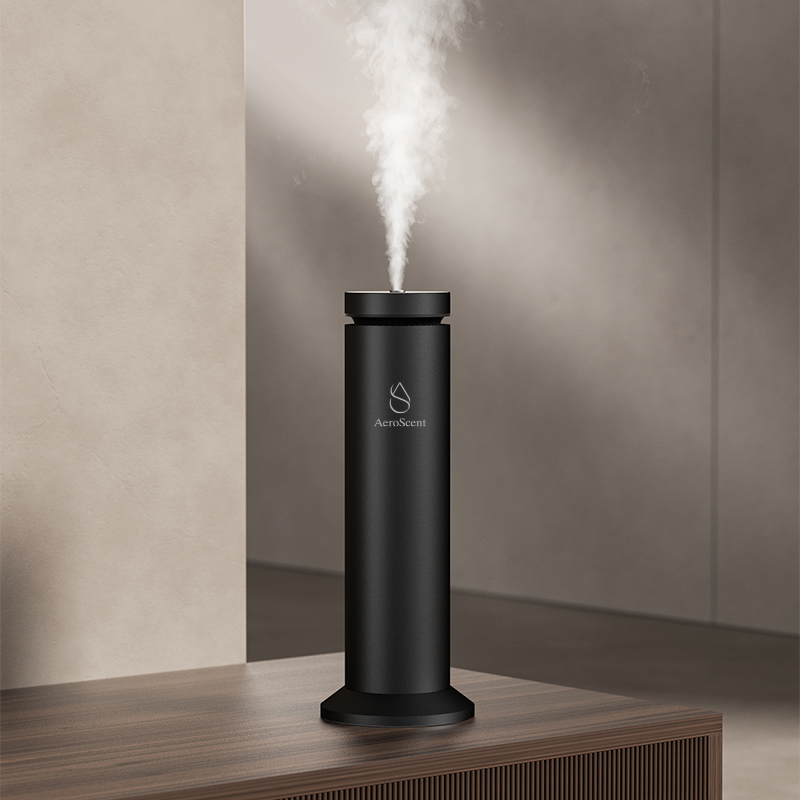
Standalone systems offer a zone-specific approach. They deliver plug-and-play operation. They utilize internal fans to push the cold-air mist directly into the room. This works perfectly for tight corridors and busy elevators. Retail boutiques also favor this method. Sometimes landlords prohibit ductwork modifications entirely. Standalone units solve this problem beautifully.
These portable units do present specific constraints. You must ensure secure placement. You need to prevent tampering by curious guests. Many commercial models feature locking compartments for this reason. Aesthetically, they must align with your interior design. The tower must blend into your existing decor naturally.
Facility managers often make one critical mistake. They calculate square footage instead of cubic footage. You cannot evaluate coverage strictly by floor space. You must factor in your ceiling height. Vaulted ceilings trap massive amounts of air. Multi-level lobbies create highly complex circulation patterns. Always multiply length by width by height. This calculation provides your true cubic volume.
Air exchange rates also dictate your equipment needs. Commercial buildings cycle fresh air constantly. Aggressive commercial ventilation dilutes ambient scent rapidly. Open-door policies in retail entrances do the exact same thing. High air turnover demands robust equipment. You need units capable of maintaining higher continuous output.
We must also plan your zoning architecture carefully. Most commercial properties feature distinct environmental zones. A luxury hotel contains a lobby, a restaurant, and a spa. You do not want food aromas mixing with spa eucalyptus. We call this undesirable mixing "scent clashing."
To avoid clashing, you employ multiple synchronized units. Proper zoning requires strategic planning. Follow these essential steps when designing your coverage:
Many vendors market commercial scenting as a set-it-and-forget-it solution. This is entirely false. You must understand consumable consumption rates. Fragrance oil usage varies drastically. Your programmed intensity settings dictate consumption. Daily operating hours also play a massive role. Typically, a commercial oil reservoir requires refilling every 30 to 90 days. You must plan this into your operational budget.
Routine maintenance keeps your equipment functioning optimally. Over time, dense essential oils can clog micro-nozzles. You must perform regular upkeep to prevent mechanical failure. We recommend following a strict service schedule.
| Task | Frequency | Action Required |
|---|---|---|
| Nozzle Cleaning | Every 30-60 Days | Run rubbing alcohol through the system for 15 minutes. |
| Filter Inspection | Quarterly | Check internal air filters for dust accumulation. |
| Tubing Check | Bi-Annually | Inspect HVAC delivery tubes for kinks or blockages. |
Compliance and safety represent another critical priority. Commercial spaces host diverse populations daily. Public foot traffic brings varying respiratory sensitivities. Always choose VOC-compliant fragrance oils. Ensure they hold IFRA (International Fragrance Association) certification. High-quality oils contain no harsh parabens. They omit harmful synthetic propellants completely. This protects your guests and your liability.
Subjective scent preferences should never drive your business decisions. We measure commercial scenting success through objective data. Brand uniformity serves as a primary driver. A reliable diffusion system ensures absolute consistency. Customers experience the exact same welcoming environment across multiple property locations. Franchise owners rely heavily on this. It standardizes the customer experience flawlessly.
Behavioral metrics provide clear evidence of success. Retailers track dwell time meticulously. Shoppers consistently linger longer in pleasantly scented environments. Lobbies suddenly feel more inviting. Guests often report a higher perceived value of your services. They perceive the facility as cleaner and significantly more luxurious.
These environmental upgrades improve guest satisfaction scores directly. Positive reviews increase organically. A signature scent triggers powerful neurological memories. Guests remember your brand long after they leave the property. Strategic scent marketing influences consumer behavior daily. It encourages repeat visits seamlessly. It builds lasting brand loyalty without requiring additional staff interaction.
A: No. Because it uses cold-air nebulization to create sub-micron particles, the fragrance remains suspended in the air. It evaporates naturally without settling on your furniture, glass, or retail inventory.
A: Most ducted systems can support integration. However, it requires access to the supply duct post-filtration. It is not compatible with ductless mini-splits or certain closed-loop radiant heating systems.
A: Duration is highly variable. A standard 500ml commercial bottle lasts between 30 and 60 days. This depends entirely on your programmable run-times, HVAC cycle frequency, and desired scent intensity.
A: Yes. When utilizing high-quality, IFRA-compliant, and hypoallergenic oils free from parabens and synthetic VOCs, the sub-micron dispersion is generally considered safe and non-irritating for diverse public commercial spaces.


