
Views: 0 Author: Site Editor Publish Time: 2026-08-07 Origin: Site


The operational shift from residential aromatherapy devices to commercial-grade ambient scenting systems requires a fundamental understanding of fluid dynamics and particle suspension. Facility managers and operations teams struggle to achieve consistent, residue-free scent distribution across large square footages without incurring high maintenance overhead, risking HVAC contamination, or dealing with the messy buildup common in consumer units. Understanding the exact mechanical processes behind a commercial plug in essential oil diffuser is necessary for evaluating hardware and selecting a system that aligns with specific facility architecture and brand identity. We will break down the physics of cold-air nebulization, evaluate form factors, and map out implementation strategies for enterprise environments.
Commercial scenting relies on precise physical processes to transform liquid fragrance into an airborne experience. You cannot simply heat oil or mix it with water if you want to cover thousands of square feet. The goal is to create a micro-fine mist. These nanoparticles typically measure under 1 micron in diameter. At this microscopic size, the scent particles become buoyant. They travel effortlessly on ambient air currents. This creates a consistent atmospheric experience across large commercial zones without settling on surfaces.
Residential devices operate differently. They lack the throw capacity required for expansive areas. Most consumer units depend on water to carry the scent. Water droplets are heavy, often measuring between 30 and 50 microns. They fall out of the air rapidly, limiting the scent's reach to a few feet. Commercial environments demand a high-pressure, dry-mist output. This output must remain suspended in the air for hours, navigating complex airflow patterns generated by HVAC systems and foot traffic.
The core mechanism involves air pressure, the Venturi effect, and specialized internal chambers. A commercial scent dispenser pulls fragrance oil directly from a reservoir into an atomization chamber. The process follows a strict mechanical sequence:
This mechanical process alters nothing about the chemical composition of the oil. It preserves the exact scent profile while maximizing coverage. Because no heat is applied, the delicate top notes of the fragrance remain intact. Because no water is added, the risk of mold and bacterial growth inside the unit is eliminated.
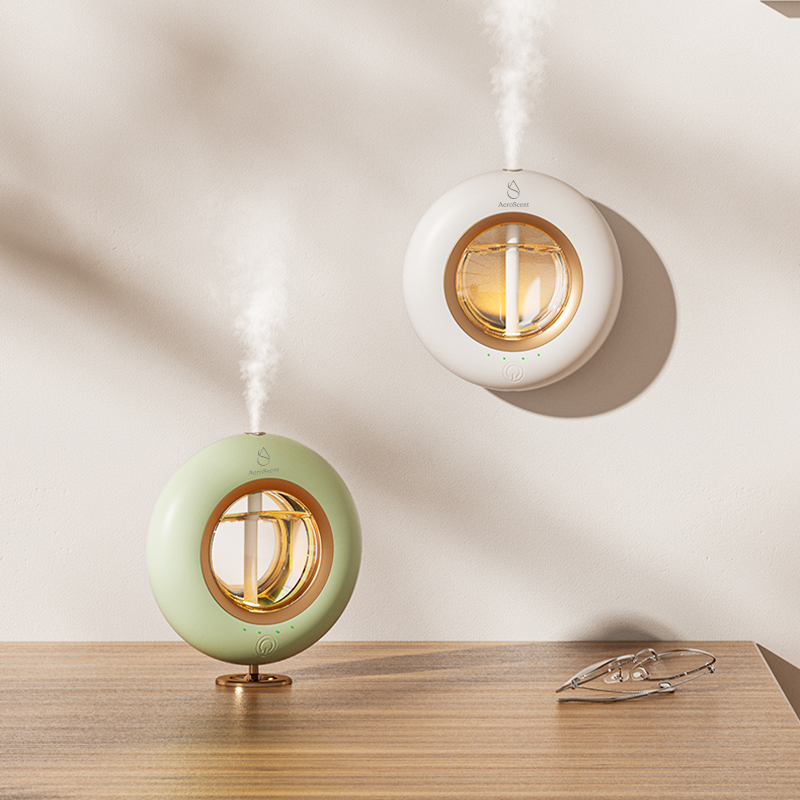
Cold-air nebulization is the absolute standard for large-scale scenting. The mechanism uses pressurized air to force essential oil through a specialized baffle. This creates a completely dry mist of nanoparticles. These particles exit the device and disperse evenly throughout the space. Facility managers prefer this technology because it operates independently of the building's water supply and requires minimal daily oversight.
This technology offers unmatched commercial viability. It leaves zero residue on floors, furniture, or inventory. It requires absolutely no water. Because it uses no heat, it preserves the structural integrity and therapeutic profile of the essential oil. The scent remains pure from the moment it leaves the machine until it dissipates through the building's exhaust vents.
There are minor trade-offs. The internal air compressors generate operational noise, similar to a low hum. You must place these units strategically or utilize sound-dampening enclosures if deploying them in whisper-quiet environments like spas or libraries. They also carry a higher initial hardware requirement compared to basic consumer models, though the reduction in maintenance labor offsets this rapidly.
Ultrasonic devices utilize electronic frequencies to create rapid vibrations. A piezoelectric transducer sits at the bottom of a water basin. It vibrates at ultrasonic speeds, creating a standing wave. This wave ejects a localized water-and-oil vapor into the air. While popular in residential settings, this mechanism struggles under the demands of a commercial facility.
Commercial viability for ultrasonic units is severely limited. You can deploy them in very small, enclosed spaces. Individual spa treatment rooms or compact waiting areas are suitable. They fail in open-concept facilities because the heavy water droplets cannot travel far enough to scent a large room evenly.
The trade-offs are significant. Ultrasonic machines introduce excess humidity into the environment, which can interfere with sensitive electronics or paper goods. The water dilutes the scent efficacy over large areas. Most importantly, they require daily cleaning. Minerals in the water and thick essential oils create mold, biofilm, and calcification buildup. This buildup can permanently damage the internal components if left unchecked, leading to frequent hardware replacement.
Heat dissemination uses a direct heat source to evaporate oil into the air. Evaporation relies on passive capillary action. Porous, plant-based reeds absorb scented oils and release them slowly over time. Neither of these methods provides the control or power required for professional facility management.
These methods are generally obsolete for enterprise use. They cannot meet the demands of modern facility management, which requires precise scheduling, adjustable intensity, and massive square footage coverage.
Heat alters the chemical profile of the oil. It degrades the delicate top notes of the fragrance, leaving a flat or burnt smell. Passive evaporation lacks any projection power. You cannot control the output intensity, making it impossible to scent large square footage effectively. A commercial electric diffuser must offer programmable control, which passive systems simply cannot provide.
| Technology | Particle Size | Residue Risk | Maintenance Frequency | Commercial Viability |
|---|---|---|---|---|
| Cold-Air Nebulization | Under 1 micron | Zero | Monthly (Cartridge Swap) | High (Industry Standard) |
| Ultrasonic | 30 - 50 microns | High (Water/Oil Film) | Daily (Scrubbing/Refilling) | Low (Small enclosed rooms only) |
| Heat / Evaporation | Varies (Vapor) | Low | Weekly (Refilling) | Obsolete for enterprise |
Compact units designed for localized scenting serve specific architectural needs. A commercial wall plug diffuser provides targeted fragrance delivery without occupying floor space. These units are engineered to lock securely into standard outlets, preventing tampering or accidental unplugging by cleaning staff.
Optimal use cases include hallways, elevator banks, waiting rooms, and localized zones under 500 square feet. These areas require consistent scenting but lack the square footage to justify a massive standalone machine. They are particularly effective in transitional spaces where you want to create a specific olfactory impression as guests move from one zone to another.
The operational reality is straightforward. The device plugs directly into standard electrical outlets. It offers plug-and-play simplicity. Facility staff can install them in minutes. However, their smaller oil reservoirs mean they require more frequent cartridge replacements compared to larger industrial units. You must factor this into your monthly maintenance schedule.
Medium to large open spaces require robust hardware that can operate independently of ductwork. Standalone units house larger compressors and massive oil capacities, often holding 500ml to 1000ml of fragrance oil. This allows them to run for months without intervention.
Optimal use cases include hotel lobbies, retail showrooms, and open-plan offices. These environments often feature high ceilings and complex foot traffic patterns. Standalone units can push scent through these challenging spaces by leveraging their high-velocity output fans.
These units operate independently of the HVAC system. They are highly portable and adjustable. You can move them as seasonal displays or layout changes occur. You must place them strategically. Leverage natural facility airflow to push the scent through the space. Avoid placing them in dead air zones to prevent "scent pooling," where fragrance concentrates heavily in one corner. Keep them away from direct return vents, or the HVAC system will suck the scent out of the room before occupants can experience it.
Enterprise-scale scenting requires integration directly into the building's air handling units (AHU). This is the most advanced form factor available. It utilizes the building's existing ductwork and blower fans to distribute the scent evenly across massive areas.
Optimal use cases include whole-building distribution, multi-zone facilities, and spaces exceeding 5,000 square feet. Casinos, large resorts, and massive retail centers rely exclusively on this method. It guarantees that every square foot of the facility receives the exact same concentration of fragrance.
The operational reality involves connecting the nebulizer directly to the ductwork. It injects the dry mist into the supply air using a specialized pitot tube. This provides the most consistent, invisible scenting experience. Guests smell the fragrance but never see the hardware. This requires professional installation. You must coordinate the scenting schedule with existing HVAC fan operations. The diffuser must be wired to an air switch or the fan relay so it only runs when the HVAC blower is actively pushing air. Injecting scent into a dormant duct will cause the oil to settle and coat the sheet metal.
You must match the hardware output to the exact physical dimensions of your space. Success requires mapping cubic footage against the maximum output capacity of the chosen hardware. Do not just measure floor space. High ceilings drastically increase the volume of air you need to scent. A 1,000 square foot room with 10-foot ceilings requires significantly less output than a 1,000 square foot room with 20-foot ceilings.
Analyze natural drafts, entry and exit points, and HVAC return vents. If you place a diffuser directly beneath a powerful return vent, the HVAC system will immediately extract the scent from the target zone. Map the positive and negative pressure zones. Place the hardware where the natural airflow will carry the nanoparticles across the room. In spaces with heavy negative pressure, such as near commercial kitchens or large exhaust fans, you will need to increase the diffuser's output to compensate for the rapid air turnover.
Commercial hardware must reduce labor, not increase it. Success means achieving a minimum of 30 days of autonomous operation between oil refills. Facility teams do not have time to service diffusers daily. Every minute spent cleaning a water basin is a minute taken away from critical building maintenance.
Compare the labor requirements of different systems. Daily ultrasonic water refills and basin scrubbing consume massive amounts of staff time. Monthly nebulizer cartridge swaps take less than two minutes. Prioritize systems with programmable timers and large reservoirs to stretch maintenance cycles as long as possible. Look for units with Bluetooth or Wi-Fi connectivity, allowing facility managers to monitor oil levels and adjust schedules remotely without physically inspecting the device.
Protecting facility assets is non-negotiable. Success requires zero accumulation of oil droplets on floors, inventory, or sensitive electronic equipment. Slippery floors create severe liability risks. A drop in the Dynamic Coefficient of Friction (DCOF) on hard surface flooring can lead to slip-and-fall lawsuits.
Verify the micron size of the output before deployment. The particles must be light enough to remain airborne until they naturally dissipate. Only true cold-air nebulizers guarantee a dry mist. If a device spits visible droplets or leaves a damp ring around its base, it is entirely unsuitable for commercial deployment. Furthermore, heavy oil particles can settle on server racks, point-of-sale systems, and retail merchandise, causing permanent damage. Sub-micron atomization is the only way to prevent this.
Integrating scent into ductwork carries specific mechanical risks. The primary risk is oil buildup inside the ducts or interference with sensitive air quality sensors. Heavy oil particles can coat the sheet metal, trapping dust and creating fire hazards over time.
The human brain quickly adapts to constant smells. This phenomenon is olfactory fatigue, or "noseblindness." The risk is that employees or long-term occupants stop smelling the fragrance. Facility managers often react by increasing the output intensity. This wastes oil and creates an overpowering, unpleasant wall of scent for new visitors walking through the door.
Introducing compounds into commercial air supplies requires strict oversight. The risk involves triggering respiratory issues, violating indoor air quality (IAQ) standards, or creating an atmosphere that drives customers away.
A: Coverage depends heavily on the specific technology and form factor. Small wall-mounted units typically cover up to 500 square feet. Standalone floor units can scent between 1,000 and 3,000 square feet. HVAC-integrated systems can cover upwards of 5,000 to 10,000 square feet depending on the building's air handling capacity.
A: A true cold-air nebulizing diffuser leaves absolutely zero residue. It breaks the oil down into sub-micron nanoparticles that remain suspended in the air until they dissipate. However, ultrasonic or water-based diffusers will leave a noticeable, slippery residue as heavy water droplets fall onto surfaces.
A: A cold-air dispenser uses pressurized air to shatter pure essential oil into a dry, invisible mist without altering its chemistry. An ultrasonic diffuser uses electronic vibrations to mix oil with water, creating a heavy, localized vapor that adds humidity and requires daily cleaning.
A: Capillary action is a passive process where porous reeds slowly absorb and evaporate oil. It offers zero control over intensity and cannot project scent across large areas. Active electric diffusion uses mechanical force to distribute scent rapidly, consistently, and over massive square footages.
A: No. Wall plug units are designed for localized, plug-and-play operation in standard electrical outlets. HVAC integration requires specialized, high-capacity nebulizers equipped with air tubes and pitot nozzles designed specifically to inject scent directly into ductwork post-filtration.
A: Yes, provided you use pure, IFRA-compliant oils free of synthetic solvents. However, running them continuously is inefficient due to olfactory fatigue. It is safer and more effective to program duty cycles to maintain air quality and scent perception.


