
Views: 0 Author: Site Editor Publish Time: 2026-09-24 Origin: Site


Operating a commercial scenting system 24/7 is a common operational error that degrades the customer experience and unnecessarily inflates consumable costs. Facility managers and business owners struggle to balance consistent brand scenting with the realities of olfactory fatigue (nose blindness) and the high cost of commercial-grade fragrance oils. Establishing the correct daily run time requires moving away from continuous operation and adopting precision duty cycles based on cubic footage, HVAC airflow, environmental variables, and specific industry foot-traffic patterns.
We will break down the exact mathematical and environmental factors you need to calculate optimal diffusion intervals. You will learn how to configure your hardware to maintain a consistent ambient scent without overwhelming occupants or wasting expensive liquids. Proper scheduling transforms a chaotic scent environment into a controlled, predictable atmospheric element.
Continuous operation is counterproductive: Human olfactory receptors adapt to constant scents within 15–20 minutes; intermittent diffusion (duty cycling) is required to maintain scent perception.
Cost efficiency relies on programmable hardware: Advanced scheduling features reduce fragrance oil consumption by up to 40% compared to manual or continuous operation.
Air volume and environment dictate intervals: A large area aroma diffuser requires different work/pause ratios depending on whether it is a standalone unit, integrated into an HVAC system, or operating in varying seasonal humidities.
Compliance and IAQ: Strategic run times ensure indoor air quality (IAQ) remains within safe thresholds, preventing residue buildup and respiratory irritation.
The primary goal of commercial scenting is achieving a consistent, ambient brand experience. You want occupants to notice the fragrance without feeling overwhelmed. Wasting resources on continuous output directly contradicts this goal. Success requires understanding how the human nose processes ambient smells and how machine run times impact your consumable inventory.
Human biology naturally filters out constant background stimuli. This survival mechanism applies heavily to our sense of smell. When you enter a scented room, olfactory receptors in your nasal cavity send signals to your brain. If the scent remains constant, these receptors adapt rapidly. Within 15 to 20 minutes, the brain stops registering the fragrance. This phenomenon is commonly known as nose blindness.
Running a diffuser continuously guarantees that your staff will stop smelling the fragrance almost immediately. Visitors will notice it upon entry, but the impact fades before they complete their transaction. To combat receptor adaptation, you must use intermittent bursts of scent. A schedule of two minutes of active diffusion followed by three minutes of rest allows the air to clear slightly. This brief pause resets the olfactory receptors. When the machine fires again, the scent registers as fresh and noticeable. You maintain the atmospheric effect without bombarding the sensory system.
Over-diffusing directly impacts your bottom line without adding any experiential value. Commercial-grade fragrance oils represent an ongoing operational expense. Managing this consumption dictates the efficiency of your scent marketing program. You must analyze the difference between continuous operation and programmed duty cycles.
Consider a machine running 12 hours a day continuously. It atomizes oil without pause, consuming maximum liquid volume. Now compare this to a 30% duty cycle over the same 12-hour period. The machine only actively diffuses for roughly 3.6 hours total, broken into hundreds of small intervals. The ambient scent level remains identical to visitors due to particle buoyancy, but you save massive amounts of fragrance oil. Strategic scheduling stretches your consumable inventory significantly while maintaining the exact brand experience you desire.
Operational Mode (12-Hour Shift) | Active Diffusion Time | Rest Time | Estimated Monthly Oil Consumption (Standard Output) | Olfactory Fatigue Risk |
|---|---|---|---|---|
Continuous (24/7) | 12 Hours | 0 Hours | 800ml - 1000ml | Extreme (Nose blindness within 20 mins) |
50% Duty Cycle (e.g., 60s ON / 60s OFF) | 6 Hours | 6 Hours | 400ml - 500ml | Moderate (Requires adjustment for heavy traffic) |
30% Duty Cycle (e.g., 30s ON / 70s OFF) | 3.6 Hours | 8.4 Hours | 240ml - 300ml | Low (Optimal for consistent perception) |
15% Duty Cycle (e.g., 15s ON / 85s OFF) | 1.8 Hours | 10.2 Hours | 120ml - 150ml | None (Best for small or enclosed spaces) |
There is no universal setting for scenting a space. You must evaluate mathematical, chemical, and environmental variables to dictate your scheduling. A Commercial Aroma Diffuser requires precise calibration based on the unique physical characteristics of your facility.
In the context of cold-air atomization, a duty cycle refers to the ratio of active diffusion time to rest time. The machine operates in a continuous loop of work and pause intervals. You program these intervals in seconds. This granular control allows you to maintain a specific concentration of scent particles in the air.
Baseline interval recommendations vary by space size and desired intensity. For moderate spaces with standard ceilings, a cycle of 60 seconds on and 120 seconds off provides a subtle, consistent background scent. High-ceiling environments require more aggressive saturation. In these spaces, you might program 90 seconds on and 60 seconds off. You must adjust these baselines based on real-world observation and occupant feedback.
Square footage is an inadequate metric for scenting calculations. Scent particles fill three-dimensional space. You must calculate cubic volume by multiplying length, width, and height. A 5,000 square foot room with 10-foot ceilings requires vastly different settings than a 5,000 square foot room with 25-foot ceilings. You must determine how long a large area aroma diffuser needs to run to achieve full volumetric saturation.
Measure the length and width of the target scent zone.
Measure the exact ceiling height, accounting for vaulted or drop ceilings.
Multiply Length x Width x Height to find total cubic feet.
Cross-reference this cubic volume with your diffuser's maximum output capacity to establish a baseline work interval.
Airflow dynamics heavily influence dispersion rates. Natural ventilation, frequently opened doors, and strong drafts pull scent particles out of the target zone. If your space experiences high air turnover, you must decrease the pause interval to replenish the lost fragrance. Conversely, tightly sealed rooms retain particles longer, allowing for extended rest periods.
The specific chemical profile of your chosen fragrance alters your required run times. Fragrances consist of top, middle, and base notes. These notes possess different volatility rates, meaning they evaporate at different speeds.
Highly volatile top notes, such as citrus, peppermint, or eucalyptus, dissipate rapidly. They provide an immediate, bright impact but vanish quickly from the air. To maintain a citrus-heavy scent profile, you require shorter, more frequent diffusion cycles. Heavier base notes, like woods, musks, and ambers, feature larger molecular structures. They linger significantly longer in the air. When diffusing heavy woody profiles, you can utilize extended pause intervals without losing the ambient scent.
Fragrance Profile | Dominant Notes | Volatility Rate | Recommended Scheduling Adjustment |
|---|---|---|---|
Citrus & Fresh | Lemon, Bergamot, Mint | High (Evaporates quickly) | Shorten pause intervals; increase cycle frequency. |
Floral & Herbal | Lavender, Rose, Rosemary | Medium (Moderate hang time) | Standard baseline duty cycles (e.g., 60s ON / 120s OFF). |
Woody & Musky | Sandalwood, Amber, Vanilla | Low (Lingers extensively) | Extend pause intervals; reduce cycle frequency. |
Temperature and humidity directly affect scent throw and particle buoyancy. You must adjust your schedules as the seasons change. High humidity in the summer introduces heavy moisture into the air. This moisture weighs down scent particles, causing them to fall to the floor faster. During humid months, you generally need slightly longer work intervals to maintain saturation.
Winter heating systems create dry, warm environments. Dry air allows sub-micron scent particles to travel rapidly and stay buoyant for extended periods. You can often reduce your work intervals during the winter, relying on the HVAC system to distribute the fragrance efficiently.
Your installation method dictates your scheduling limitations. HVAC-connected systems require strict synchronization with your building's air handling unit (AHU). If the AHU fan is off, the diffuser must be off. Running an HVAC diffuser into a stagnant duct causes heavy oil condensation. This wastes fragrance and damages your ductwork.
Standalone operation relies entirely on localized air currents. Localized units require shorter, more frequent bursts. If a standalone unit runs too long in one cycle, heavy scent pooling occurs immediately around the machine. Strategic physical placement near natural airflow pathways helps standalone units mimic the distribution efficiency of HVAC integration.
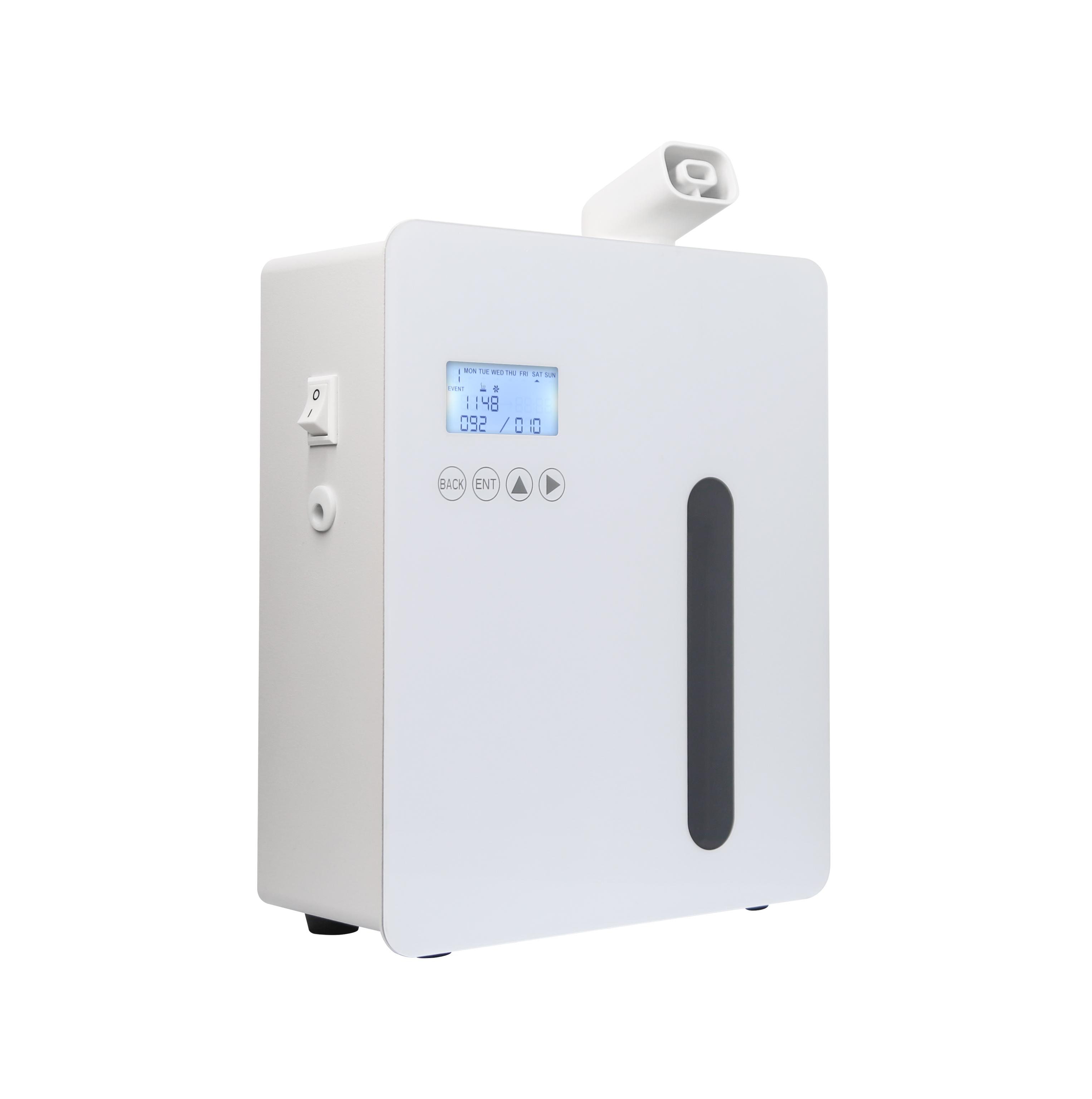
Different business environments demand different scenting strategies. You must map your run-time configurations to your specific operational hours, traffic patterns, and customer expectations. A schedule that works for a retail store will fail in a medical clinic.
Retail stores require dynamic scheduling to handle fluctuating foot traffic. You should align your diffuser schedules strictly with your posted store hours. Never run the machines overnight. Program a 15-minute pre-opening cycle. This establishes the ambient scent baseline before the first customer walks through the doors.
You must also adjust intensity during peak operational hours. High volumes of foot traffic introduce body heat and physical movement, which disrupt natural airflow and dilute the fragrance. Program your system to increase the work interval by 10% to 15% during your busiest daily windows to maintain a consistent brand presence.
Hospitality environments present the unique challenge of 24-hour spaces. Running a static schedule around the clock wastes resources during low-traffic overnight hours. You must implement a tiered scheduling approach.
Program higher intensity and longer work cycles during peak check-in and check-out times. The lobby experiences heavy door movement and high occupancy during these windows. Overnight, shift the schedule to lower intensity with extended pause intervals. The lobby remains scented for late arrivals, but you drastically reduce oil consumption when the space is largely empty.
Therapeutic and medical settings require extreme caution. The goal is subtle relaxation, not aggressive branding. When deploying a commercial aromatherapy machine in these environments, you must prioritize low-intensity thresholds.
Utilize extended pause intervals to maintain a calming environment. A cycle of 30 seconds on and 180 seconds off often provides enough ambient fragrance to soothe anxious patients without triggering respiratory sensitivities. Always solicit feedback from staff and patients to make sure the scent remains strictly in the background.
Executing optimal run times requires capable hardware. You cannot implement precision duty cycles on basic machines. When evaluating equipment, you must guide your purchasing decisions based on technical specifications that support granular scheduling.
Rudimentary machines offering only basic low, medium, and high settings fail in commercial applications. You cannot customize the work and pause intervals on these devices. You require multi-event, 7-day programmable logic controllers (PLCs) or advanced app-based scheduling.
App-based controls utilizing Bluetooth or Wi-Fi allow facility managers to adjust schedules remotely. You can program multiple daily events, shifting intensity automatically from morning to afternoon. This level of granular control maximizes oil efficiency and combats olfactory fatigue.
The physical mechanism of diffusion dictates how long your machine needs to run. Traditional heat or water-based diffusers produce heavy particles that fall quickly. Cold-air atomization forces pressurized air through the essential oil, breaking it down into sub-micron nanoparticles.
These ultra-fine particles stay airborne significantly longer. Because the scent remains suspended in the air currents, you can program shorter work intervals and longer pause intervals. The efficiency of the atomization process directly reduces your required daily run time.
Expansive facilities rarely require the same scent intensity in every zone. A hotel lobby needs a different schedule than the adjacent public restrooms. Multi-zone systems provide necessary scalability for large area diffusers.
Advanced commercial units allow a single central compressor to drive multiple distinct atomizing heads. You can program independent schedules for each zone. The lobby head fires aggressively during check-in, while the restroom head maintains a steady, low-intensity cycle all day. This independent programming prevents over-scenting smaller adjacent spaces.
Frequent daily cycling demands reliable, efficient internal components. Look for commercial units equipped with low-voltage DC motors. These motors handle the constant stop-and-start action of duty cycling without overheating or drawing excessive power.
Even with hundreds of micro-cycles per day, the electrical footprint of a DC-powered diffuser remains negligible. This keeps your operational focus entirely on managing the consumable fragrance oil rather than monitoring utility spikes.
Improper scheduling introduces technical, safety, and experiential risks. You must anticipate these pitfalls before deploying your hardware. Implementing strict mitigation strategies protects your building infrastructure and maintains a pleasant scenting program.
Setting the diffuser to maximum output on day one is a common mistake. It overwhelms occupants, triggers complaints, and wastes expensive oil. You must treat the first week of operation as a strict calibration phase.
Start with a highly conservative 20% duty cycle (e.g., 30 seconds ON, 120 seconds OFF).
Run this baseline schedule for three full operational days.
Solicit honest feedback from staff members working in different zones of the facility.
If the scent is unnoticeable, incrementally increase the work interval by 10 seconds.
Repeat this gradual adjustment protocol until you reach the ideal ambient level.
Integrating a diffuser into your HVAC ductwork carries specific mechanical risks. If the diffuser fires while the AHU fan is inactive, the atomized oil has nowhere to go. It pools inside the ductwork, creating sticky residue, damaging the metal, and introducing potential fire hazards.
You must mandate the use of air-switch sensors or sail relays. These physical sensors mount inside the duct and detect active airflow. They wire directly to the diffuser's control board. The diffuser physically cannot operate unless the sensor detects adequate air pressure. This foolproof mitigation strategy protects your building infrastructure.
Excessive run times negatively impact indoor air quality. Pumping too much fragrance into a sealed environment elevates Volatile Organic Compound (VOC) levels beyond recommended thresholds set by OSHA or ASHRAE. Poor IAQ leads to staff headaches and customer discomfort.
Adhere strictly to your calculated duty cycles to prevent particle buildup. Furthermore, only utilize fragrances that comply with International Fragrance Association (IFRA) standards. IFRA-compliant oils undergo rigorous testing to verify they remain safe for continuous ambient inhalation when diffused at proper intervals.
High-frequency duty cycles require consistent mechanical upkeep. Atomizer nozzles process thick, viscous oils daily. Over time, microscopic blockages alter the spray pattern and reduce efficiency. You must base your maintenance schedule on your total operational hours.
For machines running standard daily schedules, mandate a nozzle cleaning protocol every 30 to 60 days. Remove the fragrance bottle, fill a temporary bottle with standard rubbing alcohol, and run the machine for 15 minutes. The alcohol flushes the microscopic atomization pathways, dissolving hardened oil residue and restoring the machine to factory performance.
There is no single correct daily run time for commercial scenting. Optimal operation relies entirely on precise duty cycling tailored to your specific cubic volume, airflow dynamics, and fragrance profile. Moving away from continuous 24/7 operation saves resources and prevents olfactory fatigue. When evaluating commercial scenting solutions, prioritize hardware that offers granular digital scheduling, sub-micron atomization, and HVAC airflow sensors.
Take the following steps to optimize your system:
Audit your facility's cubic footage to establish an accurate baseline for required air saturation.
Map your peak operational hours and foot-traffic patterns to design a tiered, dynamic diffusion schedule.
Consult with a qualified scent marketing technician to properly install air-switch sensors for any HVAC-integrated units.
Initiate a strict 3-day calibration protocol, starting at a 20% duty cycle, before finalizing your permanent settings.
A: Running a diffuser continuously wastes oil and causes olfactory fatigue, making occupants nose-blind to the scent within 20 minutes. Instead of continuous output, use 24-hour scheduling with intermittent duty cycles to maintain a noticeable fragrance while conserving resources.
A: A duty cycle is the ratio of active diffusion time to resting time. It consists of a work interval and a pause interval. For example, a common duty cycle is 60 seconds of active diffusion followed by 120 seconds of rest.
A: Consumption varies heavily based on your programmed duty cycle and the cubic footage of the space. On average, a properly calibrated machine uses between 100ml and 500ml of fragrance oil per month depending on settings.
A: Yes. Highly volatile top notes, like citrus or peppermint, dissipate rapidly and require more frequent diffusion cycles. Heavier base notes, such as woods or musks, linger longer in the air, allowing for extended pause intervals.
A: No. HVAC diffusers must only operate when the system fan is actively moving air. Running the diffuser without airflow causes heavy oil condensation inside the ductwork, leading to residue buildup and potential damage.
A: Biological adaptation to a constant scent occurs within 15 to 20 minutes. Intermittent scheduling combats this by providing brief pauses in diffusion, which allows olfactory receptors to reset and register the scent again.
A: Yes. Machines running high-frequency cycles require periodic maintenance to prevent clogs. You should flush the atomizer nozzle with rubbing alcohol every 30 to 60 days to dissolve oil residue and maintain optimal performance.


