
Views: 0 Author: Site Editor Publish Time: 2026-07-27 Origin: Site


Arbitrary oil measurement remains the most common point of failure in aromatherapy and ambient scenting. Guessing drop counts inevitably leads to one of two outcomes: imperceptible results or overwhelming, potentially hazardous environments. Users often pour oil directly into the water reservoir without considering the mechanical limits of their hardware. This lack of precision creates immediate functional issues.
Incorrect oil-to-water ratios directly impact hardware longevity, user safety, and consumable costs. Over-saturating the water degrades internal components. Heavy oils pool on the oscillating plate, causing the device to overheat or fail prematurely. Conversely, under-saturating fails to meet the basic success criteria for ambient scenting. The mist disperses, but the aromatic footprint remains nonexistent. You waste water, electricity, and time.
Establishing a standardized, evidence-based framework solves this problem. Determining the exact number of drops requires analyzing tank capacity, water volume limits, oil viscosity, room dynamics, and specific hardware specifications. By applying a calculated approach, you protect your equipment while achieving the precise aromatic intensity required for your space.
Establishing a baseline measurement balances aromatic output with safe inhalation thresholds. You need enough oil to project scent across a room, but not so much that it irritates the respiratory system or damages the internal plastics. The industry relies on a straightforward metric to achieve this balance. The standard rule dictates using 3 to 5 drops of essential oil per 100ml of water. This ratio provides the ideal dilution for standard ultrasonic atomization. It ensures the ceramic disk can effectively break down the oil particles without becoming bogged down by excessive viscosity. Sticking to this baseline prevents overwhelming the room while guaranteeing a noticeable scent profile.
To scale this rule accurately across different hardware sizes, refer to the comprehensive tank capacity matrix below. This matrix serves as the foundational reference for any Essential Oil Diffuser setup.
| Diffuser Tank Capacity | Recommended Drop Count | Application Notes |
|---|---|---|
| 100ml | 3 to 5 drops | Standard baseline for small rooms, personal desks, or localized scenting zones. |
| 150ml | 5 to 7 drops | Ideal for medium-sized bedrooms, bathrooms, or small office spaces. |
| 200ml | 6 to 10 drops | Standard living room application with moderate airflow. |
| 300ml | 9 to 15 drops | Effective for larger living spaces, open kitchens, and areas with higher ceilings. |
| 400ml | 12 to 20 drops | Designed for extended run times in spacious environments or commercial lobbies. |
| 500ml | 15 to 25 drops | Maximum threshold for heavy open-plan commercial or residential spaces. |
Always initiate your testing protocol at the lower end of the spectrum. Start with 3 drops per 100ml to establish a baseline. This prevents olfactory fatigue, where your nose becomes blind to the scent due to overexposure. However, heed the under-satiation warning. Dropping below the 3-drop threshold renders the diffusion aromatically ineffective. The mist will carry moisture, but the scent molecules will be too sparse to register. You will see the vapor, but you will not smell the intended fragrance.
When dealing with larger tanks, the math scales linearly, but the physical reality of the oil mixing with water changes slightly. A 500ml tank requires a significant amount of oil (up to 25 drops) to achieve the same saturation as a 100ml tank with 5 drops. Users often hesitate to add 25 drops, feeling it is excessive. This hesitation leads to the most common complaint: a lack of scent. If you upgrade to a larger capacity unit, you must commit to the higher consumable usage to achieve the desired results.
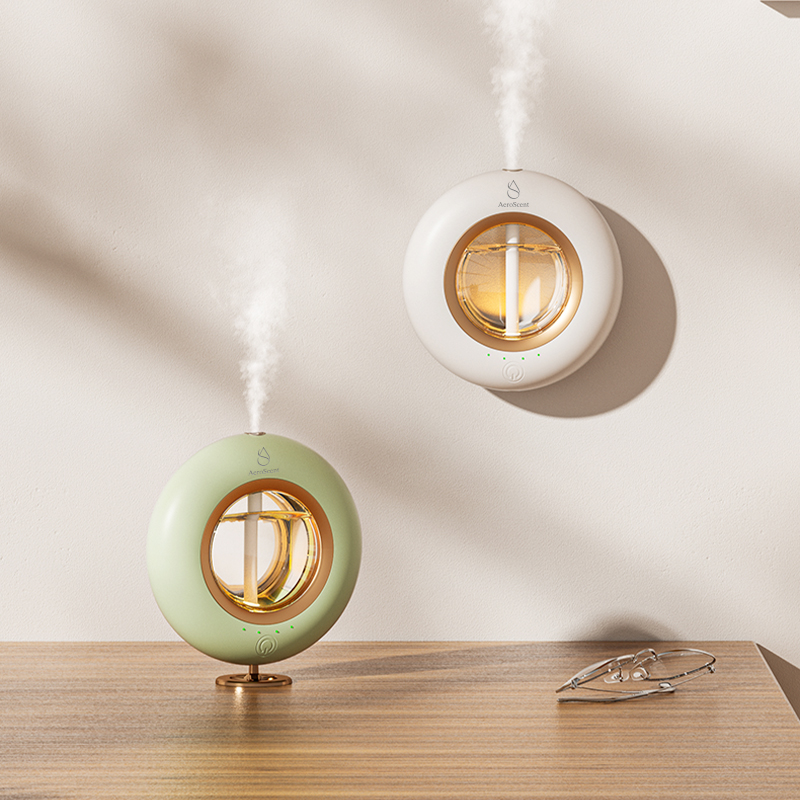
Drop counts are not absolute. The physical properties of the liquids you use dictate how they interact inside the reservoir. Essential oil viscosity and density play a massive role in atomization. Thick, resinous oils like vetiver, patchouli, or myrrh behave very differently in water than thin, highly volatile oils like lemon, sweet orange, or eucalyptus. Heavy oils resist breaking down. They tend to sink or clump together, requiring the ultrasonic plate to work harder to achieve cavitation. Furthermore, drop size physically varies depending on the oil's viscosity and the specific orifice reducer installed on the bottle. A single drop of thick sandalwood contains more mass and volume than a single drop of liquid peppermint.
Aromatic intensity and flash points also demand ratio adjustments. Strong base notes linger longer and project aggressively. Fleeting top notes dissipate rapidly. When blending, you must reduce the total drop count if you incorporate inherently potent oils. Eucalyptus, oregano, and cinnamon dominate a room quickly. Using 5 drops of cinnamon per 100ml will likely cause respiratory discomfort, whereas 5 drops of sweet orange might feel perfectly balanced. You must evaluate the specific profile of the oil before blindly applying the standard ratio.
Environmental dynamics alter the required drop count to achieve desired saturation. A 200ml tank running 8 drops might perfectly scent a closed 120-square-foot bedroom. Move that same unit into a 400-square-foot living room with vaulted ceilings and active HVAC airflow, and the scent will vanish. High ambient humidity also suppresses scent travel, as the air is already saturated with moisture. You must adjust your drop count upward to compensate for high ceilings, aggressive ventilation, and large square footage.
Consider the following environmental factors when adjusting your baseline:
Understanding the mechanics of an ultrasonic aroma diffuser clarifies why ratios matter. At the bottom of the water tank sits a small ceramic disk. When powered, this disk vibrates at ultrasonic frequencies, typically between 1.7 and 2.4 MHz. This rapid vibration creates ultrasonic cavitation, violently agitating the water and oil mixture until it breaks down into microscopic particles. A built-in fan then blows this fine, cool mist out of the nozzle. The frequency of the ultrasonic plate directly impacts how effectively the device atomizes different volumes of oil. Higher frequencies produce finer mist but can struggle if the oil concentration is too dense.
The max fill line constraint represents a critical physical boundary. The relationship between water volume and mist performance is absolute. Overfilling the tank past the maximum limit restricts the physical movement of the ceramic disk. The weight of the excess water suppresses the cavitation process. If you overfill the tank, proper atomization stops entirely, regardless of your precise oil-to-water ratio. The device will simply churn the water without producing mist. Many users mistakenly add more oil when they see weak mist output, not realizing the actual problem is an overfilled water reservoir.
Tank capacity dictates the output rate and the intended use case. Low-capacity units ranging from 50ml to 100ml are engineered for localized scenting. They sit on desks or nightstands. High-capacity units holding 300ml to 1000ml target open floor plans. The trade-off is straightforward. Larger tanks require significantly more oil per session to reach the 3-5 drops per 100ml baseline. However, they offer much longer run times and eliminate the need for frequent refilling.
Power settings and mist modes further influence consumption. Intermittent mist settings pause the output, extending the longevity of the scent dispersion while conserving oil. Continuous high-output modes burn through the water and oil mixture rapidly, providing an intense aromatic burst but requiring quicker replenishment. If you run a device on a continuous high setting, you will need to clean the transducer plate more frequently to prevent residue buildup.
Material compliance ensures hardware survival. High concentrations of corrosive oils, particularly citrus varieties containing d-limonene, degrade cheap plastics. Medical-grade or high-density plastics like Polypropylene (PP) resist this chemical degradation. Using high drop counts in a diffuser made from inferior ABS plastic will eventually cause the tank to crack or leak. Always verify the plastic grading before committing to heavy daily usage.
Ignoring the capacity matrix invites severe hardware degradation. Exceeding recommended drop counts introduces mechanical risks. When you overload the water with oil, the ultrasonic transducer plate cannot atomize the mixture fast enough. Un-atomized oil pools directly on the ceramic disk. This heavy layer of residue acts as an insulator, causing the plate to overheat. Over time, this pooling leads to permanent corrosion, clogged output nozzles, and total mechanical failure. You will notice the mist output becoming weaker and weaker until the device stops functioning entirely.
Health and safety compliance requires strict adherence to dilution ratios. Over-exposure to vaporized essential oils triggers physiological reactions. Users in over-saturated rooms frequently report respiratory irritation, sudden headaches, dizziness, and mucous membrane sensitivity. These risks multiply in households or commercial spaces with vulnerable occupants. If pets, infants, or individuals with asthma occupy the space, you must reduce the ratio to 1-2 drops per 100ml. Opting for shorter diffusion intervals also mitigates exposure risks.
Implementing strict mitigation strategies protects both the user and the hardware. A routine cleaning protocol removes residual oil buildup. After every few uses, empty the tank completely. Wipe the interior with a soft cloth. To restore hardware efficiency, use isopropyl alcohol or white vinegar to dissolve heavy resinous buildup on the transducer plate. Keeping the disk clean ensures the device atomizes the precise ratio you measure.
Follow this field-tested maintenance protocol to ensure longevity:
Commercial buyers must evaluate manufacturer specifications rigorously when sourcing inventory. Partnering with a reliable essential oil diffuser exporter requires checking specific technical metrics. You must verify the transducer lifespan, typically rated in operational hours. Inspect the plastic grading, ensuring the water reservoir utilizes PP rather than standard ABS to prevent chemical melting. Confirm the presence of continuous and intermittent mist capabilities, as these features dictate how consumers control oil consumption.
Retailers must align the product with consumer expectations to prevent operational failures. Product manuals must clearly communicate capacity-to-drop ratios. High return rates often stem from user error rather than defective hardware. Consumers frequently claim a device fails to work because they placed 3 drops of oil into a massive 500ml tank, resulting in no scent. Others overfill the water reservoir past the max line and assume the motor is broken. Clear documentation solves these user-generated issues.
Scalability and private labeling involve strategic inventory decisions. Stocking high-capacity models drives higher consumable oil sales, as a 500ml tank requires up to 25 drops per use. However, compact 100ml models present a lower barrier to entry for new consumers. Balancing these conceptual trade-offs ensures you meet varying market demands while maintaining functional reliability across your product line. You must educate your customer base on proper usage to ensure long-term satisfaction and repeat consumable purchases.
The ideal drop count is never a static number. It remains a calculated range rooted in the 3-5 drops per 100ml baseline. You must adjust this ratio based on oil viscosity, room size, and strict hardware limits. Choosing the right hardware capacity depends entirely on the intended room size and the user's willingness to consume essential oils at scale. Larger rooms demand larger tanks and higher oil volumes. Precision in measurement guarantees both aromatic success and hardware longevity.
A: Yes. Excessive oil can clog the ultrasonic plate, degrade the plastic tank, and cause respiratory irritation or headaches. Overloading the water prevents the device from atomizing the mixture properly, leading to mechanical failure and an overwhelming, unsafe environment.
A: Following the standard ratio of 3-5 drops per 100ml, a 500ml diffuser requires between 15 and 25 drops for optimal performance, depending on desired aromatic strength and the specific viscosity of the oil used.
A: Using less than the minimum baseline of 3 drops typically results in an under-saturated mist that fails to project scent effectively, leading to poor olfactory results. The device will output water vapor, but the aromatic footprint will be imperceptible.
A: This is typically caused by under-saturating a large water tank, overfilling the water tank past the max line, using poor-quality/adulterated oils, olfactory fatigue, or a dirty ultrasonic plate failing to atomize the mixture.
A: Yes. Highly potent, volatile top-note oils (like peppermint or eucalyptus) require fewer drops, while milder or highly viscous base-note oils (like patchouli or sandalwood) may require slightly more to achieve the same aromatic footprint.
A: To maintain the correct atomization ratio and prevent hardware failure, wipe out the tank after every use and perform a deep clean with vinegar or rubbing alcohol every 3 to 5 uses. This removes thick oil residue from the ceramic disk.
A: Ultrasonic diffusers dilute oil in water and use high-frequency vibrations to create a mist. Nebulizing diffusers use pressurized air to atomize pure essential oil without water, requiring entirely different usage metrics and consuming oil much faster.


