
Views: 0 Author: Site Editor Publish Time: 2026-09-25 Origin: Site


Implementing a scent marketing strategy requires more than just purchasing high-end fragrance; poor hardware placement is the primary cause of uneven scenting, wasted fragrance oil, and negative ROI. Commercial environments—unlike residential spaces—feature complex variables such as high ceilings, variable HVAC airflow, rapid air exchange rates, and heavy foot traffic. Placing a unit based on aesthetics rather than fluid dynamics leads to "dead zones" or overwhelming scent concentrations. To maximize the efficacy of your scenting strategy, facility managers and business owners must evaluate placement through the lens of cubic volume, airflow patterns, smart connectivity, and hardware capabilities. This guide breaks down the technical criteria for positioning commercial scenting equipment.
Before mounting any hardware, you must define what successful scenting looks and feels like in a commercial environment. Optimal dispersion means the fragrance distributes evenly throughout the target zone without creating heavy, overwhelming pockets of perfume. Guests should notice a subtle, pleasant aroma upon entering the space, but they should not feel overpowered. A successful installation prevents scent fatigue, ensuring the fragrance remains noticeable but unobtrusive for employees or guests who spend extended periods in the building. Achieving this requires matching the machine's output capacity to the physical dynamics of the room.
Modern commercial scenting equipment operates differently from standard residential humidifiers or aerosol dispensers. These units do not use water, and they do not use heat. Instead, they rely on cold-air atomization technology. An internal air pump forces ambient air through a specialized nozzle submerged in liquid fragrance oil. This high-pressure process breaks the oil down into sub-micron nanoparticles, creating a dry vapor. Because these particles are microscopic and completely dry, they do not fall to the floor or leave oily residue on furniture. They remain suspended in the air and follow ambient air currents. Your scent will go exactly where the air goes, making airflow mapping a mandatory step in the installation process.
Relying solely on square footage to determine equipment placement is a frequent operational failure. Commercial spaces operate in three dimensions. A 1,000-square-foot lobby with a standard 10-foot ceiling contains 10,000 cubic feet of air. That same 1,000-square-foot footprint with a 25-foot atrium contains 25,000 cubic feet of air. The second scenario requires significantly higher output settings and entirely different placement strategies to achieve the same scent intensity. You must calculate the total cubic volume (Length x Width x Height) before selecting a mounting location.
| Space Dimensions (L x W) | Ceiling Height | Total Square Footage | Total Cubic Volume | Placement Implication |
|---|---|---|---|---|
| 50 ft x 20 ft | 10 ft | 1,000 sq ft | 10,000 cubic ft | Standard wall-mount or freestanding placement is sufficient. |
| 50 ft x 20 ft | 25 ft | 1,000 sq ft | 25,000 cubic ft | Requires higher output; consider HVAC integration or multiple units. |
| 100 ft x 50 ft | 15 ft | 5,000 sq ft | 75,000 cubic ft | HVAC integration strongly recommended for even distribution. |
| 100 ft x 100 ft | 20 ft | 10,000 sq ft | 200,000 cubic ft | Requires multiple HVAC injection points or synchronized standalone units. |
You must map the natural airflow of your facility before finalizing any hardware placement. Start by identifying positive and negative pressure zones. Positive pressure pushes air out of a room, while negative pressure pulls air in. Locate all HVAC supply vents (where air blows out) and return grilles (where air gets sucked back in). Note the natural drafts created by exterior doors, large windows, and elevator shafts. Positioning a unit in a negative pressure zone near an exterior door will result in your fragrance being pulled outside. Conversely, placing it under a supply vent can help push the scent further into the room. Use a smoke pen or a simple piece of tissue paper to visually track how air moves through your target zones.
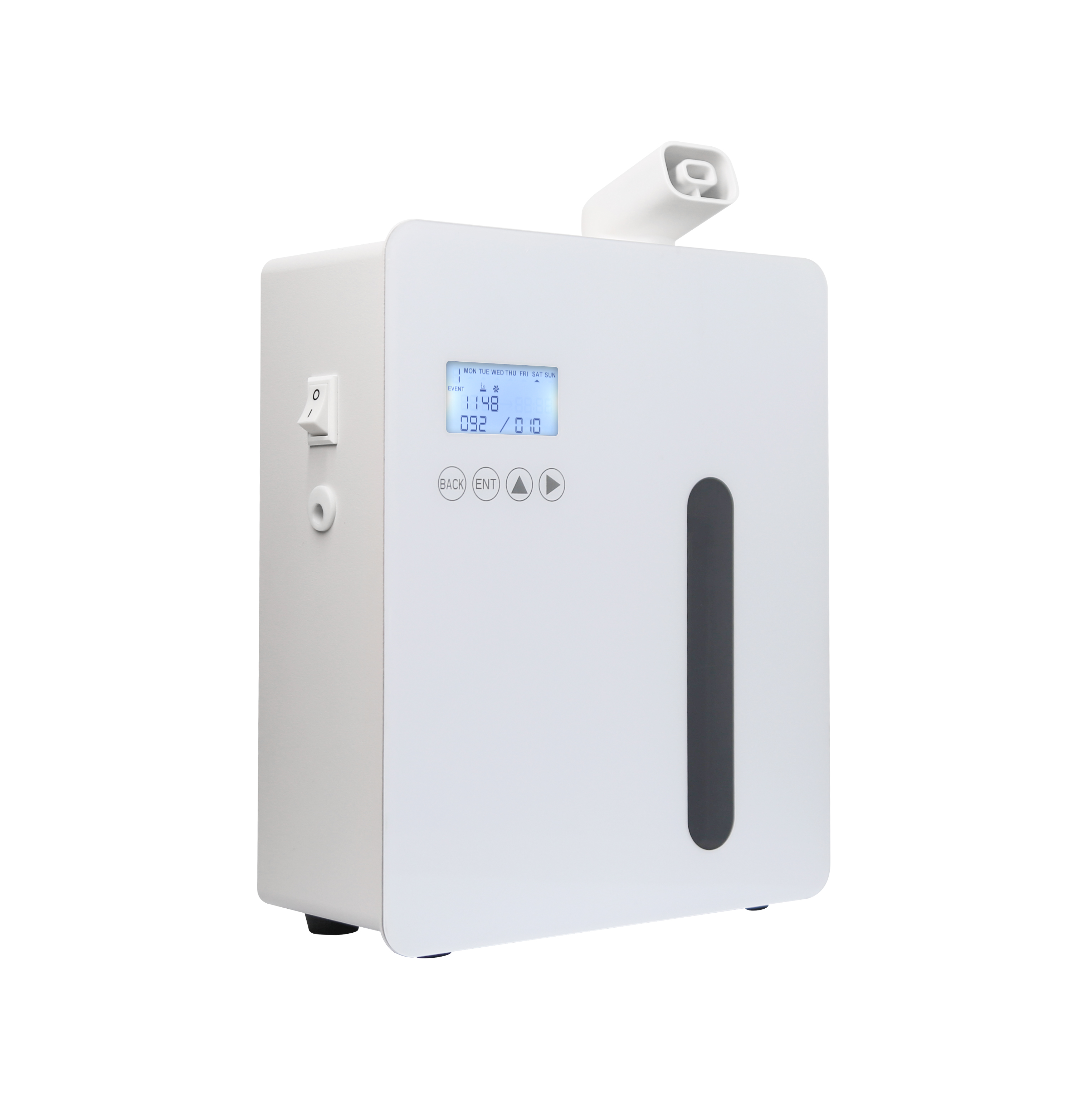
Connecting your scenting equipment directly to the building's ventilation system provides the most uniform coverage available. This method is highly recommended for any open space exceeding 3,000 square feet. By injecting the dry vapor directly into the ductwork, a commercial aromatherapy machine utilizes the existing air handler to distribute the fragrance evenly across every square inch of the conditioned space.
Installation location within the ductwork requires precision. You must install the injection tube in the supply duct, downstream from the air handler, heating and cooling coils, and air filters. If you inject the scent upstream of the filter, the filtration media will scrub the nanoparticles out of the air, ruining the effect and clogging your HVAC filters. If you inject it before the cooling coils, condensation will interfere with the dry vapor plume, causing the oil to drop out of suspension and pool inside the ductwork.
You also need to account for static pressure. The HVAC system operates under pressure to push air through the building. The scenting unit must feature an internal pump powerful enough to overcome this static pressure. If the duct pressure exceeds the pump's capacity, the scent will not enter the airflow. Instead, it will back up into the machine, causing severe mechanical failure and oil leaks inside your utility closet. Always verify the maximum static pressure rating of your equipment before drilling into the sheet metal.
When ductwork is inaccessible, or you only want to scent specific zones, standalone units are the practical alternative. The decision between centralized and perimeter placement depends entirely on your floor plan. For wide-open spaces, a centralized location allows large area diffusers to disperse the vapor in 360 degrees, maximizing coverage. In long, narrow rooms, perimeter placement leverages directional airflow to push the scent down the length of the space.
Mounting height directly impacts human perception. Always position wall-mounted or freestanding units between 3 to 6 feet off the ground. This places the dispersion nozzle directly at chest to nose level. The scent plume interacts immediately with human traffic before naturally dispersing upward toward the ceiling. Place these units on stable, vibration-free surfaces like reception consoles, reinforced shelving, or dedicated pedestals. If mounting to drywall, use heavy-duty toggle bolts rather than standard plastic anchors. The internal pump generates micro-vibrations during operation, and weak mounting hardware will eventually loosen, causing the machine to rattle against the wall.
Security remains a valid concern for standalone hardware. Placing units in public reach increases the risk of tampering, theft, or accidental damage. To mitigate this, you can mount them higher on walls, out of direct reach, though this slightly reduces immediate scent impact. Alternatively, conceal them inside custom cabinetry. If you choose concealment, the cabinet must feature vented grilles, and the machine's nozzle must align perfectly with the vents to ensure the vapor escapes freely into the room without condensing on the interior wood.
The entrance is where you establish your brand's scent logo. You want to greet guests immediately upon entry, creating a memorable first impression. Position the equipment so the vapor path intersects with the main walking path, but do not point the nozzle directly at the front doors. Blasting guests in the face with concentrated fragrance as they walk inside creates an overwhelming, unpleasant experience.
Managing door drafts requires careful observation. Revolving doors and double-door vestibules often create an inward draft when opened. Position your units slightly deeper into the lobby, allowing this natural inward draft to catch the scent plume and carry it further into the building. If you place the unit too close to the door, a sudden outward draft could pull your fragrance straight into the parking lot.
Narrow spaces create a distinct wind-tunnel effect. You can leverage this physical phenomenon, known as the wake effect, to maximize your coverage. Place units at the beginning of the corridor or at major intersections. As heavy foot traffic moves down the hall, the physical movement of people creates a wake that pulls the suspended cold-air nanoparticles along with them, naturally distributing the scent down the entire corridor.
Enclosed corridors require strict intensity management. Because the cubic volume is much lower than an open lobby, the air saturates quickly. Avoid placing high-output machines in these transitional spaces unless you adjust the intensity settings significantly downward. Over-saturation in a confined hallway leads to immediate scent fatigue and complaints from occupants.
Open-concept retail environments benefit heavily from the centralized anchor strategy. Position your primary Commercial Aroma Diffuser in the most centralized, unobstructed location available. This allows the dry vapor to expand outward in all directions. Once the central anchor is established, you can evaluate the perimeter for weak spots and add supplemental units as needed.
Massive spaces often require multiple machines working in tandem. When synchronizing multiple units, space them evenly based on their maximum coverage capacity. For example, place a unit every 1,500 square feet. Ensure their dispersion paths overlap slightly to prevent dead zones, but keep them far enough apart to avoid creating clashing scent zones where the fragrance becomes uncomfortably dense.
Strategic point-of-sale placement directly influences consumer behavior. Position units near high-margin product displays or checkout counters. A pleasant, subtle aroma in these specific zones increases dwell time, improves buyer mood, and can positively impact purchasing decisions while customers wait in line.
| Commercial Zone | Primary Placement Strategy | Airflow Consideration |
|---|---|---|
| Main Lobby / Vestibule | Deep placement, facing inward. | Utilize inward drafts from exterior doors. |
| Narrow Corridors | Start of the hallway or intersections. | Leverage the wake effect from foot traffic. |
| Open Retail Floor | Centralized anchor point. | Allow 360-degree unobstructed dispersion. |
| Restrooms | Near the entrance, away from exhaust. | Avoid placing directly under exhaust fans. |
The most common and costly installation error is the short-circuit effect. If you place a diffuser directly beneath an HVAC return vent, near a bathroom exhaust fan, or next to an open window, the ventilation system will immediately suck the fragrance out of the room. The cold-air vapor never has a chance to circulate. This completely wastes the consumable oil cartridge and provides zero benefit to the space. Always locate return grilles before mounting hardware and maintain a minimum distance of 15 feet from any active exhaust pull.
Physical barriers destroy scent dispersion. Placing units behind heavy velvet curtains, tucking them behind large potted plants, or facing the nozzle directly into a wall disrupts the nanoparticle plume. When the pressurized vapor hits a solid object immediately after leaving the nozzle, the nanoparticles condense and settle on the surface. This creates dead air zones in the room and leaves a sticky oil residue on your furniture or walls. Ensure the nozzle has a minimum of 6 feet of clear, unobstructed airspace directly in front of it.
Hardware placement must account for ongoing maintenance. The refill reality is simple: if the maintenance team cannot easily reach the unit, it will eventually sit empty. Mounting a machine 15 feet high on a lobby wall might look clean, but it requires a ladder or a scissor lift every time the oil needs replacing. Hiding a unit in a cramped, cluttered utility closet guarantees it will be neglected. Position the equipment where staff can safely and quickly swap bottles, check power connections, and clean the atomizing nozzles without disrupting daily operations.
Commercial scenting equipment requires continuous, reliable power. Battery-operated units do not possess the pump strength necessary for large-scale atomization. You must plan your placement around existing 110V or 220V electrical outlets. Running long extension cords across a lobby floor is unprofessional and creates severe tripping hazards. If an ideal location lacks power, hire a licensed electrician to hardwire a new receptacle directly behind the intended mounting spot to hide all cabling.
Modern equipment relies heavily on smart technology. Facility managers use mobile applications or desktop dashboards to set operating schedules, adjust intensity levels, and monitor oil consumption remotely. This requires a stable internet connection. Before finalizing placement, check the Wi-Fi signal strength in that exact spot using your smartphone. Most commercial units operate on 2.4GHz bands for better range through walls. A weak signal will disconnect the machine, causing it to miss scheduled run times or operate at the wrong intensity.
Floor space regulations dictate where freestanding units can safely sit. You must ensure that pedestals or floor-standing towers do not obstruct pathways mandated by the Americans with Disabilities Act (ADA). Keep equipment clear of wheelchair turning radiuses, primary walkways, and emergency egress routes. Wall-mounted units must also comply with protrusion limits. Objects mounted between 27 and 80 inches off the floor cannot protrude more than 4 inches into a circulation path to prevent visually impaired individuals from walking into them.
Employee comfort is just as important as the guest experience. Never place a high-output large area aroma diffuser directly next to a receptionist's desk, a security podium, or an employee's permanent workstation. Subjecting staff to concentrated fragrance for eight hours a day guarantees severe scent fatigue, headaches, and potential human resources complaints regarding fragrance sensitivity. Keep the hardware positioned to target transient traffic rather than stationary personnel.
A: For standalone units, position the equipment between 3 to 6 feet off the ground. This targets the human breathing zone directly. Utilize stable surfaces like reception consoles, reinforced shelves, or dedicated pedestals. If you are utilizing HVAC integration, the unit connects directly to the ductwork in a utility room, making room height irrelevant.
A: Yes, but only if the cabinet is properly modified. The cabinet must be well-vented, and the unit's directional nozzle must align perfectly with the exterior airflow. If the vapor hits the inside of a closed cabinet, the oil will condense, build up on the wood, and fail to scent the room.
A: Common placement failures include positioning the unit too close to an HVAC return vent, blocking the nozzle with furniture, or placing it in a dead air zone. Additionally, poor Wi-Fi might prevent scheduled runs, or the machine's output capacity may simply be insufficient for the room's total cubic volume.
A: It depends on the draft direction. Placing units near open windows or outward-drafting doors risks pulling the scent outside, wasting the oil. However, you can strategically position units slightly inside a vestibule to utilize inward drafts, which helps push the fragrance deeper into the main lobby.
A: Complex floor plans with multiple walled-off sections or long corridors benefit greatly from multiple smaller units to ensure even coverage. Conversely, massive open-concept spaces can effectively utilize one centralized, high-output unit to achieve 360-degree dispersion without cluttering the floor plan.


