
Views: 0 Author: Site Editor Publish Time: 2026-08-28 Origin: Site


Environmental factors directly shape how we work. While professionals obsess over ergonomic chairs and monitor heights, localized air quality and ambient scent profoundly impact cognitive endurance, focus, and workplace stress management. Standard corporate offices, cramped work-from-home setups, and small meeting rooms frequently suffer from stagnant air that drains mental energy. Deploying standard room-sized aromatherapy solutions in these compact areas fails. High-output devices overwhelm small spaces, risk damaging nearby electronics with excessive moisture, and create friction in shared environments due to varying scent sensitivities. You need a targeted, localized approach. Implementing a small desk essential oil diffuser offers a strategic solution for personalizing your immediate environment. This technical evaluation explores diffuser mechanisms, spatial constraints, and shared-workspace compliance to help you select the exact device needed to optimize your specific workstation without disrupting the surrounding environment.
Establishing the baseline requirements for desktop aromatherapy requires a shift in perspective. When dealing with a localized work zone, study table, or small meeting room, bigger is never better. High-capacity units designed for living rooms push too much vapor into a confined area, leading to overwhelming fragrance accumulation and potential moisture damage. An effective office diffuser must operate within strict spatial and acoustic boundaries.
Your desk is a micro-environment. A standard office desk measures roughly 48 by 24 inches. Within this limited footprint, you house a monitor, a laptop, a keyboard, and various paper documents. The airflow dynamics around these electronics dictate how airborne particles travel. A successful desktop unit must respect these physical constraints by delivering a subtle, consistent experience rather than a powerful blast of vapor. The goal is to create a personal olfactory bubble that enhances your immediate breathing zone while remaining completely undetectable to someone walking past your cubicle or sitting at the opposite end of a small meeting table.
The ideal scent boundary for a personal workspace falls within a three-to-five-foot radius. This localized throw ensures you receive the cognitive and emotional benefits of the essential oils without crossing into a colleague's workspace. Room saturation occurs when a device forces volatile organic compounds (VOCs) into the broader HVAC airflow of the room. Desktop models achieve this precise localized throw through lower output settings, smaller internal fans, or passive evaporation techniques that rely solely on ambient air circulation. If you can smell the oil from the hallway, the output is too high for a desk application.
Positioning your device correctly prevents hardware damage and ensures optimal vapor delivery. Water vapor naturally settles, and prolonged exposure causes moisture to accumulate inside unsealed electronics, leading to corrosion on motherboards and internal components. Follow these specific steps to establish a safe operating zone on your desk:
Deep work requires minimal auditory distraction. Many users overlook the acoustic profile of their chosen device until they try to concentrate in a quiet room. Acceptable decibel levels for desk devices should remain under 30 dB. Constant humming from internal fans, aggressive vibration against hard wooden desk surfaces, or the trickling sound of water quickly disrupts focus.
Modern professionals spend hours on video calls. High-sensitivity desktop microphones easily pick up the mechanical buzzing or water-dripping sounds of poorly insulated units. To mitigate this, place a small neoprene mousepad under the device. This simple addition absorbs mechanical resonance and prevents hollow desk surfaces from amplifying the internal motor noise.
Workspace surface area is a premium commodity. A device with a large footprint creates clutter and reduces your functional work zone. Analyze the physical dimensions of the unit to ensure it integrates seamlessly alongside your keyboard, mousepad, and reference materials.
Power requirements also dictate placement flexibility. USB-powered models offer excellent convenience, allowing you to draw power directly from a monitor hub or laptop docking station, thereby reducing cable clutter. Traditional AC adapter models require access to a wall outlet or power strip, which limits where you can position the unit on your desk. Battery-operated models provide the ultimate freedom, allowing you to move the device from your desk to a reading chair or study table without managing cords, though they require frequent recharging.
Selecting the right hardware requires understanding the physics behind how different devices disperse essential oils into the air. The mechanism you choose directly impacts the intensity of the scent, the level of maintenance required, and the safety of your surrounding equipment. A mini diffuser typically utilizes one of three primary technologies: ultrasonic, nebulizing, or passive diffusion.
Ultrasonic technology dominates the desktop market due to its versatile performance and ease of use.
For professionals seeking potent delivery without the risks associated with water vapor, nebulizing technology offers a distinct alternative.
Passive diffusion provides the most subtle and low-impact method for introducing scent into a workspace.
| Technology Type | Spill / Moisture Risk | Acoustic Profile | Scent Intensity | Maintenance Requirement |
|---|---|---|---|---|
| Ultrasonic | High (Water vapor settles on desk) | Low (Faint trickling or fan hum) | Moderate | Daily emptying, wiping, and drying |
| Nebulizing | None (Waterless operation) | Medium (Pump vibration on hard surfaces) | High | Periodic nozzle cleaning with alcohol |
| Passive | Low (Only if knocked over) | Silent (Zero moving parts) | Low | Minimal (Occasional reed replacement) |
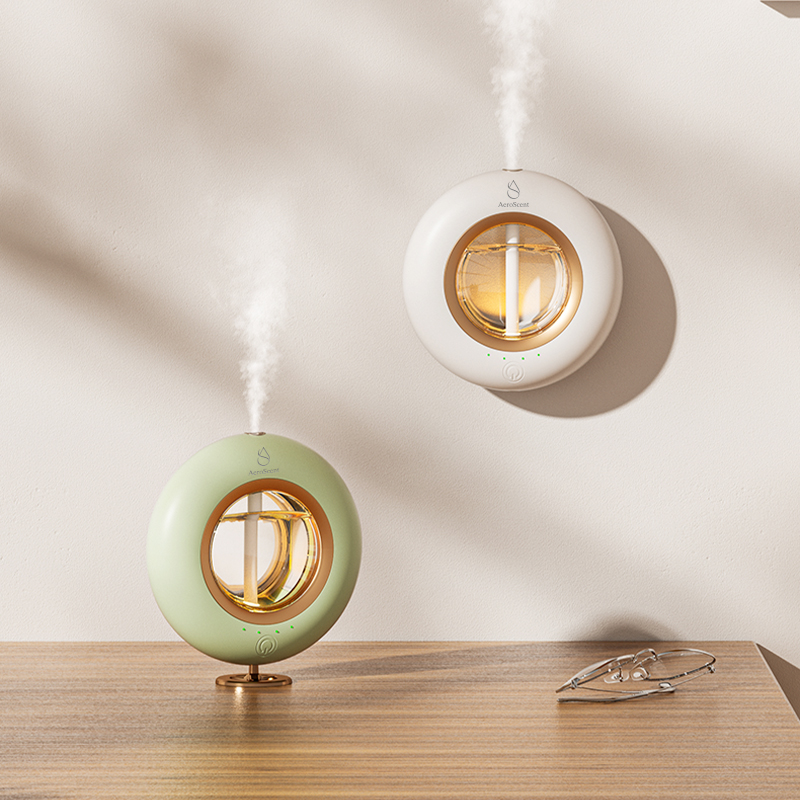
Introducing airborne particulates into a shared environment requires strict adherence to workplace etiquette and a deep understanding of human biology. What one person perceives as a refreshing citrus aroma, another experiences as a severe biological trigger. Operating a desk aroma diffuser in a communal setting demands proactive communication and respect for shared air quality.
Scent sensitivities are documented biological realities. Airborne particulates, including naturally derived volatile organic compounds (VOCs) like limonene and linalool found in essential oils, trigger migraines, nausea, and respiratory conditions such as asthma. The olfactory bulb connects directly to the brain's limbic system, meaning scent reactions are immediate and involuntary.
Never assume that because an oil is natural, it is universally safe for everyone in the room. Strong floral oils like ylang-ylang or heavy wood oils like cedarwood frequently cause adverse reactions in sensitive individuals. Acknowledge these biological realities before powering on any device in a shared space. If your desk sits directly beneath an HVAC return vent, the system will pull your localized scent and distribute it throughout the entire floor, completely negating your attempts at localized diffusion.
Before bringing any aromatherapy device into a corporate building, consult your employee handbook. Many modern organizations enforce strict fragrance-free workplace clauses to comply with occupational health guidelines and accommodate employees with severe allergies. These policies typically prohibit perfumes, colognes, and active scent-dispersing devices.
If your workplace enforces such a policy, active ultrasonic or nebulizing devices are prohibited. In these scenarios, subtle passive options like a personal scent inhaler or a single drop of oil on a terracotta pendant serve as the only compliant methods for personal aromatherapy.
If your office permits desktop devices, establish a clear communication loop with your immediate desk neighbors. Gaining consent is the first step in open-plan etiquette. Ask the colleagues sitting directly adjacent to you if they have any specific aversions to certain botanical profiles.
Start with the lowest possible output setting and use universally tolerated, mild scents like sweet orange or lemon. Check in with your neighbors after the first hour of operation to gauge the scent intensity from their seating position. Agree on a simple signal or understanding that they can ask you to turn the device off at any time without awkwardness or conflict. Maintaining this professional courtesy ensures your personal well-being tool does not become a source of workplace friction.
Hardware selection only solves half the equation. To truly benefit from desktop aromatherapy, you must apply evidence-based practices regarding botanical profiles and operational schedules. Haphazardly running a device all day diminishes its effectiveness and leads to cognitive fatigue.
Different botanical profiles trigger distinct physiological and psychological responses. Tailor your oil selection to the specific cognitive demands of your workday.
The human olfactory system adapts rapidly to continuous stimuli. This phenomenon, known as olfactory fatigue or nose-blindness, occurs when the receptors in your nose become saturated and stop sending scent signals to your brain after prolonged exposure. If you run your device continuously, you stop smelling the oil within 15 to 30 minutes. This often prompts users to add more oil or increase the output, which over-saturates the room and bothers colleagues.
To maintain efficacy, implement intermittent diffusion schedules. Operate the device for 30 minutes, followed by a 60-minute rest period. Many modern desktop units feature built-in interval timers that automate this process. Intermittent use prevents receptor saturation, conserves your essential oils, and keeps the cognitive benefits sharp throughout the workday.
A common misconception is that aromatherapy devices clean the air or eliminate bad office odors, such as stale lunch smells or damp carpets. Diffusers do not purify the air; they merely add scent particles to it. Attempting to mask a foul odor with essential oils results in unpleasant olfactory clashing, creating a room that smells like a mixture of peppermint and old tuna fish.
If your primary goal is to remove bad smells or reduce airborne dust and allergens, an essential oil device is the wrong tool. In those instances, a desktop HEPA air purifier equipped with an activated carbon filter is the appropriate solution. Use the air purifier to clean the environment, and use the aromatherapy device strictly for cognitive and emotional support.
Consistent performance and safe operation rely entirely on rigorous maintenance. Neglecting the physical upkeep of your device compromises the hardware and introduces significant health risks into your immediate breathing zone.
Water-based ultrasonic models demand strict daily and weekly cleaning routines. Stagnant water left in the reservoir overnight creates an ideal environment for mold spores and bacterial growth. When you turn the device on the next morning, these pathogens aerosolize and disperse directly into your breathing zone. Follow this weekly deep-cleaning protocol to maintain sanitary operation:
Nebulizing models require less frequent but equally important maintenance. Flush the glass nozzle with rubbing alcohol every few weeks to prevent thick essential oils from clogging the micro-tubes.
The type of device you select dictates how rapidly you consume essential oils. Nebulizers atomize pure oil, meaning a standard 10ml bottle depletes significantly faster than it would in a water-based unit. Ultrasonic models require only 3 to 5 drops of oil per water tank, stretching your consumable supply over a much longer period. Factor in these usage rates when determining which technology aligns with your daily operational habits. Always prioritize high-quality, unadulterated essential oils. Synthetic fragrance oils leave sticky residues that quickly degrade internal mechanical components and offer zero cognitive benefits.
Understand the realistic durability of desktop aromatherapy hardware. Frequent use, continuous vibration, and exposure to volatile plant compounds naturally degrade internal components over time.
Ultrasonic models typically offer a lifespan of one to two years under daily office use. The ceramic ultrasonic plate eventually loses its ability to vibrate effectively. This degradation accelerates if you use hard tap water, which causes rapid mineral scale buildup from calcium and magnesium deposits. Using distilled water significantly extends the life of the vibrating plate. Nebulizing models often last longer due to the absence of water and mineral scale, provided the internal air pump is kept free of dust and the glass components are regularly cleared of sticky oil residue.
A small desk essential oil diffuser serves as a highly effective tool for personalizing a workspace, enhancing emotional well-being, and managing cognitive load. Its success depends entirely on ensuring the technology aligns with the physical constraints of your desk and the social dynamics of your environment. By respecting scent boundaries and prioritizing regular maintenance, you transform a stagnant workspace into an optimized environment for deep work.
To move forward effectively, take the following actions:
A: They are safe when positioned correctly. Ultrasonic models emit water vapor that can settle and cause moisture damage to unsealed electronics over time. Maintain a strict distance of at least 24 to 36 inches from laptops, monitors, and external hard drives. For maximum safety near sensitive equipment, choose a waterless nebulizing or passive model.
A: Passive ceramic or reed diffusers work best for open-plan environments. They rely on natural evaporation without internal fans, preventing the forced air circulation of scents into neighboring cubicles. This ensures the scent remains strictly within your immediate personal space without bothering colleagues.
A: No. Diffusers only add scent particles to the air; they do not filter or clean it. Attempting to mask bad odors with essential oils usually leads to an unpleasant clash of smells. To actually remove odors, you need an air purifier equipped with a HEPA and activated carbon filter.
A: Water-based ultrasonic models require daily and weekly maintenance. Empty the water and wipe the reservoir dry at the end of every workday to prevent bacterial growth. Perform a deep clean weekly using a water and white vinegar solution, and gently clean the ultrasonic plate with rubbing alcohol.
A: Yes. Even pure essential oils contain volatile organic compounds (VOCs) that can trigger respiratory reactions, asthma, or migraines in sensitive individuals. Always communicate with your immediate desk neighbors and gain their consent before operating an active scent device in a shared workspace.
A: Rosemary and peppermint provide excellent cognitive support. Rosemary contains 1,8-cineole, which is linked to increased alertness and memory retention. Peppermint provides a cooling, stimulating effect that helps combat mid-afternoon fatigue and sustains mental energy during complex analytical tasks.
A: The primary differences are water tank capacity, mist output volume, and spatial coverage. Mini models hold less water, produce a subtle mist designed for a 3-to-5-foot radius, and feature smaller footprints. Standard room models push heavy vapor designed to saturate areas of 300 square feet or more.


