
Views: 0 Author: Site Editor Publish Time: 2026-08-18 Origin: Site


Professionals constantly look for ways to optimize their workspace for better focus. Standard residential diffusers fail in desk environments. They throw scent too far, take up too much space, and generate distracting noise. These issues cause friction with coworkers and risk damaging nearby electronics like monitors and keyboards. You need a framework to evaluate and select a purpose-built small essential oil diffuser for office use. This approach balances your need for cognitive support with strict workplace etiquette, spatial limits, and hardware safety. We will break down how to navigate facility policies, choose the correct diffusion technology, and implement targeted aromatherapy without disrupting the shared workspace.
Modern workstations operate under strict real estate limitations. Desk surfaces must accommodate dual monitors, docking stations, ergonomic keyboards, and document storage. Introducing bulky residential appliances disrupts this workflow. You need compact footprints that integrate seamlessly into the existing hardware ecosystem. A properly sized device sits safely away from high-traffic zones on the desk. It prevents accidental spills over crucial documents or expensive peripherals. Downsizing ensures the device serves as an unobtrusive background tool rather than a physical obstacle. When you place a large water reservoir next to a laptop, you invite disaster. One wrong move while reaching for a pen can short out a motherboard. Smaller units with lower centers of gravity mitigate this physical risk entirely. They fit under monitor risers or neatly beside pen cups.
Framing the use of an office scent diffuser requires a focus on verified psychological benefits. Avoid unverifiable physiological health claims. Professionals use these tools for habit-stacking. Associating a specific scent with deep work conditions the brain to focus faster. Targeted aromas help reduce midday stress and tension. They also improve perceived air quality in stuffy environments. We deploy these devices to establish cognitive baselines and maintain mental endurance during long shifts. They are productivity instruments, not medical treatments. When you smell peppermint at 2 PM, your brain recognizes it is time to finish the quarterly report. This psychological anchor is highly effective for knowledge workers who battle afternoon fatigue.
Closer, lower-output diffusion outperforms high-output room diffusion for individual productivity. High-output devices flood the room, quickly leading to olfactory fatigue or nose-blindness. The proximity principle dictates that keeping a low-intensity scent within a three-foot radius sustains olfactory engagement. You register the scent consistently without overwhelming your senses. This highly localized approach ensures the therapeutic benefits remain confined to your immediate zone. It maximizes your personal benefit while minimizing the impact on the surrounding environment. If you run a high-capacity unit, your olfactory receptors shut down after twenty minutes. You stop smelling the oil, so you turn up the output. Meanwhile, your coworkers fifty feet away are choking on lavender. A smaller unit prevents this escalation.
Selecting the right diffusion method dictates how the device interacts with your workspace, your electronics, and your colleagues. Each technology presents specific operational realities. You must match the hardware to your specific desk environment.
Ultrasonic technology uses water and high-frequency vibrations to create a fine mist. This is the most common format for desktop use.
When specifying an ultrasonic unit, you must account for the mist trajectory. The vapor must fall away from paper trays and exposed circuitry.
Nebulizing units use pressurized air to atomize pure essential oil. They operate without heat or water, delivering an undiluted fragrance profile.
Nebulizers work best in private offices with closed doors. The raw oil output easily overwhelms a standard cubicle grid.
Passive systems utilize porous materials like ceramic, wood, or felt. Some incorporate small internal fans to evaporate oils naturally into the surrounding air.
A passive ceramic stone sits safely on top of a computer tower. It requires no power and bothers no one outside a two-foot radius.
To simplify the selection process, review the operational differences in the table below:
| Technology Type | Moisture Risk | Acoustic Output | Scent Intensity | Maintenance Frequency | Best Office Application |
|---|---|---|---|---|---|
| Ultrasonic | High (Mist/Spill) | Very Low (<30dB) | Moderate (Adjustable) | Daily water, weekly clean | Private offices, large desks |
| Nebulizing | None | Moderate (Motor Hum) | High (Potent) | Monthly bottle swap | Enclosed spaces, fast scenting |
| Passive/Evaporative | None | Silent | Low (Localized) | Daily oil application | Open-plan, shared cubicles |
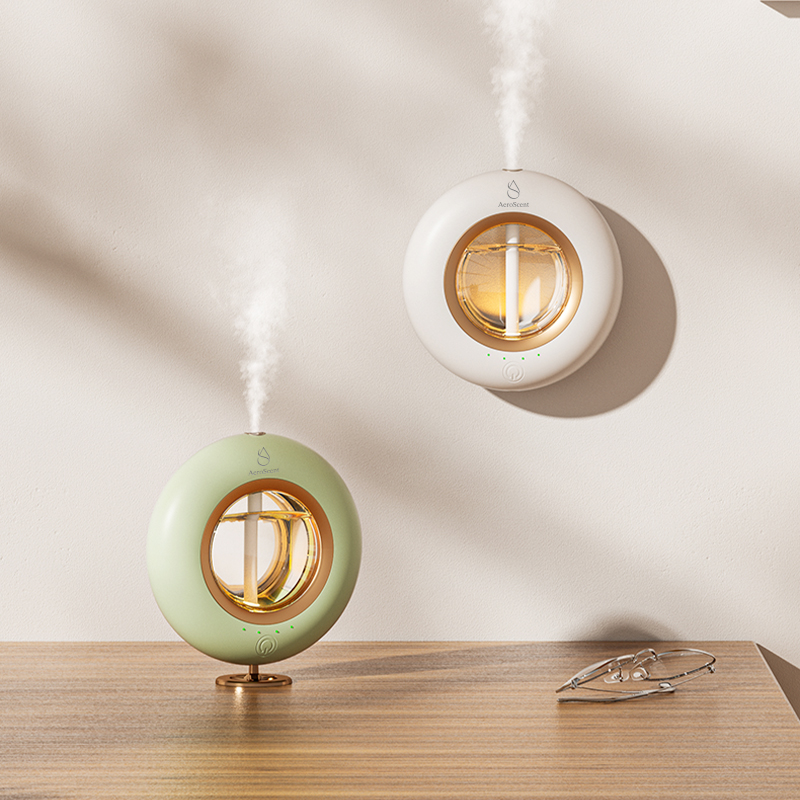
Noise control is non-negotiable in an office setting. Establishing acceptable noise thresholds prevents the device from becoming a distraction. A desk aroma diffuser must operate below 30 decibels. Anything louder interferes with deep work, focus blocks, or conference calls. Motor hum from low-quality fans or nebulizer pumps easily bleeds into microphone audio during virtual meetings. Prioritize units with verified acoustic ratings to maintain a professional acoustic environment. A 30-decibel rating equates to a quiet whisper. If you can hear the device over the standard HVAC background noise, it is too loud for desk use.
You must evaluate output settings to ensure the aroma remains strictly confined to your immediate workspace. Intermittent modes are superior to continuous modes for desk applications. Intermittent diffusion pulses the scent, preventing it from traveling across the room and saturating the shared air. The goal is a micro-climate of scent. If a colleague standing six feet away can smell your device, the dispersion radius is too wide. Look for hardware that offers a 30-second on, two-minute off cycle. This specific timing maintains the cognitive benefits of the aroma without building up a heavy cloud in your cubicle.
Power delivery impacts desk organization. Traditional AC adapters require bulky wall plugs and add to cable clutter. USB and USB-C powered units offer a distinct operational advantage. They integrate seamlessly with modern docking stations, monitors, and laptop hubs. This allows you to power the device directly from your existing hardware setup, keeping cables routed cleanly and freeing up limited wall outlets for critical equipment. When you use a USB-C connection, you can also easily move the unit between your home office and corporate desk without crawling under tables to manage power bricks.
Operating liquid-based devices near expensive hardware requires mandatory safety features. Auto-shutoff mechanisms triggered by waterless detection are essential to prevent overheating. Weighted bases or low-center-of-gravity designs prevent accidental tipping when moving documents. Directional nozzles are critical. They allow you to route the mist or vapor explicitly away from monitors, laptops, and paper trays, mitigating the risk of moisture accumulation on sensitive components. A good directional nozzle lets you point the output directly at your chest, maximizing your exposure while keeping your keyboard perfectly dry.
Identifying the best essential oils for the office dictates the success of your setup. Focus entirely on universally tolerated, work-enhancing profiles. Rosemary and peppermint drive focus and mental clarity. Bergamot and sweet orange reduce stress without inducing lethargy. You must absolutely avoid heavy florals like ylang-ylang or polarizing musks like patchouli. These heavy molecules linger in the air and frequently cause headaches or nausea in shared environments. Stick to top notes that dissipate quickly. Citrus and mint profiles evaporate fast, meaning they will not permanently scent the carpet or fabric cubicle walls around your desk.
You must address the reality of scent sensitivities, migraines, and asthma in shared environments. Establishing consent with your immediate desk neighbors is a mandatory first step. Have a direct conversation before turning the unit on. Dose oils conservatively. Start with one or two drops rather than the recommended five or six. It is always easier to add more scent later than to ventilate an over-scented office block. If a neighbor complains, stop immediately. Your right to aromatherapy never supersedes a colleague's right to breathe comfortably.
Corporate environments operate under strict compliance rules. Audit your employee handbook for scent-free workplace clauses before purchasing hardware. Understand how open-plan HVAC systems distribute localized aerosols. A strong draft from an overhead vent can carry your desk scent across the entire floor. Ensure ADA compliance regarding allergies. If a coworker reports an adverse reaction, HR policies will always prioritize the health and safety of the affected employee over your preference for aromatherapy. Always check with facilities management to ensure your specific device does not violate fire codes or electrical safety standards.
Desk diffusers carry a specific operational burden. Stagnant water and oil residue breed bacteria quickly. Establish strict protocols for cleaning ultrasonic plates to prevent mold growth. Use a cotton swab and rubbing alcohol weekly. Wipe down the exterior of the unit and the surrounding desk surface to avoid sticky oil build-up. Poor hygiene not only ruins the device but can project a musty, unpleasant odor into the office. If you leave water sitting in the reservoir over the weekend, dump it out on Monday morning. Never run weekend-old water through an ultrasonic plate.
Analyzing long-term usability reveals that the cheapest hardware often fails first. A low-grade ultrasonic mini diffuser suffers from rapid oil degradation and requires constant maintenance. The ultrasonic plate corrodes, and the fan bearings wear out, leading to increased noise. Investing in a mid-tier passive ceramic unit or a high-quality ultrasonic device with a durable transducer ensures consistent performance. Reliable hardware prevents mid-workday malfunctions and protects your desk from unexpected leaks. You want a tool that works quietly in the background, not a maintenance liability that distracts you from your actual job.
Pure essential oils are highly concentrated plant extracts. Citrus oils, in particular, act as natural solvents. They interact aggressively with cheap plastics, causing them to cloud, crack, or melt over time. This degradation can leach chemical compounds into the water reservoir and eventually into the air you breathe. Evaluating units constructed with glass, ceramic, or high-grade PP (polypropylene) reservoirs is critical for longevity and safety. These materials resist chemical breakdown and maintain their structural integrity under daily use. Always check the manufacturer specifications to confirm the plastic type before running lemon or grapefruit oils through the system.
A: Yes, if managed strictly. Keep the device at least two feet away from all electronics. Utilize directional nozzles to route the mist away from screens, keyboards, and paper trays. Monitor the immediate desk area daily for moisture accumulation to prevent hardware damage.
A: Focus on universally tolerated options. Rosemary and peppermint enhance mental clarity and focus. Bergamot and sweet orange elevate mood and reduce stress without causing drowsiness. Always avoid heavy florals, strong musks, or overly sweet blends in shared workspaces.
A: Passive diffusers are completely silent because they rely on natural evaporation without electronic parts. Ultrasonic models are also extremely quiet, typically operating below 30 decibels. Nebulizing diffusers are generally the loudest due to the internal motor hum required to pressurize the air.
A: Utilize intermittent timer settings to strictly control output. Consider passive diffusion for a highly localized scent throw. Always establish consent with your immediate desk neighbors. Select low-intensity oils and dose them conservatively to keep the aroma confined to your personal zone.
A: Yes. Many companies enforce standard corporate scent-free policies. HR must also ensure ADA compliance regarding employee allergies, asthma, and chemical sensitivities. Always check your employee handbook and consult management before introducing diffused scents into a shared environment.
A: A waterless nebulizing diffuser uses pressurized air to atomize pure essential oil, delivering a strong scent without adding moisture. An ultrasonic diffuser uses water and high-frequency vibrations to create a mist, adding slight humidity but requiring more maintenance and presenting a spill risk.
A: Clean ultrasonic units weekly. Empty residual water, wipe the reservoir with a damp cloth, and clean the ultrasonic plate gently with a cotton swab dipped in rubbing alcohol. This prevents mold, bacterial growth, and sticky oil residue buildup, ensuring safe and consistent operation.


