
Views: 800 Author: Site Editor Publish Time: 2026-11-10 Origin: Site


Companies rarely fail at buying a scent air machine for business use. They fail at the plan around it: a unit matched to the wrong volume, an oil bill nobody estimated, and thirty stores that drift until they no longer smell like the same brand.
This guide is for the people who sign off on that plan: a store owner fitting out one room, a chain team standardising fifty, a supermarket zone manager covering a selling floor, or an importer building a catalogue around commercial scenting. Work through it in order and you will leave with four things: your coverage band, the control tier your staffing supports, a formula for the monthly oil budget, and questions that will sort a serious supplier from a quotation forwarder in one email.
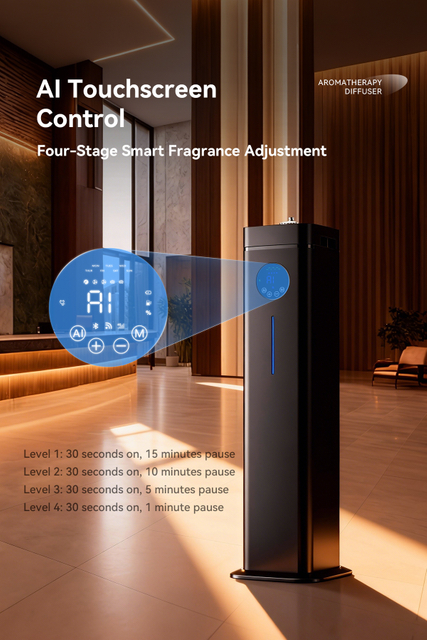
Product photography from the RAMOND commercial range.
In this guide:Coverage bandsFour buyer profilesTechnologyOil budgetObjectionsSupplier questionsFAQWhere this leaves you
Coverage is quoted in cubic metres because ceiling height, layout and airflow decide how far scent actually travels, not floor area alone. The conversion takes ten seconds: floor area multiplied by ceiling height. A 100 m² shop under a 3 m ceiling is 300 m³; the same footprint beneath a 6 m atrium is 600 m³ and lands in the next band up.
Coverage band | Typical business setting | What it changes for you |
|---|---|---|
Up to 500 m³ | Single shop unit, salon room, reception counter | One compact unit handles the space; ceiling and wall models covering 300–450 m³ fit rooms where floor space is tight, with plug-in and battery power options |
600–1,800 m³ | Mid-size store, café, office reception, clinic floor | One mid-range unit; this is the band where app control starts to earn its keep |
3,600–4,000 m³ | Hotel lobby, full supermarket floor, exhibition hall | Floor-column machines built for long daily runtimes; selected models connect to the HVAC supply-air side |
Dual-channel, up to 8,000 m³ | Large halls, multi-zone buildings, warehouse formats | Two independent channels of 4,000 m³ each: doubled throw in one volume, or one channel per scent |
The RAMOND range maps onto those bands directly. The compact tier runs from the K10S at 150 m³ through the K26 (300 m³) to the K28 (500 m³). The mid band holds the K56S (600 m³), the K31S (800 m³) and the K40 and K60 at 1,800 m³. Large floors get the K70 Pro (3,600 m³), the K58S (3,650 m³) and the K71S (4,000 m³), and the K62S and K72Pro carry two channels of 4,000 m³ each for the dual-channel band.
Do the conversion before anything else. If the arithmetic on your own floor plan is unclear, the coverage guide walks through it with worked examples. Once you know your band, every other decision about a scent air machine for business gets simpler.
A coverage band is the same number for everyone. What you do with it is not. The four profiles below cover the situations this page is actually searched for.
A 100–300 m² shop with standard ceilings lands between 300 and 900 m³: the top of the compact band or the bottom of the mid band, and one machine covers it. The decisions that matter are placement and power. Ceiling and wall models in the 300–450 m³ range keep the floor clear and the device out of daily traffic, and the battery option means a room without a convenient outlet needs no new wiring. Put the oil formula below against your trading hours, and the running cost is a known number before you order.
A scent programme across a chain fails in one of two ways: stores drift into different intensities, or the oil bill drifts away from the forecast. Both are solved by standardisation rather than supervision. Pick one model per coverage band so every site runs the same refill rhythm and settings, then let the control ladder do the managing: touch-panel models are managed at the machine, S models add Bluetooth app control from a phone at the store, and Pro models add WiFi app control, so a seasonal scent change is scheduled once from head office and every store follows it the same morning. Oil supply follows the same logic: 100–1,000 ml aluminium bottles suit individual sites, and 5 L drums suit districts dense enough to run a refill route.
A full selling floor sits in the 3,600–4,000 m³ band, and the large-band machines above are built for exactly that volume and run time. Above it, the dual-channel K62S or K72Pro gives you two independent 4,000 m³ channels, which is how a second zone gets covered or a second scent gets carried without a second full installation.
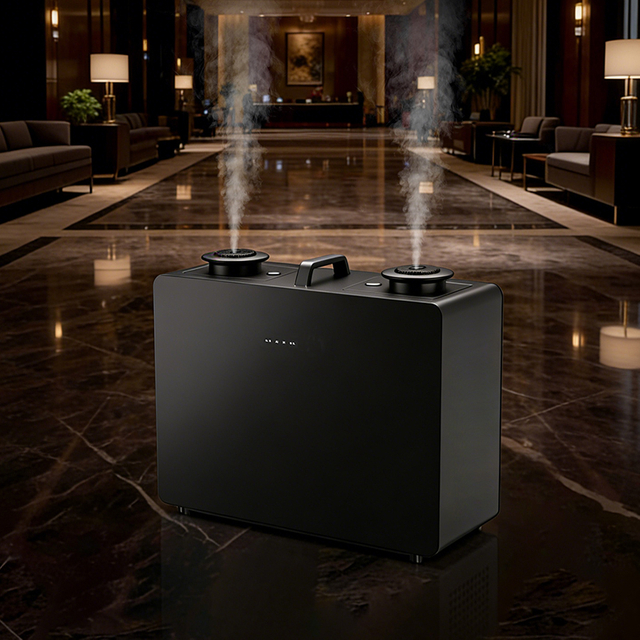
Dual-head layout from the RAMOND K62S product shots.
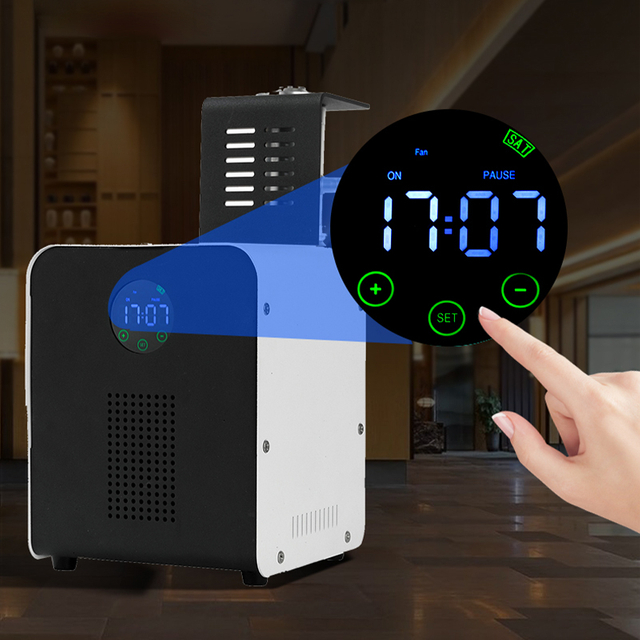
Side-mounted bottle cabinet from the same product series.
Two honest limits apply. How several machines behave in one open volume (concentration overlap, scent boundary lines) is a layout question, so ask any supplier for a placement plan against your floor drawing rather than a box count. And if you would rather push scent through existing ductwork, selected floor-column models connect to the HVAC supply-air side, with the connection point confirmed by your facilities team.
For an importer, the interesting fact is not any single machine but the ladder itself: a supplier whose catalogue of scent machines for business runs from a 150 m³ counter unit to an 8,000 m³ dual-channel machine answers the coverage question for every downstream customer, instead of forcing you to stitch programmes from several factories. The commercial questions follow: OEM, ODM and private-label arrangements exist for the hardware, and export documentation support exists for the oils; what MOQ, certificate list and lead times look like for your market is exactly the kind of thing to raise as questions rather than assumptions, and the vetting list below gives you the wording.
Four diffusion technologies cover the market, and commercial spaces overwhelmingly land on one of them. Cold-air nebulizing breaks straight fragrance oil into a dry, fine mist: no water tank, no added moisture, and enough throw to carry across an open lobby. Ultrasonic machines vibrate a water-and-oil mix into a cool mist, which suits a single enclosed room but not a selling floor; evaporative and heat-based formats fade over distance and belong at desk scale. If the underlying choice needs unpacking, the ultrasonic versus nebulizing comparison covers the trade-off in detail, and the dedicated scent air machine guide explains how these machines work step by step.
Machines ship once; bottles keep moving. That asymmetry is why the oil line deserves its own arithmetic, and why the recurring question, what a scent machine for business actually costs per month, is answered by calculation rather than by a quotation. Consumption in the RAMOND range spans roughly 2.6 ml/h on the compact K28 to around 10 ml/h on the large-area K70 Pro, so the formula is: daily oil use equals hourly consumption multiplied by trading hours, and monthly use multiplies that by trading days.
Worked example: a mid-range model at 6 ml/h running six hours a day, 26 days a month, uses about 36 ml per day and roughly 940 ml per month, just under two 500 ml bottles. Run it twelve hours a day in a hotel lobby and the month burns closer to 1.9 litres, which is why supply formats matter. The aluminium bottle range runs from 100 ml to 1,000 ml, and 5 L drums take over once a site or a district empties bottles faster than purchasing wants to reorder them. Plug in your own trading hours and shortlisted model, and the number stops being a guess.
One figure the formula deliberately excludes is the oil price, because it varies by fragrance and by order volume. Get a per-litre quotation at your actual volumes, apply it to the formula, and the monthly spend becomes a number you can defend. The fragrance oil range page lists the current options by space type.
Every long-listing conversation in this category circles the same doubts. Some have direct answers in the equipment's construction. The rest become questions, because a supplier who dodges a question during the sale will not answer it after delivery.
Cold-air nebulizing produces a dry mist from straight oil: no water, no damp residue, and an intensity you set by schedule rather than by hand. What no supplier should promise is that a person standing directly beneath a unit perceives nothing; that depends on placement and ceiling height. A trial unit settles it faster than any specification sheet.
Ceiling and wall models in the 300–450 m³ range include a battery option, which removes wiring from the scope in rooms without a convenient outlet, and floor columns need only a power socket. HVAC connection is the one path that touches building systems: selected floor-column models connect to the supply-air side, and the correct answer to who confirms the connection point is your facilities team. Treat a supplier who waves that away as a risk rather than a convenience.
No, but the control tier decides how much walking the programme takes. Touch-panel models are managed at the machine, S models from a phone at the store, and Pro models over the network from wherever the schedule is decided. The management weight of a chain programme falls as the control tier rises: that is why the S and Pro suffixes exist in the model codes.
The machines consume straight fragrance oil in standardised supply formats: 100–1,000 ml bottles and 5 L drums in this range. Whether third-party oils perform correctly in a specific machine is a compatibility question, and it belongs in your first conversation with any supplier, in writing.
Line machines up on three axes and the spread usually explains itself: coverage band in cubic metres, technology route, and control tier. A quotation that cannot state all three for each model is a price without a specification.
Warranty terms and after-sales arrangements are set per supplier and per contract, not by the category. Put both in the vetting list below and get the answer before money moves, not after.
The usual supplier checklist stops at specifications. If you are buying for a chain or for resale, the questions that predict the working relationship are operational. Six to send before the first purchase order:
What does your trial process look like? We want one unit and an oil set running in a pilot store for a month before any fleet commitment.
If we standardise on one model across all sites, what refill cadence and pack sizes keep every location on schedule at our store count?
For private label: which elements can carry our brand (machine housing, oil bottles, shipping cartons), and where does OEM work end and ODM begin?
How are machines packed for container freight, and what is the procedure if a unit arrives damaged?
Which parts are field-replaceable by our own staff, and how are spares stocked over a multi-year fleet life?
Can a single order combine compact, mid and large-band models, and how is a mixed order packed and documented?
Send the same list to every supplier on your shortlist. The speed and specificity of the replies will tell you more than any quotation, and the answers become the annex to your first contract.
How many scent air machines does a multi-store business need?
One machine per site, in the band that matches each site's volume. The standardisation matters more than the count: one model per coverage band across the chain means one refill rhythm, one set of settings, and one control tier to manage.
Can two different fragrances run in one large space?
Dual-channel models such as the K62S and K72Pro carry two independent channels of 4,000 m³ each, so two scents can run without a second installation. For several machines in one open volume, ask the supplier for a placement plan against your floor drawing.
How do I estimate the monthly fragrance oil spend?
Multiply hourly consumption by trading hours, then by trading days. Consumption across the RAMOND range runs from about 2.6 ml/h on the compact K28 to around 10 ml/h on the K70 Pro. Oil pricing varies by fragrance and order volume, so ask for a per-litre figure at your volumes.
What should I send a supplier to get an accurate recommendation?
Floor area and ceiling height (or the volume), the number of points or zones, daily trading hours, your preferred control tier, and for cross-border orders the documentation requirements of your target market.
The sequence in this guide is the sequence the purchase actually follows: coverage band first, then the buyer profile, then the control tier, then the oil arithmetic, then the questions. A scent air machine for business is a small purchase next to the fit-out around it, but it is a recurring one, and the plan is what turns it from a gadget into part of the brand.
If you want the range lined up by band before you write the brief, the full product range and the commercial aroma diffuser category are the two starting points, and the large-space project guide takes big floors in more depth.
Send your floor area and ceiling height (or the volume in m³), the number of points to scent, the type of venue, and your daily trading hours. What comes back is a model suggestion in your band, a control tier matched to how you manage sites, and an oil estimate built on the schedule you gave.


