


Scent Diffuser Machine: Types, Coverage and How to Choose
A scent diffuser machine is an automatic fragrance device: it meters fragrance into the air on a schedule and at an intensity you set, so a room stays at the level you want without anyone spraying or tending it.
Most buyers who arrive here are fitting out a business space: a shop floor, a hotel lobby, an office reception, or a chain of locations that need to smell the same. By the end of this guide you can shortlist models against your own floor plan, budget the oil, and know what to ask any supplier before you commit.
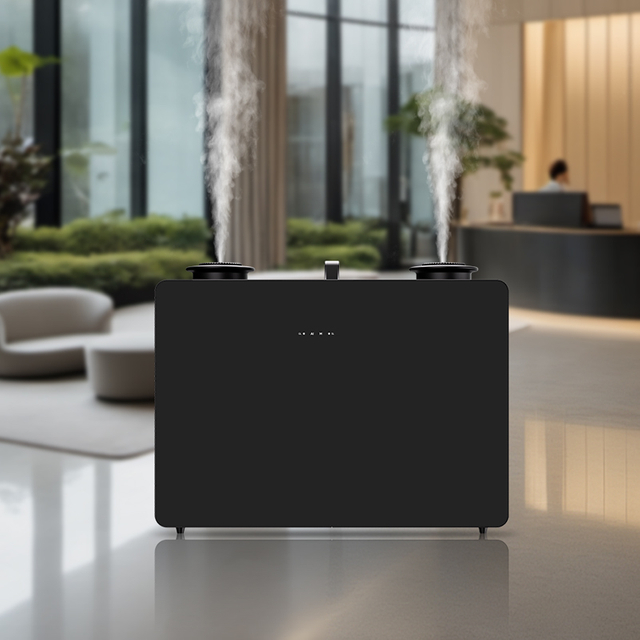
This guide walks the decision in the order you will actually face it: what the equipment is called, which technology suits a commercial space, how to size it in cubic metres, where it can physically live, who runs it day to day, and what the oil budget looks like.
One Device Family, Several Names
Search around this category and you will meet three other labels almost immediately: scent air machine, aroma diffuser machine and fragrance diffuser machine. Suppliers pick the label their market uses, not a different kind of equipment. Hospitality and facility teams tend to say scent air machine; sellers focused on the oil side say aroma or fragrance diffuser. The practical consequence is that you should line quotations up by coverage and technology rather than by name, because the label alone tells you nothing about how a machine performs.
| Common name | What people usually mean | Where it appears in the RAMOND range |
|---|---|---|
| scent diffuser machine | The general term for an automatic fragrance machine | The whole range summarised on this page |
| scent machine / scent air machine | The same equipment, common in hospitality and facility-management contexts | K-series commercial models and the dedicated scent-air guide |
| aroma diffuser machine | Emphasises the aroma-oil side of the equipment | The commercial aroma diffuser category |
| fragrance diffuser machine | Emphasises fragrance-oil compatibility | Same range; see the oils section below |
If you arrived searching for a scent air machine specifically, the dedicated guide to scent air machines explains how those machines work step by step and how to evaluate one for a business space. Whichever name you search under, the first real decision is the diffusion technology.
Which Technology Fits a Commercial Space
Four technologies dominate the market, and only two of them make sense for a working business space. Cold-air nebulizing uses a small air pump to break straight fragrance oil into a dry, fine mist: no water tank, no heat, and a throw strong enough to carry across lobbies and open floors. Ultrasonic machines vibrate a water-and-oil mix into a cool mist, which keeps them quiet and compact but limits them to single rooms. Evaporative units pass air over a scent pad and suit a desk or a corner rather than a full room, while heat-based formats spread scent gently and lose fidelity over distance, which is why they appear mostly in consumer products.
For shops, hotels and offices, the trade-off usually comes down to throw and upkeep. Nebulizing wins on both: the mist is dry so it travels further, and refilling means swapping a bottle rather than scrubbing a tank. That is why the RAMOND K series is built around it, with the X series ultrasonic line kept for bedrooms, treatment rooms and other single-room settings.
| Your situation | Technology to start with |
|---|---|
| Open lobby, hall or retail floor | Cold-air nebulizing |
| One enclosed room where quiet matters | Ultrasonic |
| Whole floor or multiple zones | Cold-air nebulizing via HVAC connection |
| A desk or reception corner | Compact evaporative or small plug-in unit |
If you are weighing ultrasonic against nebulizing in detail, the ultrasonic vs nebulizing comparison breaks down the trade-offs with examples. Once you know which technology fits, the next step is putting a number on your space.
Size the Space in Cubic Metres
Coverage is quoted in cubic metres, not square metres, because ceiling height, layout and airflow decide how far scent actually travels. The arithmetic is simple: multiply floor area by ceiling height. A 100 m² retail floor with a 3 m ceiling is 300 m³; the same footprint under a 6 m atrium is 600 m³ and needs the next band up. That one number is what every model on a supplier list is matched against.
For a single space, one machine in the right band does the job. For a chain of stores, the calculation repeats per site, and the useful shortcut is to standardise on one model per band, so every location runs the same refill rhythm and the same settings.
| Coverage band | Example RAMOND models | Tank, control and best fit |
|---|---|---|
| Up to 500 m³ | K10S (150 m³), K26 (300 m³), K28 (500 m³) | 60–280 ml tanks; touch or Bluetooth. Suits small retail units, shop counters and reception corners |
| 600 – 1,800 m³ | K31S (800 m³), K56S (600 m³), K40 (1,800 m³), K60 (1,800 m³) | 400–800 ml tanks; Bluetooth or WiFi app. Fits mid-size shops, cafés, salons and office reception areas |
| 3,600 – 4,000 m³ | K70 Pro (3,600 m³), K58S (3,650 m³), K71S (4,000 m³) | 1,000–2,000 ml tanks; touch, Bluetooth or WiFi. Built for hotel lobbies and full supermarket floors |
| Dual-channel, up to 8,000 m³ | K62S, K72Pro (4,000 m³ × 2 channels) | 2 × 1,000 ml tanks; Bluetooth or WiFi app. Covers large halls and multi-zone buildings |
Model codes carry the control type: S models add Bluetooth app control, Pro models add WiFi app control, and unmarked models run from the touch panel. For smaller rooms, the ceiling and wall series covers 300–450 m³, with plug-in and battery options in the mix; the home-use guide below takes that line apart room by room.
Three questions narrow the choice quickly: how many points are you scenting (one floor here, or a chain of stores working to the same brief)? Is there existing HVAC ductwork to tie into, or does each zone need its own unit? And should staff manage settings locally, or would you rather set everything from head office over a network? The next two sections map the second question, and the controls section maps the third.
Not sure how to convert your floor plan into volume? The coverage guide walks through the calculation with worked examples.
Want a shortlist for your floor plan?
Tell us the space you are scenting, roughly how big it is, and how you would like it installed. We will come back with two or three models that fit, plus an oil-usage estimate based on the schedule you plan to run.
Request a quoteWhere the Machine Lives: Standalone, Ceiling or HVAC
Installation decides where a machine can go and who needs to be involved. Standalone floor columns plug into a power outlet and sit where air moves through the space, which makes them the default for lobbies without duct access. Ceiling and wall units fix out of reach of daily traffic and suit corridors, meeting rooms, salons and clinics. HVAC connection is the third path: selected floor-column models connect to the supply-air side, so fragrance travels with the treated air into every zone the system reaches, which is the usual answer for whole floors and multi-zone buildings.
| Installation | How it works | Best for |
|---|---|---|
| Floor-standing standalone | Plug into a power outlet and place the unit where air moves through the space | Single zones and lobbies without duct access |
| Ceiling / wall-mounted | Fixed to the ceiling or wall — discreet and out of reach of daily traffic | Corridors, meeting rooms, salons and clinics |
| HVAC-connected | Selected floor-column models connect to the supply-air side, so fragrance travels with treated air | Whole floors and multi-zone buildings |
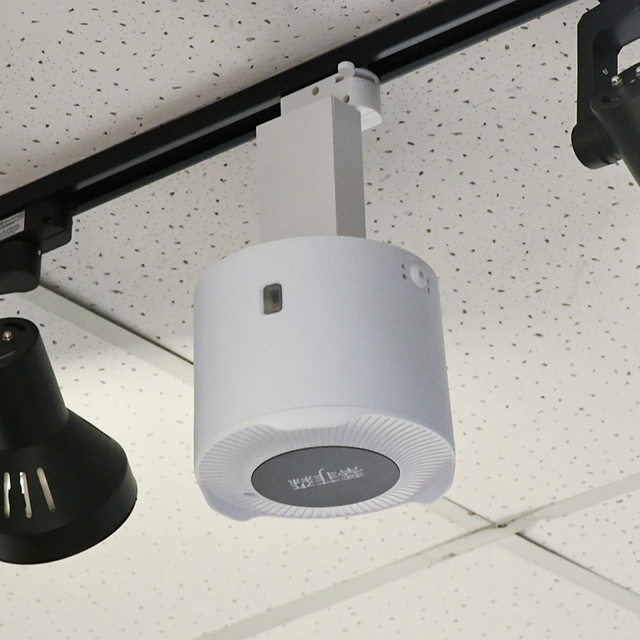
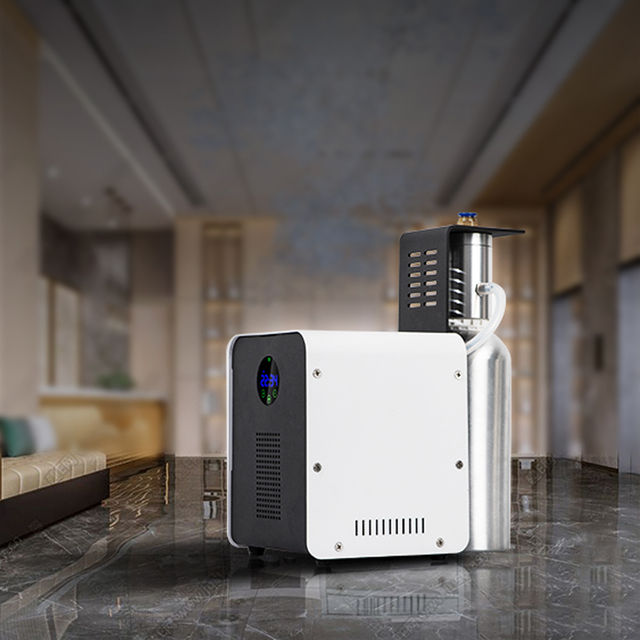
For a whole-building project, HVAC connection depends on your air-handling layout. The commercial scenting solutions page explains how to plan the connection point and what to confirm with your facilities team.
Who Runs It: Touch, Bluetooth or WiFi
The control question is really a staffing question: who sets the machine, and how often does that person change anything? One machine managed by one person works fine on the touch panel, which is what unmarked models offer. A site where schedules change with the season, or where several machines run side by side, is easier on Bluetooth app control (the S models), set from a nearby phone with no network wiring. A chain of locations that wants every machine on the same schedule and the same intensity belongs on WiFi app control (the Pro models), adjusted over the network without walking up to each unit.
RAMOND encodes this in the model name, so you can tell how a machine is operated before you open the specification sheet. To line the full range up side by side, start from the full product range, or look at an example listing, the K31S Bluetooth model.
Oil Use and the Running Budget
Nebulizing machines run on straight fragrance oil: you replace the bottle when it empties, and there is no water tank to clean between refills. Ultrasonic machines use a water-and-oil mix, so the tank needs regular rinsing; in spaces with no maintenance staff, that difference decides the choice on its own. RAMOND supplies fragrance oils in aluminium bottles from 100 ml up to 1,000 ml, plus 5 L drums for high-volume sites, and for anyone running many locations or reselling into local markets, oil is the recurring side of the equation: machines ship once, bottles keep moving.
Consumption depends on the model, the intensity setting and daily runtime. Published figures for the range span roughly 2.6 ml/h on the compact K28 to around 10 ml/h on the large-area K70 Pro. The arithmetic is easy to plan around: a mid-range model at 6 ml/h running six hours a day uses about 36 ml, so a 500 ml bottle lasts roughly two weeks. Budget from the model and schedule you will actually run, and the oil line item stops being a guess.
For scent selection by space type, the fragrance oil options page lists the current range, and the cleaning routine for oil diffusers covers day-to-day upkeep. The questions buyers ask most often are collected below.
Seven Questions to Ask Any Supplier Before You Commit
A shortlist built on coverage, installation and control is only half the purchase. Before you commit, put these seven questions to whoever supplies the machines; the answers tell you more about the working relationship than any specification sheet.
- Which coverage band does each shortlisted model actually reach in a space like mine, at my ceiling height?
- What does the recommended model consume per hour at the intensity I plan to run?
- Can the model connect to HVAC, and what does the supplier need from my facilities team to confirm the connection point?
- How are fragrance oils supplied, in what sizes, and how often will a site like mine need refills?
- Which control option matches my staffing, and can machines be grouped or standardised across sites?
- What warranty covers the pump and the unit, and what happens if a machine fails on site?
- What documents come with a cross-border order (for example, a compliance checklist for the oils)?
You can send the same list to us. On the sourcing side, the aroma diffuser manufacturer and OEM page covers the factory scope, OEM workflow and private-label options behind the range above, and the export compliance checklist answers the documentation question in detail.
Frequently Asked Questions
How does a scent diffuser machine work?
A nebulizing machine uses a small air pump to break liquid fragrance oil into a dry, fine mist and releases it into the room on a set schedule. An ultrasonic machine vibrates a water-and-oil mixture into a cool mist instead. In both cases you set the intensity and operating window, and the machine keeps the level consistent while it runs.
What types of scent diffuser machines are there?
Four technologies cover most machines: cold-air nebulizing, ultrasonic, evaporative and heat-based. For commercial spaces, cold-air nebulizing is the usual choice because of its strong throw and dry mist; ultrasonic machines suit single rooms where quiet operation matters.
How large a space can one machine cover?
Coverage depends on room volume, layout, ceiling height and airflow. Compact RAMOND models start at around 150 m³, mid-range machines cover 600–1,800 m³, and large floor-column units reach 3,600–4,000 m³. Dual-channel models such as the K62S cover up to 8,000 m³ in total, and HVAC connection extends scenting across multiple zones.
Can a scent diffuser machine connect to HVAC?
Selected floor-column models can be connected to the supply-air side of an HVAC system, so fragrance travels through the existing ductwork into every treated zone. Suitability depends on your air-handling layout, so confirm the connection point with your facilities team before you order.
How much fragrance oil does it use?
Actual consumption depends on the model, the intensity setting and daily runtime. Published figures for the RAMOND range span roughly 2.6 ml/h on the compact K28 to around 10 ml/h on the large-area K70 Pro, so an estimate should always be tied to the specific model and schedule you plan to run.
Do I need Bluetooth or WiFi control?
RAMOND names this in its model codes: S models add Bluetooth app control for scheduling and intensity from a nearby phone, while Pro models add WiFi app control over a network connection. Touch-only models remain a good fit where one person manages a single machine.
Where This Leaves You
There is no single best machine, only a best fit. Match the coverage band to your real volume, pick the installation your building allows, choose the control level your staffing supports, and budget oil from the model and schedule you will actually run. If those four answers are on the table, the shortlist writes itself, and the range on this page spans every band from 150 m³ to 8,000 m³.
Ready to match a machine to your space?
Send over your space volume, layout and preferred control type. What comes back is a shortlist built around those numbers, an oil-usage estimate for the hours you expect it to run, and no obligation to take it further.
Request a quote